
Clover flower midge
Contarinia floricola
Description
How to identify
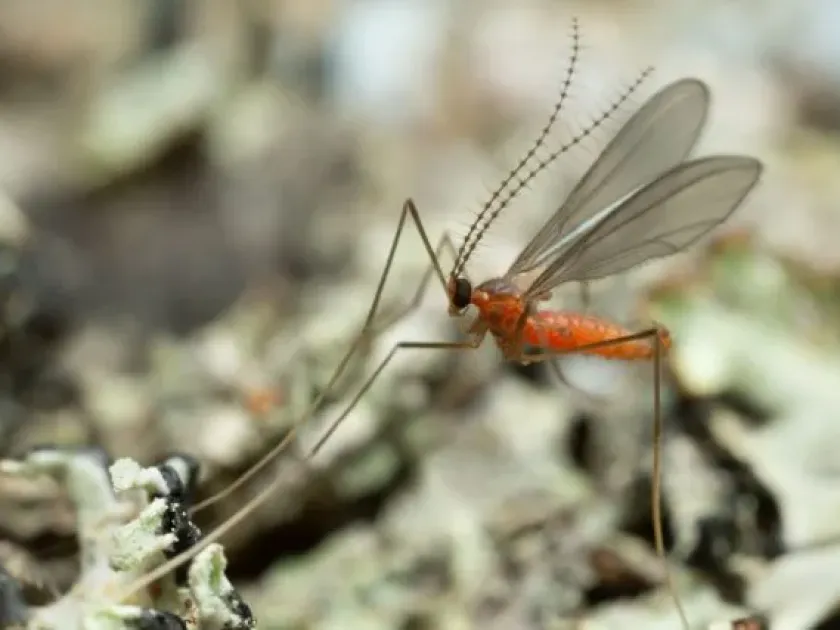
The clover flower midge (Contarinia floricola) belongs to the order Diptera and the family Cecidomyiidae. It is an extremely small insect, with adults measuring approximately 1.5 to 2 mm in length.
Adult midges have a yellowish-red or brownish appearance, making them difficult to spot in the field. Their short lifespan is primarily dedicated to reproduction, with females laying eggs inside the flower buds.
The larvae are legless, maggot-like creatures that typically exhibit a white, yellowish, or bright orange coloration. They are the stage responsible for the damage to the host plant.
The life cycle involves overwintering as mature larvae in the soil. During spring, they pupate, and the adult midges emerge to infest the new growth of clover crops.
Their ability to remain in the soil as pupae allows them to survive harsh winter conditions and emerge exactly when the clover host plants start their budding phase.
What it damages
The clover flower midge primarily affects red clover (Trifolium pratense). The damage is concentrated in the reproductive organs, specifically the flower buds, which are essential for seed production.
Larvae feed internally on the developing anthers and ovaries of the clover flowers. This feeding activity causes the buds to become deformed and prevents them from opening or producing viable seeds.
A single bud can host a large number of larvae, leading to total sterility of the flower head. This results in significant yield losses for farmers growing clover for seed production.
In addition to direct seed destruction, heavy infestations can weaken the entire clover plant, reducing its ability to regenerate after cutting or grazing.
Economic damage is most severe in years when weather conditions favor the mass emergence of the midge, potentially leading to the loss of the majority of the seed crop.
When it appears
The emergence of the first generation of adults coincides with the budding phase of clover, usually occurring in late spring or early summer. This is a critical time for monitoring.
Depending on the climatic zone, the midge can complete two or more generations throughout the growing season. Warm temperatures accelerate the lifecycle, leading to more frequent outbreaks.
The second and third generations often coincide with the flowering of second-cut or late-maturing clover, ensuring that the pest population persists throughout the season.
As temperatures begin to drop in late summer or autumn, the larvae migrate into the soil to form cocoons and enter diapause, effectively waiting for the next spring season.
Tracking the timing of emergence is essential for implementing timing-sensitive control measures, such as chemical applications or early harvesting.
Signs of infestation
The most distinctive symptom of an infestation is the swelling and deformation of clover buds. Instead of blooming, the buds remain closed and take on an abnormal, rounded shape.
Upon opening these distorted buds, you will find multiple small, orange or white larvae actively feeding inside. This is the definitive diagnostic sign of the midge presence.
Infested fields may display patchy flowering, where areas with high infestation fail to produce normal purple blossoms. Affected plants often look withered or brownish near the top.
A lack of pollinator activity in specific areas of the clover field can also be a secondary indicator, as damaged flowers do not produce the nectar required to attract bees.
Regular scouting by opening buds during the early budding stage is the most reliable way to assess the level of infestation and determine if intervention is needed.
Control measures
Cultural control is the most effective approach to managing the clover flower midge. Maintaining a proper crop rotation with at least a 3-4 year interval between clover plantings helps break the life cycle.
Deep plowing after the harvest of seed crops is crucial. By burying the larvae and pupae deep in the soil, the emergence of adults the following spring can be significantly reduced.
Spatial isolation of new clover fields from old, infested fields prevents the spread of the midge population. Keeping new seed crops at a distance of at least 1-2 km is recommended.
Chemical control, if necessary, involves the use of insecticides during the early budding stage. However, applications must be timed carefully to protect bees and other beneficial insects during the subsequent flowering period.
- Implement a strict crop rotation cycle.
- Use deep plowing in autumn to bury larvae.
- Maintain spatial separation between new and old seed crops.
- Monitor pest levels using sticky traps or bud dissection.
- Apply insecticides only when economic thresholds are exceeded, before the flowering stage.
Taxonomy
- Latin name
- Contarinia floricola
- Order
- Diptera (flies)
- Family
- Cecidomyiidae
- EPPO code
- CONTPO
Discussion
No discussions yet — be the first.