
Pine needle gall midge
Contarinia baeri
Description
How to identify
The pine needle gall midge, scientifically known as Contarinia baeri, belongs to the family Cecidomyiidae within the order Diptera.
Adults are tiny, fragile midges that are rarely seen by the naked eye due to their diminutive size and short lifespan during the emergence period.
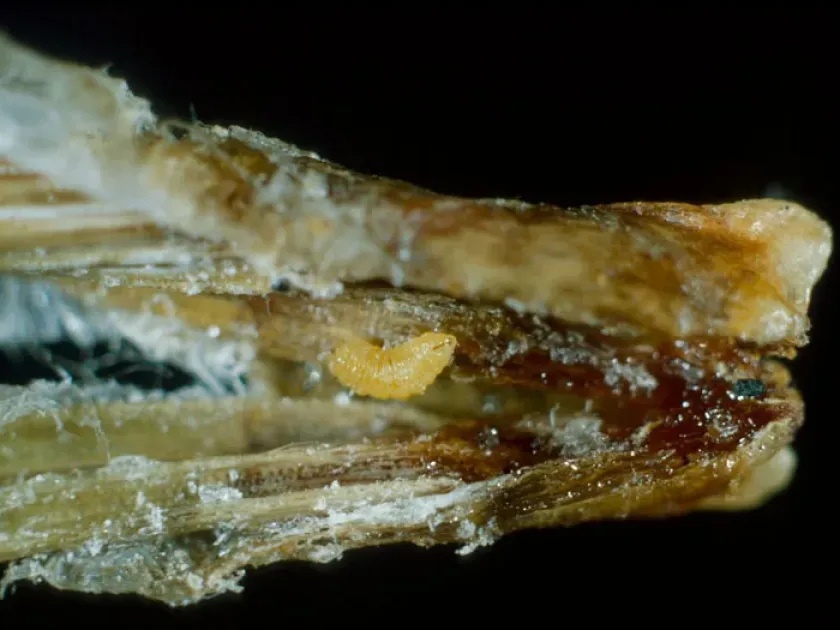
The larval stage is the most critical for identification; the larvae appear as small, yellowish-orange maggots residing inside the galls of pine needles.
This species is highly specialized, having evolved to thrive specifically within the tissues of developing pine needles, which creates a very stable micro-environment.
Entomologists typically rely on identifying the specific gall shapes on the needles rather than observing the elusive adult midges themselves.
What it damages
The primary host for Contarinia baeri is the Scots pine (Pinus sylvestris), though other pine species may also be subject to infestation.
The larvae feed on the sap of current-year needles, causing significant physiological stress to the tree and disrupting normal needle development.
Heavy infestations lead to stunted needle growth, premature needle drop, and a general decline in the aesthetic value of ornamental or forest pines.
While the midge rarely kills mature, healthy trees, it can severely weaken young saplings, making them susceptible to secondary pests and drought.
Economic damage is most pronounced in nurseries and plantations where growth rate reduction significantly impacts the quality of the timber or seedlings.
When it appears
The adult flies emerge in early spring, precisely timing their life cycle with the bud break and needle elongation period of the host pine trees.
Females lay eggs on the newly formed needles, after which the larvae hatch and burrow into the needle tissue to begin feeding and forming galls.
Development occurs throughout the summer months, with larvae remaining inside the needle until late autumn or early winter.
Wintering usually takes place in the soil or in the leaf litter beneath the trees, where the larvae enter a dormant state until the following spring.
Temperature patterns and moisture levels in early spring are the key drivers that dictate the exact timing of adult emergence and subsequent infestation levels.
Signs of infestation
The most diagnostic sign of an infestation is the formation of distinct galls—small swellings or thickenings—located at the base of the pine needles.
Infested needles often exhibit chlorosis (yellowing) or premature browning, particularly around the areas where the larvae have been feeding.
Affected needles may appear twisted, bent, or noticeably shorter than the healthy needles on the same branch or adjacent trees.
- Swollen needle bases.
- Premature defoliation of current-year growth.
- Distorted, stunted needle shapes.
In cases of severe infestation, the needles may shed entirely, leaving the tips of the shoots bare and giving the tree a thin, sickly appearance.
Control measures
Cultural control remains the primary strategy, specifically the removal and destruction of infested fallen needles to break the pest's overwintering cycle.
Chemical control is challenging and requires precise timing; systemic insecticides must be applied just as larvae begin to feed, before they are protected by the gall tissue.
Ensuring trees are healthy through proper fertilization and watering increases their natural resistance, making them less attractive to ovipositing females.
Monitoring populations using pheromone traps can help foresters decide if chemical intervention is necessary and when exactly to perform the treatment.
Biological control, including the protection of native parasitoid wasps, is encouraged in forest ecosystems to naturally manage the midge population density.
Taxonomy
- Latin name
- Contarinia baeri
- Order
- Diptera (flies)
- Family
- Cecidomyiidae
- EPPO code
- CONTBA
Discussion
No discussions yet — be the first.