
Quince curculio
Conotrachelus anaglypticus
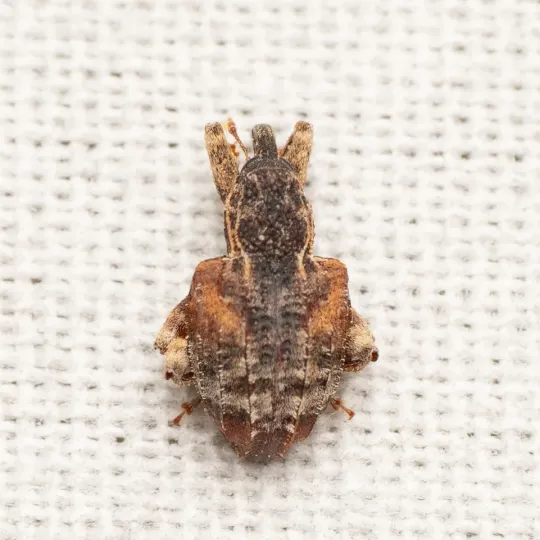
Description
How to identify
The Quince curculio (Conotrachelus anaglypticus) is a member of the Curculionidae family, commonly known as true weevils. These insects are distinguished by their elongated snouts, which are used for both feeding and boring holes for egg-laying.
Adult weevils possess a robust, hard-shelled body that is typically mottled with brown, grey, and black tones. This coloration provides excellent camouflage against tree bark, making them difficult to spot during the day.
The larvae are small, legless, and C-shaped, usually exhibiting a creamy white color with a dark, sclerotized head capsule. They are exclusively adapted for a life inside the fruit tissue.
Identification often requires careful inspection of the orchard during the early fruit development stages. Because they are shy and tend to drop to the ground when disturbed, detecting them can be a challenge.
Their biological structure and behavior are highly specialized, allowing them to exploit fruit trees with high efficiency and minimize exposure to many types of natural predators.
What it damages
While the primary host plant is the quince tree, the Quince curculio is also known to infest apple and pear trees when orchard populations are high. This flexibility makes them a persistent threat.
Adult weevils feed on buds and leaves in early spring, causing minor structural damage. However, the most severe economic impact occurs when females deposit eggs into the developing fruitlets.
The emerging larvae tunnel through the fruit flesh, causing internal damage that leads to premature fruit drop and rot. This renders the harvest completely unmarketable.
The presence of larvae also creates entry points for fungal pathogens, such as brown rot, which can further spread throughout the entire crop if not managed quickly.
In neglected orchards, the cumulative effect of larval feeding and secondary infections can result in the loss of a significant percentage of the potential total yield.
When it appears
Adults emerge from the soil in early spring as temperatures rise. This emergence is synchronized with the phenology of their host trees, specifically coinciding with budding and blooming.
The mating and egg-laying phase occurs shortly after fruit set. The timing of this stage is critical, as it dictates the window of opportunity for effective chemical interventions.
During the summer months, larvae feed inside the fruit. Once they reach maturity, they chew their way out of the fruit and drop to the ground to pupate in the soil.
Depending on the local climate and temperature gradients, the species may have one or two generations per year, often entering diapause in the soil to survive the winter.
Monitoring for adult activity during the post-bloom period is essential to predict the severity of the upcoming larval infestation and to schedule control applications.
Signs of infestation
The earliest indicator of an infestation is the appearance of small, circular or irregular puncture marks on the skin of young fruits, which are sites where eggs were laid.
As the larvae develop inside, the fruit often displays signs of deformation, such as bumpy surfaces, dimples, or sunken areas caused by internal tissue consumption.
A sudden increase in fruit drop during late spring and early summer is a strong diagnostic sign of a heavy curculio infestation. Dissecting these dropped fruits usually reveals larvae and their tunnels.
Observing adult weevils in the evening using the limb-jarring technique is a common method for detection, as they are often more active during low-light conditions.
Secondary symptoms include premature yellowing of the fruit and the rapid onset of decay, which is often exacerbated by the waste products left behind by the feeding larvae.
Control measures
Effective management relies on a combination of cultural practices and targeted chemical control to reduce the population below the economic threshold of damage.
Strict sanitation is vital; collecting and destroying all fallen fruit immediately prevents the larvae from exiting the fruit and migrating into the soil to complete their lifecycle.
Cultivating the soil beneath the trees in autumn and early spring can expose hibernating adults or pupae to environmental stress and natural predators like birds or ground beetles.
Chemical applications should be focused on the period immediately following petal fall, using insecticides to target adults before they can successfully lay eggs inside the fruit.
- Implement a regular monitoring program using pheromone or visual traps.
- Thin out dense canopy foliage to increase sunlight and reduce the insect's preferred environment.
- Encourage natural predators by providing diverse habitats within the orchard.
- Use systemic insecticides only when necessary and in accordance with local regulations.
Taxonomy
- Latin name
- Conotrachelus anaglypticus
- Order
- Coleoptera (beetles)
- Family
- Curculionidae
- EPPO code
- CONHAN
Discussion
No discussions yet — be the first.