
Avocado seed moth (often referred to in the context of weevils, specifically Conotrachelus aguacatae)
Conotrachelus aguacatae
Description
How to identify
The avocado seed weevil (Conotrachelus aguacatae) belongs to the order Coleoptera and the family Curculionidae. It is a small but highly destructive insect characterized by a distinct snout and a dark, hard exoskeleton.
Adult weevils are typically brownish-black, measuring approximately 6–8 millimeters in length. They are highly skilled at hiding within the dense canopy of avocado trees, making detection a challenge.
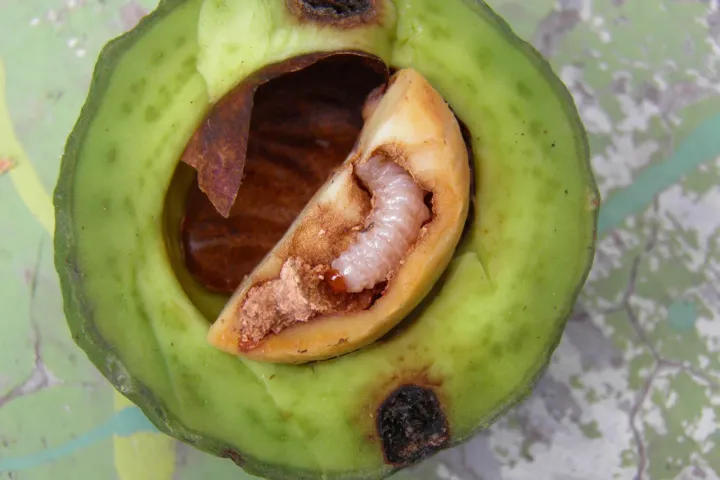
The larvae are legless, C-shaped, and creamy-white with a brown head capsule. Their entire developmental stage occurs hidden deep within the avocado fruit, specifically targeting the seed and surrounding pulp.
As a specialist herbivore, the weevil has evolved in close association with Persea americana. Its morphology is perfectly adapted for drilling into the tough skin of developing avocados.
Correct identification often relies on finding the characteristic exit holes made by adults or the internal damage observed after cutting open a suspected infested fruit.
What it damages
This pest is exclusively associated with avocado trees. The economic impact is severe because the damage is internal, often going unnoticed until the fruit is harvested or opened.
Larvae consume the avocado seed and the internal pulp, leaving behind frass (excrement) and tunnels that completely ruin the fruit's nutritional and commercial value.
Adults also contribute to the damage by feeding on young stems and leaves, although the primary agricultural loss is attributed to the reproductive cycle inside the fruit.
Secondary infections, including various fungal pathogens, often enter the fruit through the oviposition wounds created by the female weevil, causing the fruit to rot prematurely.
Due to the high risk of spreading this pest, international trade of fresh avocados from infested regions is subject to strict phytosanitary regulations to prevent global dispersal.
When it appears
The activity of the avocado seed weevil is largely dictated by the phenological stage of the avocado tree, specifically during the period of fruit set and development.
Females lay their eggs in small punctures on the fruit surface. In tropical regions with year-round avocado production, multiple generations can overlap, resulting in continuous pressure throughout the year.
Environmental factors such as temperature and humidity significantly influence the speed of the life cycle, with warmer conditions typically accelerating larval development.
Fallen fruits play a crucial role in the lifecycle, as they provide a protected environment for the final larval stages and pupation before the adult emerges to seek new fruit.
Effective pest management schedules must be aligned with the peak flight activity of adult weevils to ensure that treatments are applied before egg-laying begins.
Signs of infestation
Early signs of infestation include tiny, dark spots on the skin of the fruit, which are the sites where females have deposited eggs.
As the larvae develop, the fruit may show signs of lopsided growth or premature color changes. In many cases, the fruit drops prematurely from the tree even while appearing relatively normal.
When an infested fruit is cut open, the internal flesh is found to be discolored and tunneled, with the seed often being hollowed out by the larvae feeding inside.
The presence of perfectly round, small exit holes on the exterior of the fruit skin indicates that the adult weevil has already completed its development and emerged.
- Minute oviposition punctures on the fruit surface.
- Premature fruit drop in the orchard.
- Internal fruit decay and tunneling.
- Hollowed-out seeds within the avocado.
Control measures
Phytosanitary measures are the first line of defense. This includes strict movement controls of fruit from infested areas to non-infested production zones.
Cultural practices, specifically the rigorous removal and destruction of all fallen fruit, are essential to break the lifecycle and reduce the local population of the weevil.
Chemical control is performed using targeted insecticide applications timed according to the monitoring of adult activity via pheromone or visual traps.
Biocontrol agents, such as predatory fungi or specific parasitoid wasps, are being researched and utilized in integrated pest management (IPM) programs to decrease reliance on synthetic pesticides.
Maintaining healthy orchard conditions and regular pruning can improve light penetration and airflow, which may create less favorable micro-environments for the adult weevils.
Taxonomy
- Latin name
- Conotrachelus aguacatae
- Order
- Coleoptera (beetles)
- Family
- Curculionidae
- EPPO code
- CONHAG
Discussion
No discussions yet — be the first.