
Jack pine cone beetle
Conophthorus banksianae
Description
How to identify
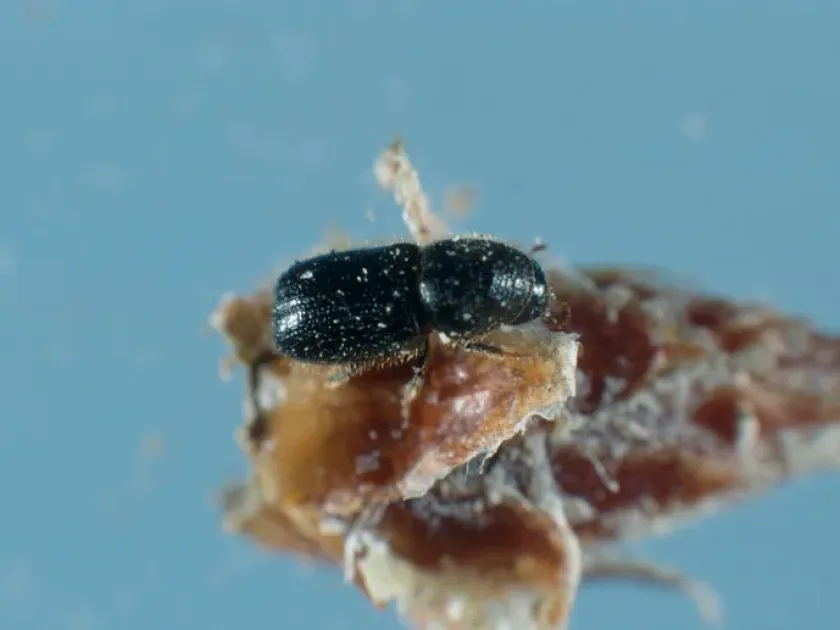
The Jack pine cone beetle (Conophthorus banksianae) belongs to the Curculionidae family, subfamily Scolytinae. It is a small insect, measuring approximately 3–4 mm in length, characterized by a cylindrical body that is dark brown or black.
Adult beetles possess well-developed mandibles, allowing them to bore deep into the woody tissues of cones. Their snout is shortened, which is typical for bark beetle relatives adapted to living within the reproductive organs of conifers.
The insect's life cycle is closely tied to the development of Jack pine cones, although the species can also be found on other closely related pine species across North America. The beetle is difficult to detect visually because it spends most of its life hidden within the infested organ.
The larvae are white, legless, and have a well-developed head capsule. They are adapted to feed on the inner tissues of the seed scales, making their development almost entirely protected from external threats.
Sexually mature beetles overwinter in fallen cones or under the bark of trees, emerging when spring temperatures rise to seek out fresh cones of the current year.
What it damages
The primary food source for this species is the developing cones of the Jack pine. Adults and larvae damage both the cone axis and the seed scales, leading to a complete loss of the tree's reproductive potential.
Damage to the seed scales and the axis disrupts the nutrient supply to the seeds. As a result of the beetle's activity, the seeds either die or remain undeveloped, rendering them unsuitable for reforestation efforts.
The pest is capable of destroying up to 80–90% of the annual cone crop in certain infested areas. This creates significant economic challenges for forest nurseries and agencies involved in collecting forest seed stock.
Furthermore, damaged cones often wither and drop to the ground prematurely. This not only denies foresters the needed seeds but also serves as a source for further spread of the beetle, as fallen cones provide a habitat for the next generation to pupate.
The pest population grows rapidly in dense monoculture plantations, where the proximity of Jack pine trees facilitates the easy spread of beetles from one tree to another during peak breeding periods.
When it appears
The active life phase of the insect begins in the spring when average daily air temperatures exceed 10–12 degrees Celsius. During this time, overwintered adults leave their hibernation sites and fly toward young shoots.
The initial attack on the cones occurs in May and June, once the cones reach a size suitable for egg-laying. Beetles bore entry holes at the base of the cone and begin the infestation process.
The flight of the beetles and active reproduction continue throughout the summer, as long as the cones are in their growth and seed-filling phase. The intensity of the attack depends on weather conditions; a warm and long summer facilitates the development of multiple generations.
In the autumn, insect activity decreases as they move toward hibernation sites. Cooling serves as a signal to cease feeding and enter a state of diapause, which is necessary for survival during the winter months.
A crucial factor in seasonal dynamics is the synchronization of beetle emergence with the timing of cone formation on specific pine stands, which determines the overall damage levels for the season.
Signs of infestation
The most obvious sign of the pest's presence is the appearance of resinous streaks at the base of the cones. This is the tree's defensive reaction to tissue damage, which results in the abundant flow of resin.
Another important diagnostic sign is the premature yellowing and withering of young cones on the branches. Such "mummies" stand out noticeably against the background of healthy green needles.
When examining cones with a magnifying glass, one can spot small entry holes surrounded by boring dust — the waste products of the beetles. The number of such holes varies depending on the level of infestation.
Dissecting an infested cone reveals tunnels bored by larvae within the central axis. Inside these tunnels, one can often find both larvae of different ages and pupae of the pest.
Mass dropping of underdeveloped cones in mid-summer also serves as indirect evidence of high beetle density in the stand, requiring immediate inspection of the seed-producing area.
Control measures
The primary control measure is the sanitary removal of fallen cones from forest stands. Collecting and subsequently burning infested debris significantly reduces the pest population density for the following year.
In specialized seed orchards, insecticide application during the peak flight period may be necessary. Using systemic products helps eliminate beetles before they can lay eggs within the cones.
An effective agrotechnical method involves monitoring with pheromone traps. These allow for precise determination of the pest's emergence and help optimize the timing of protective treatments.
Planting mixed forest stands helps reduce the risk of mass outbreaks, as it is easier in such communities to maintain a natural balance of predatory insects that feed on the pest's larvae.
- Collection and disposal of infested cones
- Insecticide spraying during spring flight
- Use of pheromone monitoring
- Thinning of dense stands to improve airflow
Taxonomy
- Latin name
- Conophthorus banksianae
- Order
- Coleoptera (beetles)
- Family
- Curculionidae
- EPPO code
- CONPBA
Discussion
No discussions yet — be the first.