
Grape weevil
Compsapoderus
Description
How to identify
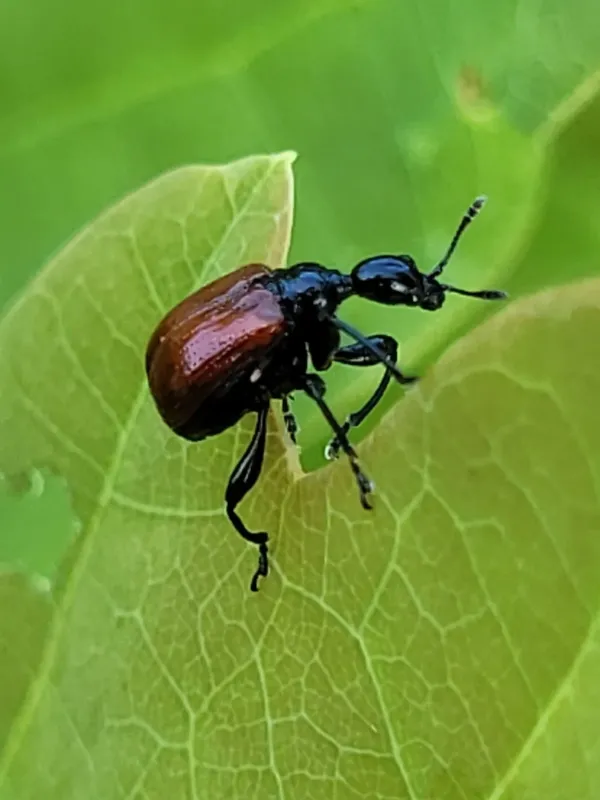
The grape weevil (Compsapoderus erythropterus) is a small beetle belonging to the Attelabidae family. The adult beetle has a distinctive appearance: the pronotum and elytra are typically bright red or reddish-brown, while the head and the underside of the body are black.
A key feature of this family is the elongated rostrum or snout. The total body length of an adult is about 5–7 mm. The surface of the body is covered with sparse, short hairs, giving the beetle a slight sheen.
The larva is legless, whitish in color, with a prominent dark head. It develops inside leaves that the female has rolled into a cylindrical shape. Pupation occurs within these leaf rolls or occasionally in the soil.
The life cycle is closely linked to the phenology of the grapevine. Adults overwinter under fallen leaves, in bark crevices, or in the topsoil, emerging in the spring as soon as temperatures remain consistently warm.
This species is an oligophage, primarily attacking grapevines, though high populations may lead them to feed on various deciduous trees and shrubs in the vicinity of the vineyard during periods of rapid growth.
What it damages
The primary host and breeding site for this pest is the cultivated grapevine. The weevil prefers young, tender leaves that have not yet hardened, making them suitable for being rolled into characteristic "cigars."
Besides grapevines, beetles can damage the foliage of various broad-leaved trees and shrubs growing near vineyards, allowing the population to persist even when the preferred host is unavailable.
Significant damage is caused not only by adults, which chew holes in the leaf blades, but also by larvae. The larvae feed on the internal tissues of the rolled leaves, causing them to wither, die prematurely, and drop off.
The loss of a large number of leaves early in the season severely weakens the vine. This impairs photosynthesis, reduces sugar accumulation in the grapes, and negatively affects the wood maturation of the canes.
Under heavy infestation, crop yields can be significantly reduced, which is especially critical for young vineyards where every leaf is vital for establishing the root system and the permanent vine framework.
Signs of infestation
The most obvious sign of infestation is the presence of characteristic leaf rolls. The female makes precise incisions on the petiole or central leaf vein and carefully rolls the leaf into a tight cylinder.
Small, rounded holes on the surface of young leaves are an early indicator of adult feeding activity. These small holes are often overlooked by growers until the leaf-rolling stage begins.
The rolled "cigars" eventually turn black and dry out, standing out against the surrounding healthy green foliage. Inside these structures, one can find the larvae and evidence of their feeding in the form of frass and destroyed leaf tissue.
During flowering and fruit set, sections of the vine may show deformed shoots. If left untreated, the area of damage spreads rapidly, potentially affecting large parts of the vineyard.
- Appearance of beetles on the tops of shoots in the spring.
- Punched-out holes in the young, unrolled leaf blades.
- Visible presence of leaf-made "cigars" on the canes.
- Mass premature leaf drop and drying of the canopy.
Control measures
Good cultural practices are the foundation of management. It is essential to remove and destroy fallen leaves in the autumn to eliminate overwintering sites. Deep cultivation between rows can also help reduce the overwintering population.
In small-scale or organic operations, hand-picking and destroying the leaf rolls along with the larvae inside is an effective method. This must be done promptly before the larvae complete their development and exit the rolls.
Chemical control is warranted during high infestation levels. Insecticide applications are most effective when timed with the emergence of adults from hibernation, before the mass rolling of leaves occurs.
Commonly used insecticides include organophosphates, pyrethroids, or neonicotinoids. It is vital to strictly adhere to label instructions, local regulations, and pre-harvest intervals to ensure safety and regulatory compliance.
Biological control strategies involve promoting natural predators such as parasitic wasps, predatory insects, and birds. Additionally, microbial insecticides based on specific bacteria can be used to target the larvae within their leaf refuges.
Taxonomy
- Latin name
- Compsapoderus
- Order
- Coleoptera (beetles)
- Family
- Attelabidae
- EPPO code
- COMUSP
Discussion
No discussions yet — be the first.