
Colletes
Colletes
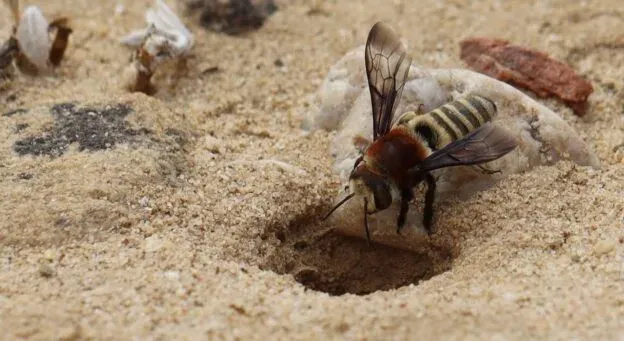
Description
How to identify
The genus Colletes, commonly known as cellophane bees or polyester bees, belongs to the family Colletidae within the order Hymenoptera. They are solitary bees, often confused with pests due to their communal nesting behavior.
Physically, they resemble honey bees but have a stockier appearance and dense hair coverage. They are named for their unique ability to secrete a cellophane-like substance from their glands, which they use to line their underground nest cells.
This lining provides a protective barrier against soil moisture, fungal infections, and bacteria, ensuring the safety of the developing larvae until they emerge.
Unlike social bees, Colletes have no queens or worker castes. Every female is capable of mating, building her own nest, and providing for her offspring.
These bees are vital members of the ecosystem as efficient pollinators for various flowering plants. Their presence is generally a sign of a healthy, pesticide-free environment.
What it damages
Colletes are not phytophagous and do not feed on leaves, stems, or fruits. Consequently, they cause no damage to agricultural crops or ornamental plants.
The primary concern regarding these bees is purely structural. When they choose a high-traffic area, such as a lawn, playground, or bare garden bed, their small nesting holes can disrupt the soil surface.
In extremely rare cases, high-density nesting in loose seedbeds might cause minor disturbance to newly sown seeds, but this is seldom considered an economic issue for farmers.
Gardeners often misidentify them as pests simply because of their numbers. In reality, the benefits they provide as pollinators far outweigh any minor inconveniences caused by their soil excavations.
They are non-aggressive bees and will typically ignore humans unless they are directly handled or their nests are physically damaged.
When it appears
The activity period for Colletes is typically restricted to the summer months, with the exact timing depending on the specific species and local climate conditions.
The life cycle is tightly regulated. Females emerge in early to mid-summer, mate, and begin excavating nests in sunny, dry soil patches.
After provisioning the nests with pollen and nectar, they lay their eggs and seal the cells. The adults die shortly after, while the next generation develops underground.
Larvae overwinter in their cells, emerging as adults the following season. Weather events like heavy rainfall can temporarily delay their emergence or nesting activities.
Peak visibility occurs during warm, sunny weather when females are frequently seen flying between flowers and their nest entrances.
Signs of infestation
The most common sign of a Colletes colony is the appearance of small, round holes in bare soil, often surrounded by a tiny mound of excavated earth.
A high density of buzzing bees hovering over a specific patch of sunny ground is a clear indicator that a nesting site has been established.
Close observation reveals individual bees moving purposefully to and from the holes, carrying pollen loads on their hind legs.
The nest entrances are often clean and well-defined. If disturbed, you may see the thin, plastic-like lining that gives these bees their "cellophane" nickname.
Absence of any plant damage, such as chewed leaves or wilted stems, confirms that these insects are mining bees and not plant-eating pests.
Control measures
There is no reason to eliminate Colletes populations, as they are beneficial pollinators. In fact, conservation of these bees is encouraged by agricultural experts.
If their presence in a specific area is unwanted, focus on non-toxic landscape management to discourage them from nesting in those locations.
- Maintain dense turf or ground cover, as these bees prefer nesting in bare, exposed soil.
- Incorporate irrigation to keep nesting sites moist; these bees avoid wet, cold soil for their brood cells.
- Use mulch or organic matter to cover bare patches of soil, making the ground less attractive for excavation.
The use of insecticides is strongly discouraged, as it is unnecessary, environmentally harmful, and ineffective at controlling solitary bee populations.
Since the adult activity cycle is brief, usually lasting only a few weeks, the simplest and most effective strategy is to wait until the nesting cycle concludes naturally.
Taxonomy
- Latin name
- Colletes
- Order
- Hymenoptera
- Family
- Colletidae
- EPPO code
- CLLTSP
Discussion
No discussions yet — be the first.