
Alfalfa beetle
Colaspidema atrum
Description
How to identify
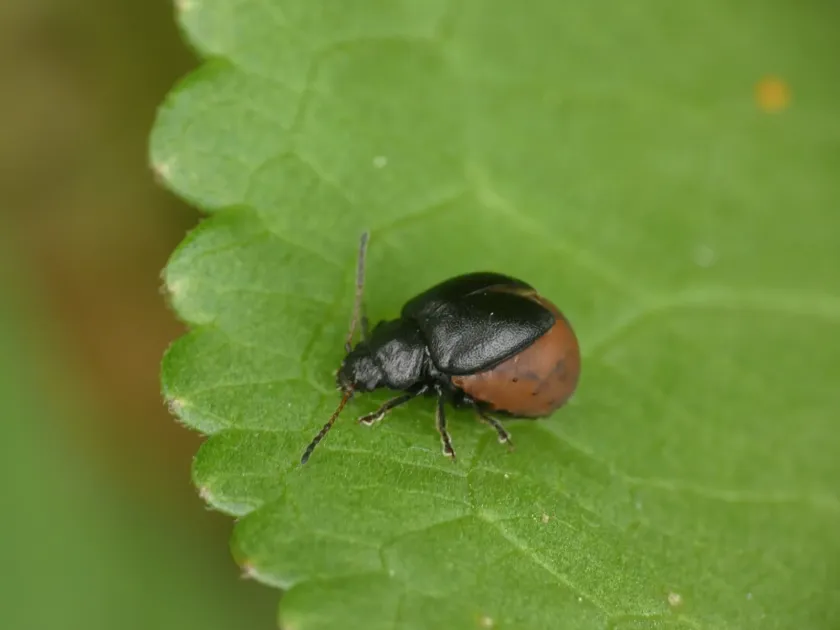
The alfalfa beetle (Colaspidema atrum) is a member of the leaf beetle family (Chrysomelidae). Adult beetles are small, usually ranging from 4 to 5 millimeters in length, and possess a distinct, rounded, metallic black body.
The surface of the elytra (wing covers) is covered with fine punctures, giving it a slightly textured appearance. Its head and pronotum are tightly integrated, creating a robust, compact insect body shape typical of the genus.
Larvae look like small, hump-backed "caterpillars" measuring about 6–7 millimeters. They are often gray or dark brown and feature rows of setose tubercles along their backs, which help distinguish them from other insect larvae in the field.
Pupation occurs in the soil, where the larvae build small earthen chambers. The pupae are yellowish and rarely visible to farmers unless they specifically dig in the topsoil during the summer months.
Eggs are oval and pale, laid in clusters on the leaves or stems of host plants. These clusters are often placed on the underside of leaves to protect the developing offspring from direct sunlight and predators.
What it damages
As the name suggests, the alfalfa beetle primarily targets alfalfa (lucerne). However, it is also known to feed on other perennial legumes like sainfoin and clover, which are common in forage crop rotations.
Damage is caused by both adults and larvae. They consume the leaf tissue, often leaving only the skeleton of veins behind, which significantly reduces the photosynthetic area of the plants and lowers the overall yield.
In high-density outbreaks, the insects can strip entire fields, leading to significant economic losses in hay and green fodder production. Severely affected plants show signs of stunted growth and yellowing.
The beetle's feeding habits can also negatively impact the regrowth ability of alfalfa after mowing. Weakened root systems, stressed by constant defoliation, may lead to early senescence of the alfalfa stand.
Beyond quantity, the quality of the harvested hay is often compromised. Infested crops have lower protein content and lower digestibility, making them less suitable for livestock feed.
When it appears
Adult beetles overwinter in the soil or under plant debris in alfalfa fields. They emerge in early spring as soon as temperatures rise, signaling the start of the growth season for their host crops.
The peak activity of adults usually coincides with the spring regrowth of alfalfa. This is the period of mating and egg-laying, which typically occurs over several weeks, leading to overlapping generations.
Larvae appear in late spring or early summer. This is the most destructive phase of their life cycle, as they feed voraciously on the foliage before descending into the soil to pupate.
Depending on local climate conditions, the insect can complete one or two generations per year. Hot and dry summer weather may induce a period of estivation (dormancy) for adult beetles.
By late summer, the population levels typically stabilize, but late-season damage can still occur if the autumn weather remains mild, allowing for extended larval development.
Signs of infestation
The first sign of an alfalfa beetle infestation is the appearance of irregular, window-like holes in the leaves. As larvae grow, these holes enlarge, leading to total leaf skeletalization.
Farmers can identify the pest by inspecting the lower foliage in the early morning. Larvae are often found resting in groups on the underside of leaves or near the stem base.
Patches of yellowing or withered plants are a clear indicator of heavy infestation. These "hotspots" often expand rapidly if not managed, eventually covering large portions of the field.
Visual presence of the shiny black beetles on the plants is another key indicator. Sweeping the field with an insect net will easily reveal the presence of adults even before severe damage occurs.
The presence of frass (insect excrement) on the leaf surfaces confirms that the damage is recent and ongoing, signaling the need for immediate assessment of population density.
Control measures
Cultural control is the most effective approach. Deep plowing of fields after harvest can destroy overwintering adults and pupae residing in the soil, effectively reducing the next season's population.
Timely mowing of alfalfa can disrupt the larval development cycle. By harvesting before the larvae reach maturity and move into the soil to pupate, farmers can significantly lower the pest load.
Chemical control should be considered only when the population exceeds the economic threshold. Insecticides should be applied during the larval stage to maximize the impact on the active population.
When using pesticides, it is essential to select products that are safe for use on forage crops and to strictly observe pre-harvest intervals to ensure the safety of the livestock.
Integrated Pest Management (IPM) practices, including the preservation of natural predators and parasites, should be encouraged to maintain a natural balance and reduce the reliance on synthetic chemicals.
Taxonomy
- Latin name
- Colaspidema atrum
- Order
- Coleoptera (beetles)
- Family
- Chrysomelidae
- EPPO code
- COAPAT
Discussion
No discussions yet — be the first.