
Alpine leaf beetle
Colaphellus alpinus
Description
How to identify
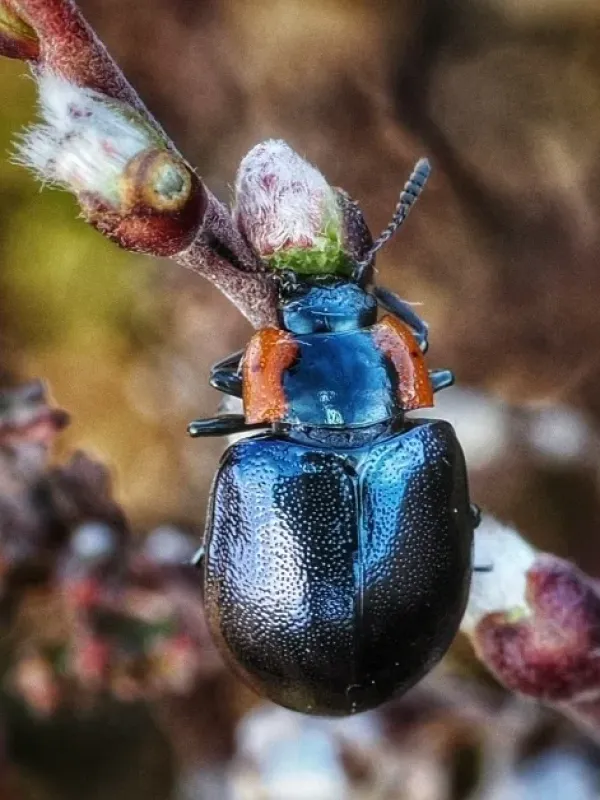
The Alpine leaf beetle (Colaphellus alpinus) is a coleopteran insect belonging to the Chrysomelidae family. Adult beetles are characterized by a metallic, bronze or bluish-green sheen and typically measure between 4 and 6 millimeters in length.
These beetles possess the classic oval body shape associated with the Chrysomelinae subfamily. Their elytra (wing covers) are covered in dense, fine punctures, which create a distinctive sparkling effect when exposed to direct sunlight.
The larvae are typically dark gray or yellowish in color, often adorned with dark spots along their lateral segments. They spend their entire developmental phase feeding openly on the foliage of host plants.
Taxonomically, this species is classified within the order Coleoptera. While visually similar to other members of the genus Colaphellus, proper identification relies on analyzing geographical occurrence and specific preferences for host plants within the Brassicaceae family.
Adult beetles are highly mobile and capable of flight, which enables them to rapidly colonize new fields. Their movement patterns are strongly influenced by the availability of preferred cruciferous vegetation during the growing season.
What it damages
The Alpine leaf beetle primarily targets crops belonging to the Brassicaceae family. Major agricultural plants at risk include various cabbage varieties, radishes, turnips, mustard, and industrial oilseed crops like rapeseed.
Significant economic damage occurs during the early stages of plant development, where infestation can lead to reduced plant density and stunted overall growth of the crop population.
Beyond cultivated crops, this beetle thrives on wild cruciferous weeds, which serve as reservoirs and alternative food sources, allowing the pest population to persist in agricultural environments throughout the season.
Feeding by both adults and larvae significantly reduces the photosynthetic surface of leaves. In severe cases, this leads to widespread defoliation, which hampers the plant's ability to store energy and produce viable yields.
Uncontrolled population outbreaks can cause extensive harvest losses. In commercial farming, this necessitates continuous monitoring and proactive management to prevent significant yield degradation.
When it appears
The pest's activity cycle initiates in early spring as temperatures rise, signaling the emergence of overwintering adults from their shelters in the soil or beneath accumulated plant debris.
During spring and early summer, the beetles focus on mating and oviposition. Females typically lay eggs in clusters on the undersides of leaves, providing the subsequent larvae with immediate access to food upon hatching.
Larval development spans several weeks, passing through multiple instars. This phase is characterized by intense feeding, often coinciding with the rapid growth of vegetable crops, which provides an abundant food supply.
Pupation occurs within the upper layers of the soil, where the insect constructs a pupal chamber. Depending on local climate conditions, the species may complete one or several generations within a single season.
As autumn approaches, activity levels decline as the insects prepare for diapause. They overwinter as adults, buried in the soil or sheltered in protected microhabitats to survive the winter temperatures.
Signs of infestation
The primary diagnostic sign of an infestation is the presence of irregular holes or small perforations in the leaf blades. Adults typically consume patches of leaf tissue, leaving behind ragged, uneven edges.
Larvae are known to skeletonize leaves, consuming the fleshy tissue between veins while leaving the larger vascular structures intact. This causes the leaves to wilt, turn yellow, and eventually die.
Direct observation of adult beetles on the foliage is a reliable sign of infestation. They are most easily detected during the early morning hours when their metabolic activity is lower, making them less prone to flee when approached.
The accumulation of larval frass (excrement) on the leaf surface is another indicator of an active infestation. This biological waste can promote the growth of opportunistic pathogens and lead to secondary rot in damaged plants.
Visually, severely infested crops appear stunted, deformed, and chlorotic. If left untreated, entire patches of young seedlings may exhibit significant biomass loss, often resulting in complete crop failure.
Control measures
The foundation of effective control is a robust crop rotation strategy, which prevents the continuous planting of cruciferous crops in the same area. This breaks the pest's life cycle and restricts population buildup.
Strict weed management is essential; eliminating wild Brassicaceae species from field borders and irrigation ditches removes critical secondary habitats that support the beetles between crop cycles.
Post-harvest deep tillage is a highly recommended practice. This technique disrupts the soil, exposing overwintering pupae and adults to harsh weather conditions and natural predators, significantly reducing the survival rate.
When the economic injury level is reached, chemical interventions using systemic or contact insecticides are necessary. Rotation of chemical classes is recommended to prevent the development of resistance.
- Utilize yellow sticky traps to monitor adult beetle flight activity.
- Encourage natural predators such as ground beetles and ladybugs.
- Apply biological insecticides based on entomopathogenic fungi where appropriate.
Taxonomy
- Latin name
- Colaphellus alpinus
- Order
- Coleoptera (beetles)
- Family
- Chrysomelidae
- EPPO code
- COLHAL
Discussion
No discussions yet — be the first.