
Kelp fly
Coelopa frigida
Description
How to identify
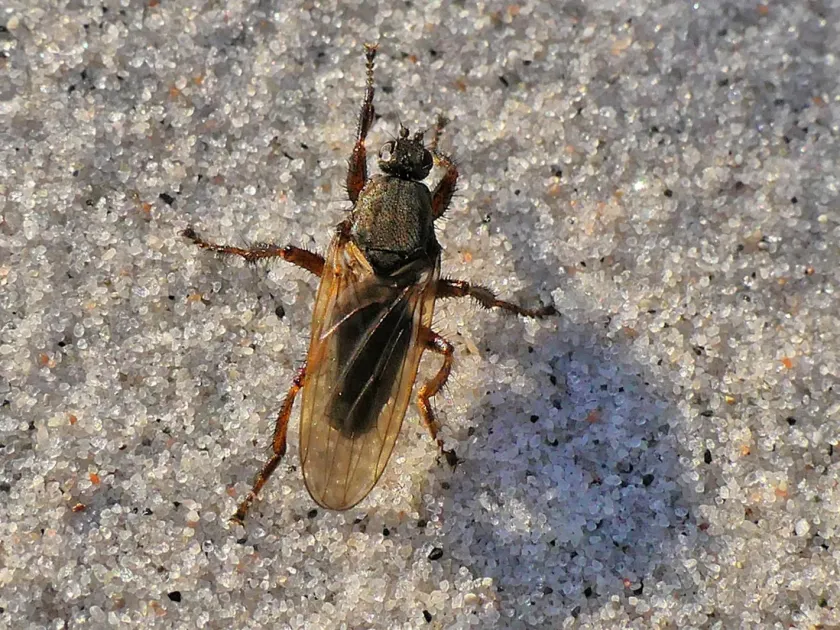
The kelp fly (Coelopa frigida) belongs to the order Diptera, family Coelopidae. This insect features a stocky body measuring 4 to 7 mm in length, colored in dark brown or blackish tones, and densely covered with bristles.
Adults have a distinctive appearance with a robust build and well-developed bristles on their legs, which help them move across slippery organic substrates.
The larvae are typical of higher Diptera: a cylindrical, whitish body tapering towards the anterior end, without a distinct head structure.
Adults are primarily active in coastal zones where decaying organic matter, specifically marine and freshwater algae, accumulates.
Identifying the pest is challenging due to its localized habitat, but large swarms near seaweed deposits serve as the primary sign of the species' presence.
What it damages
The primary damage caused by the kelp fly occurs near shoreline areas, where it can affect nearby agricultural or ornamental crops.
Larvae feed actively on decaying organic matter, but during periods of overcrowding or food shortages, they may migrate to the young shoots of coastal plants.
Crops grown in coastal zones suffer from mechanical tissue damage caused by the larvae, which subsequently creates entry points for secondary infections.
Damage manifests as eroded leaves, stems, and root collars, leading to the wilting and eventual death of weakened seedlings.
High population densities create significant sanitary nuisances, as the flies tend to swarm in large numbers around affected vegetation.
When it appears
The life cycle of Coelopa frigida is closely linked to ambient temperatures and the condition of seaweed wrack deposits on the shore.
Peak activity is observed during the spring and autumn months, when climatic conditions are most favorable for reproduction and larval development.
Females lay their eggs directly into rotting organic masses, where larvae progress through several developmental stages before pupation.
The duration of the life cycle depends heavily on the moisture levels of the substrate, which must remain moist for larval survival.
Overwintering usually occurs at the pupal or larval stage within the soil or deep inside organic debris, providing protection against low temperatures.
Signs of infestation
The first sign of infestation is the mass appearance of flies above seaweed deposits, accompanied by a characteristic buzzing when disturbed.
Inspection of coastal crops may reveal atypical holes in leaves and damage to stems near the soil surface.
The presence of specific larval excrement on the surfaces of affected plant parts indicates an active feeding phase of the pest.
Gradual yellowing and wilting of the lower parts of plants in coastal zones serve as indirect evidence of root or root-collar damage.
In high humidity conditions around plants, one may observe clusters of larvae avoiding direct sunlight.
Control measures
The primary control method involves regular cleaning of the shoreline to remove decaying seaweed deposits that serve as a food source for the flies.
Utilizing barrier control methods, such as installing fine-mesh netting, helps limit the migration of adults onto nearby plant beds.
The application of insecticides in coastal areas must be conducted with extreme caution due to proximity to water bodies and strict environmental regulations.
Biological control methods include maintaining a natural balance of entomophages that prey upon the eggs and larvae of the kelp fly.
- Timely disposal of organic waste
- Drainage of coastal areas
- Monitoring adult population levels
Taxonomy
- Latin name
- Coelopa frigida
- Order
- Diptera (flies)
- Family
- Coelopidae
- EPPO code
- CELPFR
Discussion
No discussions yet — be the first.