
Kelp fly (Coelopa)
Coelopa
Description
How to identify
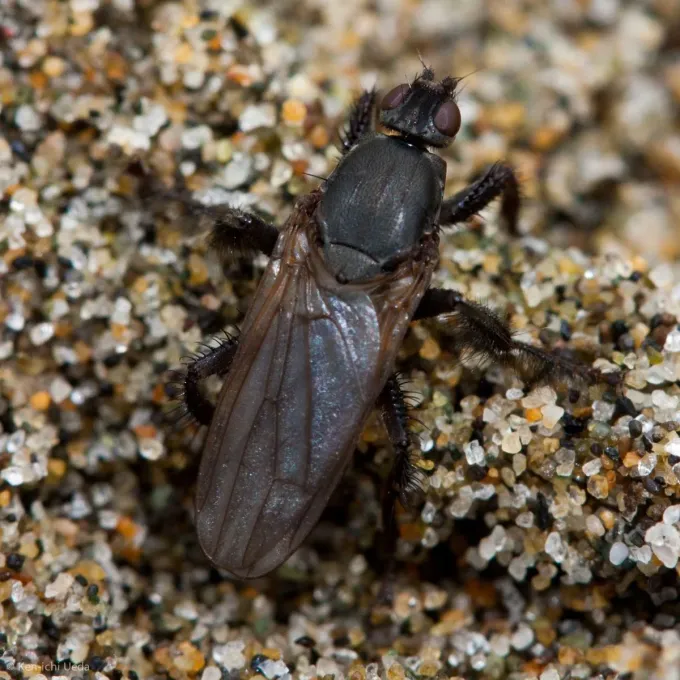
The kelp fly (genus Coelopa) belongs to the family Coelopidae, within the order Diptera. These are medium-sized flies characterized by a flattened body and dense hair, which adapt them to harsh coastal environments.
Adult flies typically measure between 4 to 8 mm in length. Their coloration ranges from dark brown to black. They possess transparent or slightly smoky wings with prominent venation.
The larvae are typically maggot-like, legless, and cream or yellowish in color. They are equipped with well-developed mouthparts designed for consuming decaying organic matter.
Species of the genus Coelopa are largely halophilic organisms, with their life cycle strictly linked to sea coasts and accumulations of washed-up seaweed.
The taxonomy of this genus includes several species, with Coelopa frigida being the most prominent and well-studied representative in northern temperate regions.
What it damages
The kelp fly is not a primary agricultural pest, as its natural diet consists mainly of decomposing marine algae found on beaches.
However, during periods of mass reproduction, these flies can cause significant disruptions for agricultural operations located in immediate proximity to the coastline.
The primary damage occurs when flies migrate to nearby vegetable crops after natural seaweed supplies are exhausted or during population explosions.
Large swarms contaminate plant surfaces with their waste, which often promotes the secondary colonization of crops by fungal and bacterial pathogens.
High population densities can create significant discomfort for farm personnel working in coastal fields, leading to reduced operational efficiency.
When it appears
The life cycle of the kelp fly is strongly dependent on the temperature of the coastal habitat and the availability of seaweed deposits.
The active breeding season begins in late spring, as the coastal substrate warms up, and continues throughout the summer until late autumn.
In milder coastal climates, adults and larvae may remain active for most of the year, provided temperatures do not reach extreme freezing points.
The largest population outbreaks occur following significant storms that deposit vast amounts of seaweed, providing abundant food resources for the larvae.
The development cycle from egg to adult is short, lasting only a few weeks, allowing for multiple generations to occur within a single growing season.
Signs of infestation
The first indicator of an infestation is the presence of dense swarms of flies concentrated around piles of rotting organic matter at the field-beach interface.
Leaves may show irregular feeding damage, often accompanied by tissue browning caused by enzymes present in the flies' saliva.
The presence of larval tunnels within stems or roots is a sign of a more severe infestation, which frequently leads to plant stunting and general chlorosis.
The accumulation of excrement on foliage, appearing as small dark spots, is another reliable indicator of high fly activity in the area.
Gradual wilting of terminal shoots without clear signs of external mechanical damage is often an indirect sign of larval activity in the root zone.
Control measures
The most effective management method involves the regular removal and proper disposal of seaweed deposits along the coastline adjacent to farmland.
Creating buffer zones or utilizing non-host vegetation strips can act as a physical barrier to prevent fly migration into vegetable production areas.
Chemical control using insecticides is generally reserved for severe outbreaks and must be implemented according to strict agricultural safety protocols.
Light traps and specific attractants can be used to monitor and manage adult populations during peak periods without relying on blanket insecticide applications.
Standard agronomic practices, such as crop rotation and the thorough removal of post-harvest debris, help eliminate secondary breeding sites for the flies.
Taxonomy
- Latin name
- Coelopa
- Order
- Diptera (flies)
- Family
- Coelopidae
- EPPO code
- CELPSP
Discussion
No discussions yet — be the first.