
Chyromya
Chyromya
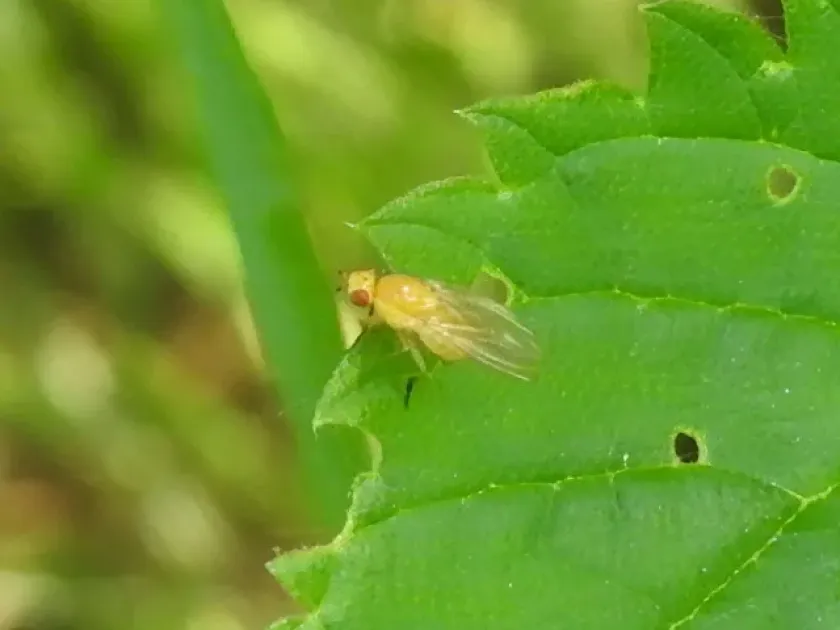
Description
How to identify
Chyromya is a genus of small flies belonging to the family Chyromyidae, order Diptera. These insects typically measure 2 to 3 mm in length and possess a yellowish or ochre coloration, which serves as a camouflage against plant debris and foliage.
Adults are characterized by specific wing venation patterns, which are essential for accurate identification. Their heads are generally rounded with well-developed eyes, and their legs are adapted for rapid movement across vegetation.
The larvae are typical of many dipteran flies: they are legless and taper toward the anterior end. Depending on the species, they may function as saprophages in decaying organic matter or as primary pests that feed on the living tissues of agricultural crops.
While the taxonomy of the genus Chyromya is well-documented, their specific agronomic impact can vary. Accurate field identification is challenging without microscopic examination of the male and female genitalia or wing structure.
These flies show significant ecological plasticity, allowing them to inhabit various environments, from wild grasses to cultivated fields, especially during periods of high humidity and moderate temperatures.
What it damages
The primary damage is caused by the larval stage, which feeds on the vegetative parts of crops. Vegetables and forage plants are the most frequent hosts, particularly when these crops are grown under high-moisture conditions.
The damage manifests as mining of the leaf parenchyma or destruction of the root system. In some instances, larvae bore into the lower stem, which not only stunts the plant but also provides an entry point for secondary fungal or bacterial pathogens.
Crops are most vulnerable during their early developmental stages, particularly at the seedling phase. Damage to the growing point can lead to severe thinning of the stand and loss of crop uniformity.
The economic threshold of damage is often dictated by environmental factors. In years with heavy rainfall and poor field drainage, the incidence of larval infestation tends to increase significantly.
Beyond direct mechanical injury, the physiological stress induced by larval feeding lowers the plant's natural resistance, making it more susceptible to environmental stressors and complicating yield estimates.
When it appears
The activity of adult Chyromya flies commences in early spring as temperatures rise. The peak of adult flight often synchronizes with the vigorous growth phase of local agricultural crops.
The life cycle is closely linked to moisture levels. High humidity favors multiple generations throughout the summer, while arid conditions typically induce a state of diapause in the soil, allowing the insect to survive unfavorable periods.
Pupation occurs in the upper soil layers or within infested plant tissues. This subterranean phase offers protection against natural predators and environmental fluctuations during the dormant periods.
The abundance of flowering weeds near fields is a key factor in population dynamics, as adults require nectar sources to reach sexual maturity before oviposition begins.
As autumn approaches, activity declines, but in warmer climatic zones, an additional late-season generation may occur before the insect enters its wintering stage in the soil or crop residue.
Signs of infestation
Common signs of an infestation include the appearance of chlorotic spots on leaves, which gradually develop into necrotic areas as the larvae consume the internal plant tissue.
- Stunted growth or deformation of young shoots.
- Brown discoloration at the base of the stem or root collar.
- Presence of tiny entry holes in stems or near the soil line.
- Premature wilting of plants that cannot be attributed to water deficit.
Visual monitoring with yellow sticky traps is an effective way to detect the presence of adult flies early in the season, before significant larval damage occurs.
Field margins adjacent to woodlands or unmanaged vegetation areas are high-risk zones and should be inspected regularly to prevent the spread of the pest into the main cultivated areas.
Control measures
Effective control of Chyromya relies on integrated pest management (IPM) practices, emphasizing cultural methods that disrupt the life cycle of the insect.
Deep autumn plowing is a highly effective control measure. It physically disrupts the pupation sites in the soil, exposing the insects to cold temperatures and predators, which significantly reduces the initial population for the following year.
Stringent weed management is essential. By eliminating alternative host plants and nectar sources, farmers can effectively lower the carrying capacity of the field and discourage adult flies from settling.
In cases where infestations exceed economic thresholds, the application of systemic insecticides may be necessary. These products are more effective as they are absorbed into the plant tissues, targeting the larvae directly.
Crop rotation remains the most reliable long-term strategy. By avoiding the cultivation of susceptible host plants in the same area in consecutive years, producers can break the pest's cycle and maintain healthier crop stands.
Taxonomy
- Latin name
- Chyromya
- Order
- Diptera (flies)
- Family
- Chyromyidae
- EPPO code
- CHYRSP
Discussion
No discussions yet — be the first.