
Alder leaf beetle
Chrysomela aenea
Description
How to identify
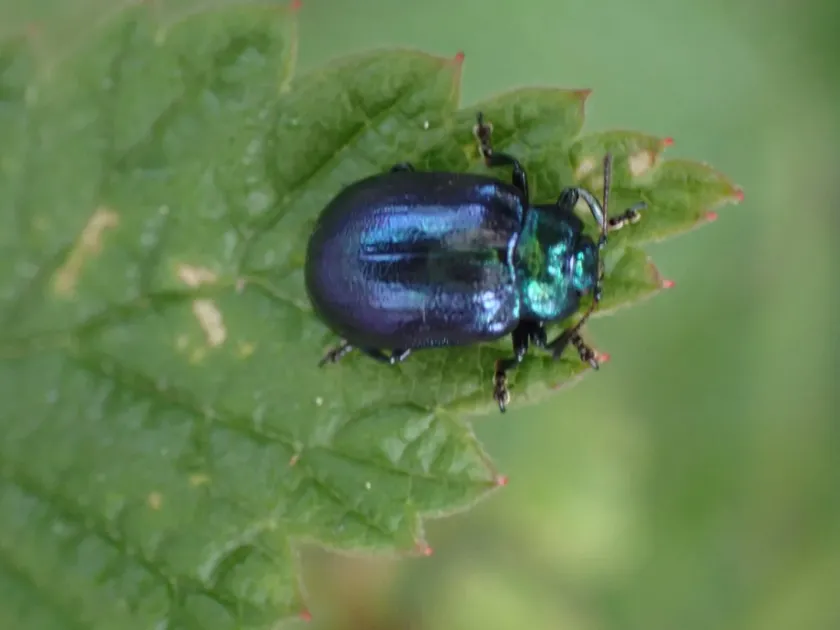
The Alder leaf beetle (Chrysomela aenea) is a member of the leaf beetle family (Chrysomelidae). Adult beetles typically measure between 6 and 8 millimeters and are known for their metallic coloration, which ranges from copper-red to green or blue, providing a distinctive appearance among leaf-feeding insects.
The life cycle of Chrysomela aenea includes complete metamorphosis: egg, larva, pupa, and adult. The insect typically spends the winter in the adult stage, hiding under fallen leaves or within the crevices of tree bark, and emerges in early spring when temperatures rise.
Larvae of the Alder leaf beetle are generally dark, often black or grey, with small protuberances on their body. They are gregarious, meaning they feed in groups, especially in the early stages of their development, making them easier to spot on host plants.
After reaching maturity, the larvae pupate on the surface of the host leaves. They fix themselves to the leaf surface with the posterior end of their body, undergoing transformation into adults within a short period during the summer months.
The reproductive capacity of the species is high, allowing for multiple generations or a rapid increase in population density if environmental conditions are favorable, particularly in habitats where host plants like alder are abundant.
What it damages
As the name suggests, the primary host of this beetle is the alder tree (Alnus species). However, during outbreaks, they can also infest related species such as willow or birch, causing significant foliage damage to these hardwood trees.
Damage is caused by both adults and larvae feeding on the leaves. They graze on the leaf tissue, often leaving behind only the vascular structure, a process known as skeletonization. This significantly impairs the tree's photosynthetic ability.
Extensive feeding can lead to premature leaf drop and tree stress. While mature, healthy trees can often withstand some level of infestation, repeated or heavy attacks year after year can weaken the tree's health, making it more susceptible to pathogens and other stressors.
In forest nurseries and urban landscapes, the aesthetic impact is immediate, as the foliage turns brown and appears withered. This can be problematic for tree health and local biodiversity, especially when young saplings are affected.
The economic impact is primarily related to forestry and landscaping, where the loss of growth rate and decorative appeal necessitates intervention to manage beetle populations and protect the vitality of the stands.
Signs of infestation
The most visible sign of an infestation is the skeletonization of leaves, characterized by a net-like appearance of remaining veins. Additionally, groups of dark-colored larvae on the undersides of leaves are a clear indicator of the beetle's presence.
Excrement left by the feeding larvae is often visible on the leaves and can accumulate on the ground beneath the tree. This biological waste is a strong indicator of an active colony currently feeding in the canopy.
During the pupal stage, small, dark, immobile pupae attached to the leaves are easy to identify. Their presence confirms that the life cycle is in progress and suggests the need for management to prevent the next generation of adults.
In warm weather, adult beetles are quite active and may be observed flying or walking along branches. If disturbed, they often drop from the tree, which is a common defensive behavior used to escape predators.
Overall foliage color changes are a late sign; as the summer progresses, heavily infested trees exhibit widespread browning and wilting, which is particularly evident in the lower and middle sections of the tree canopy.
Control measures
Control strategies for the Alder leaf beetle include cultural, mechanical, and chemical methods. Cultural practices, such as clearing and disposing of fallen leaf litter in autumn, help eliminate wintering sites and reduce the beetle population for the following season.
Mechanical removal is effective for small-scale infestations. Shaking branches over a collection sheet during the early morning hours, when the insects are less mobile, allows for the manual gathering and destruction of the beetles.
Chemical control with insecticides may be necessary in nurseries or high-value forest stands where population numbers exceed the economic threshold. Applying systemic or contact insecticides when larvae are young provides the highest level of efficacy.
- Regular monitoring of tree health during the growing season.
- Encouraging natural predators such as birds and beneficial insects.
- Using biological control agents such as entomopathogenic fungi.
Integrated Pest Management (IPM) principles should be prioritized to ensure that control measures are effective while minimizing harm to non-target species and the environment. Always follow local guidelines regarding chemical applications in forestry.
Taxonomy
- Latin name
- Chrysomela aenea
- Order
- Coleoptera (beetles)
- Family
- Chrysomelidae
- EPPO code
- CHRSAE
Discussion
No discussions yet — be the first.