
Cuckoo wasp
Chrysis fuscipennis
Description
How to identify
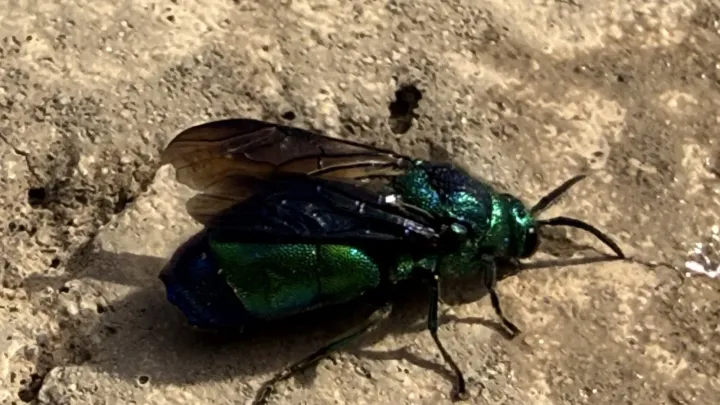
The cuckoo wasp (Chrysis fuscipennis) is a member of the Chrysididae family within the order Hymenoptera. These insects are known for their brilliant, metallic-colored exoskeletons.
They possess a heavily sclerotized cuticle with deep, coarse punctation, which acts as a protective armor against the stings of their hosts.
A distinctive behavioral trait is their ability to curl into a tight ball when threatened, exposing only the tough, armored side of their body to potential attackers.
Measuring between 5 and 12 millimeters, they exhibit shades of green, blue, or copper. The wings, as the name suggests, are often dark or smoky in color.
They are sun-loving insects frequently observed on flower heads, where they feed on nectar, contributing slightly to pollination while scouting for hosts.
What it damages
Chrysis fuscipennis is not a traditional crop pest as it does not feed on plant tissues. However, it is an ecological threat due to its kleptoparasitic nature.
The larvae develop as parasites within the nests of other solitary wasps and bees. They consume the food stores and the developing larvae of the host, killing the host's offspring.
Because the host insects are often vital pollinators, the reduction in their population due to cuckoo wasps can indirectly lead to lower yields in orchards and gardens.
By disrupting the population dynamics of beneficial solitary bees, these wasps can negatively impact the reproductive success of various flowering plants.
They are essentially competing with gardeners who aim to foster healthy populations of native bees and predatory wasps for natural pest control.
When it appears
Adult cuckoo wasps are most active during the warm summer months, aligning their lifecycle with the nesting season of their hosts.
As spring transitions into summer, they emerge from overwintering sites, utilizing solar energy to become highly active and agile during the daylight hours.
The timing of their emergence is tightly synchronized with the emergence of their host species, ensuring the availability of suitable nesting chambers.
They tend to complete one or two generations per season, depending on the climate, with peak activity coinciding with the highest temperatures.
Overwintering usually takes place in protected crevices or hollow stems, where they remain in a state of diapause until environmental cues trigger their emergence.
Signs of infestation
Identifying the presence of Chrysis fuscipennis often requires careful observation of nesting sites used by solitary hymenopterans.
Seeing small, brilliant-metallic wasps buzzing around holes in wood or soil is a clear indicator that a parasitoid may be inspecting the nest.
Signs of infestation include damage to nest entrance plugs or the presence of non-host larval remains within the nesting tunnels of solitary bees.
- Metallic-colored insects near nest sites.
- Interference with host nesting entrances.
- Evidence of parasitized larvae in artificial nests.
Increased frequency of these wasps patrolling a specific area strongly suggests that they have identified a host population in the vicinity.
Control measures
Management of the cuckoo wasp is delicate because they are part of a natural ecosystem that includes other beneficial predatory and pollinating insects.
Avoid broad-spectrum insecticide applications, as these are more likely to kill the beneficial hosts than the hardened, armored cuckoo wasps.
Providing physical protection for bee hotels, such as using mesh screens with small holes, can prevent the cuckoo wasps from reaching the nesting cells.
Maintaining a diverse garden environment ensures that hosts have multiple nesting options, which helps disperse the pressure of parasitism.
In managed garden settings, physically relocating heavily parasitized nest blocks to areas away from primary pollinator sites can help control their local population.
Taxonomy
- Latin name
- Chrysis fuscipennis
- Order
- Hymenoptera
- Family
- Chrysididae
- EPPO code
- CHSSFU
Discussion
No discussions yet — be the first.