
Cuckoo wasp
Chrysis
Description
How to identify
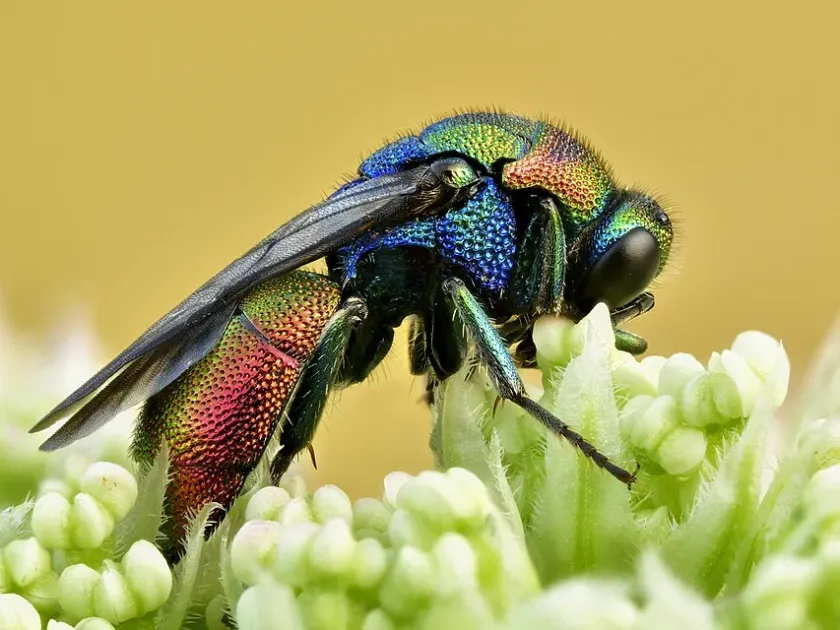
The cuckoo wasp (genus Chrysis) belongs to the family Chrysididae within the order Hymenoptera. They are widely recognized by their brilliant, metallic-colored exoskeletons, which often feature shades of emerald green, blue, or fiery red.
These insects possess a heavily sclerotized, or armored, body with distinct, deep pitting. This thick exterior serves as essential protection against the stings of host insects when the wasp enters their nests to lay eggs.
Adult cuckoo wasps typically measure between 5 to 15 millimeters in length. A defining defensive trait of these wasps is their ability to roll into a tight ball when threatened, shielding their vulnerable undersides.
The abdomen of the cuckoo wasp is anatomically unique, consisting of a reduced number of visible segments. The female's ovipositor is retractable, remaining hidden within the abdominal segments until the moment of egg-laying.
There are over a thousand species in this genus worldwide. While they are visually stunning, their ecological role is strictly kleptoparasitic, meaning they rely on the food stores and larvae of other insects to complete their development.
What it damages
Cuckoo wasps do not feed directly on plant tissues or crops, so they are not considered direct agricultural pests. However, their indirect impact can be significant due to their predatory behavior toward beneficial pollinators.
As kleptoparasites, cuckoo wasp larvae infiltrate the nests of solitary bees and wasps. They consume the pollen and nectar stores gathered by the host, and often destroy the host's larvae in the process.
This reduction in the population of efficient pollinators directly threatens crop productivity. Plants that rely on cross-pollination, such as fruit trees and berry bushes, may see reduced yields and poor fruit set.
In environments where solitary bees are managed for pollination services, the presence of cuckoo wasps can become a limiting factor for population growth. They disrupt the natural balance by effectively killing off the workers.
Therefore, their damage is characterized by the degradation of the garden's ecosystem services, specifically the loss of the insects responsible for plant fertilization and fruit development.
When it appears
Cuckoo wasp activity is closely aligned with the life cycle of their hosts. They are most commonly observed during warm, sunny weather from late spring through mid-summer, matching the peak activity of solitary bees.
Adults prefer sun-drenched areas where host nests are found, such as weathered wooden structures, cracks in masonry, or dried plant stems. They are extremely agile and swift fliers during daylight hours.
The life cycle involves complete metamorphosis: egg, larva, pupa, and adult. They typically overwinter as pupae or adults inside the host's nest, ensuring protection from winter conditions.
Most species produce one generation per year, though warmer climates may allow for a second generation. The synchronization with host emergence is critical to their successful reproduction.
Monitoring their appearance is possible by observing areas with high bee nesting activity. Their presence is usually an indicator that a specific host population is currently active in the immediate vicinity.
Control measures
Direct chemical eradication of cuckoo wasps is generally discouraged, as indiscriminate pesticide use will harm the very pollinators one aims to protect. The focus should be on ecological management.
The best strategy involves fostering robust populations of beneficial pollinators. By providing diverse floral resources and healthy nesting sites, the overall ecosystem becomes more resilient to parasitic pressure.
When managing bee nesting sites, such as bee hotels, physical barriers like fine mesh can be used to prevent cuckoo wasps from entering while allowing smaller beneficial insects to navigate through.
Avoid applying broad-spectrum insecticides, especially during the flowering season. Keeping the garden free of systemic toxins ensures that the natural predator-prey balance remains in favor of the pollinators.
- Maintain cleanliness in nesting areas for solitary bees.
- Avoid broad-spectrum pesticide applications.
- Provide diverse native nectar plants to strengthen pollinator health.
- Use physical exclusion methods for managed nesting sites.
Taxonomy
- Latin name
- Chrysis
- Order
- Hymenoptera
- Family
- Chrysididae
- EPPO code
- CHSSSP
Discussion
No discussions yet — be the first.