
Northern snakehead
Channa argus
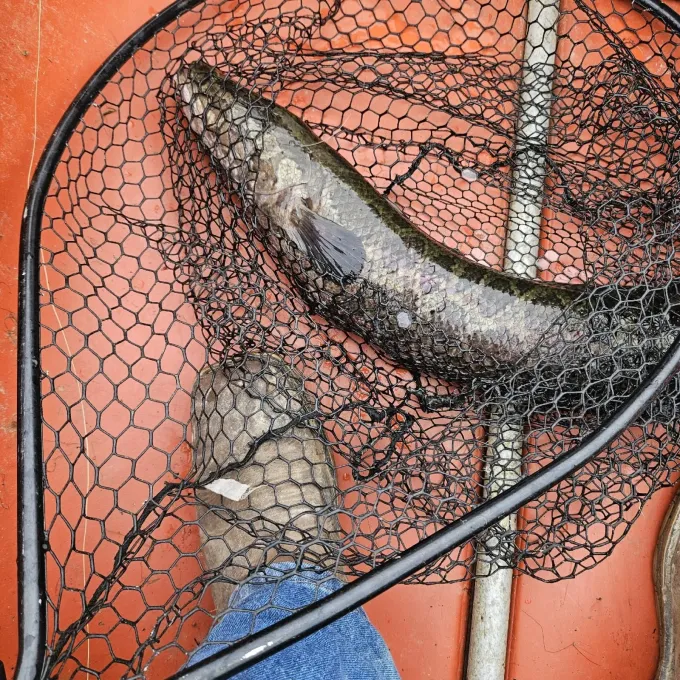
Description
How to identify
The Northern snakehead (Channa argus) belongs to the order Perciformes and the family Channidae. It is a large predatory freshwater fish characterized by an elongated, scaled body and a flattened, snake-like head.
Adult specimens can reach lengths of over one meter and weigh up to 10 kilograms. Their coloration ranges from yellow-brown to dark olive with dark blotches, providing excellent camouflage among aquatic vegetation.
A unique biological trait is its suprabranchial organ, which allows the fish to breathe atmospheric oxygen. This adaptation enables the snakehead to survive in hypoxic water conditions and even move across moist land for short distances.
It is a thermophilic species that thrives in stagnant or slow-moving waters densely populated with macrophytes. The fish exhibits extreme environmental resilience, including the ability to overwinter by burrowing into bottom sediments.
Reproduction occurs during the summer months. Both parents build nests from aquatic vegetation and actively defend their eggs and fry, resulting in exceptionally high survival rates for the offspring.
What it damages
While not a direct pest to agricultural crops, the Northern snakehead poses a severe threat to aquaculture, commercial fish farms, and irrigation systems where fish are reared.
The primary damage is the predatory depletion of valuable fish species such as carp and other farmed cyprinids. As an opportunistic feeder, it can wipe out entire populations of commercial fish in enclosed environments.
In rice-paddy farming where fish are integrated into the system for biological pest control, the snakehead can penetrate the irrigation network and consume the juvenile fish intended for cultivation.
The invasion of this species leads to the destabilization of local aquatic ecosystems. By outcompeting or consuming native fish, the snakehead disrupts food webs, which can indirectly affect water quality and the overall state of the surrounding landscape.
In regions where the species is non-native, it is classified as a highly dangerous invasive object capable of causing significant economic losses to the aquaculture industry.
When it appears
Peak activity for the Northern snakehead occurs during the warmer months, typically from late spring to early autumn, when water temperatures support high metabolic rates.
The spawning period takes place between May and July, during which the fish are most aggressive, defending their nesting territories and hunting intensively to support their energetic requirements.
As autumn progresses and water temperatures drop, the fish's activity decreases. It prepares for winter by seeking deep waters or burrowing into the substrate to enter a dormant state.
In early spring, as temperatures rise, the fish emerges from hibernation and begins aggressive feeding, making the early growing season a critical time for monitoring and control.
Agricultural and aquaculture management should focus on the early-season period to prevent the migration and establishment of the species within irrigation infrastructures.
Signs of infestation
A primary indicator of snakehead presence is the sudden decline in the numbers of local fish populations within ponds or irrigation canals, often without any outward signs of disease.
The discovery of neatly constructed nests made of aquatic plants in shallow areas is a direct sign of active breeding populations in the vicinity.
Visual observation of the fish surfacing to gulp air, often accompanied by a distinct splash, is a behavioral hallmark of the species during the warm season.
Damaged nets or predator-resistant barriers in fish farms can indicate the presence of this powerful predator, which possesses strong jaws capable of tearing through standard netting materials.
Finding juvenile snakeheads during routine irrigation channel maintenance or water drainage operations is a clear confirmation of an established infestation.
Control measures
The most effective management strategy involves installing fine-mesh physical barriers at the intakes of irrigation canals and pond systems to prevent the migration of adults and juveniles.
In cases of infestation, total drainage of ponds followed by bed disinfection is the most effective method for complete population eradication.
Commercial fishing efforts, utilizing nets, seines, and electrofishing, are necessary measures for reducing population density in areas where full drainage is not feasible.
Maintaining clean water systems by removing excessive aquatic vegetation can reduce the habitat suitability for the snakehead, making it less attractive for nesting and hunting.
- Install physical mesh barriers at water entry points.
- Conduct regular ichthyofauna surveys in aquaculture ponds.
- Drain and sanitize ponds to eliminate established populations.
Taxonomy
- Latin name
- Channa argus
- Family
- Channidae
- EPPO code
- CHNNAR
Discussion
No discussions yet — be the first.