
Beet flea beetle
Chaetocnema chlorophana
Description
How to identify
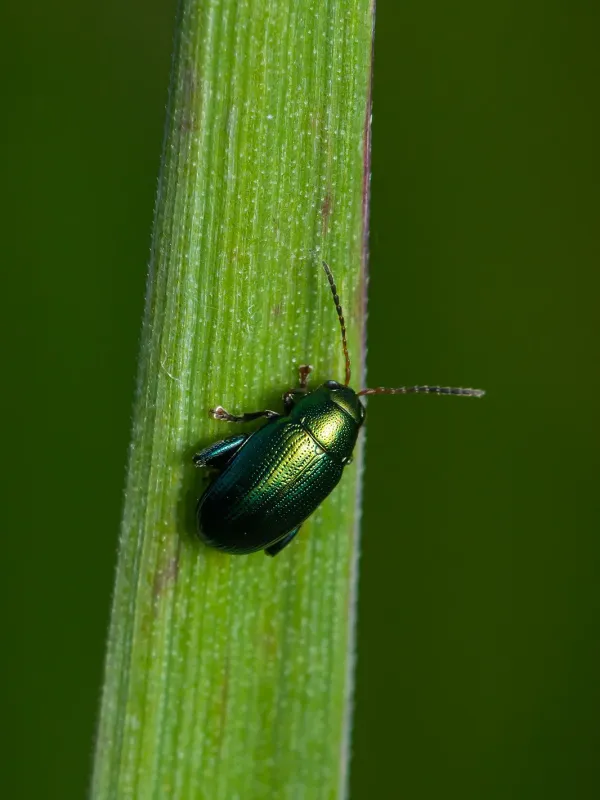
The beet flea beetle (Chaetocnema chlorophana) belongs to the Chrysomelidae family, order Coleoptera. These are small, highly mobile beetles known for their jumping ability.
Adult beetles typically range from 1.5 to 2.5 mm in length. Their bodies display a metallic luster, varying in color from bronze-green to black, with fine rows of punctures on the elytra.
Larvae are elongated, white to yellowish in color, with a characteristic brown head capsule. They grow up to 4 mm and live primarily in the soil around the roots.
The eggs are microscopic and oval-shaped, usually deposited by the female in the soil or on the underside of leaves of host plants.
Identifying them involves looking for their characteristic jumping movement on warm, sunny days, which is a hallmark of this flea beetle species.
What it damages
This beetle primarily affects plants in the Amaranthaceae family, with a significant preference for sugar, fodder, and table beets.
Adult beetles cause damage to cotyledons and early leaves, creating numerous small, "shot-hole" type perforations that hinder photosynthesis.
The larvae feed on the fine root hairs and lateral roots of the beet plants, which can seriously stunt the development of young crops.
Under heavy infestation, entire fields of seedlings can be lost, as the combined damage to leaves and roots overwhelms the plant's resources.
In dry spring conditions, the crop is particularly vulnerable, as damaged seedlings struggle to recover their leaf area and root function efficiently.
When it appears
Adult beetles overwinter in the soil or under plant debris, emerging in early spring as soon as soil temperatures reach approximately 8–10°C.
Their peak emergence typically coincides with the sprouting of beet seeds, making the seedling stage the most critical window for pest pressure.
The lifecycle, including egg, larval, pupal, and adult stages, varies in duration depending on regional temperature and humidity levels.
Throughout the summer, these insects are known to migrate between fields, which extends the infestation period to crops sown at different times.
As temperatures drop in the autumn, the beetles relocate to sheltered overwintering sites to survive the cold until the next season.
Signs of infestation
The most visible sign of infestation is the presence of numerous small holes or ulcers on the cotyledons and the first true leaves of the seedlings.
Leaves may show significant signs of stress, such as yellowing, curling, and eventually drying out when the flea beetle population is high.
A stunted appearance of the entire crop compared to healthy areas is often a result of both foliage feeding and larval root damage.
On sunny days, one can observe the beetles actively jumping away when the foliage is disturbed, which serves as a quick field diagnostic tool.
- Multiple tiny puncture holes on leaves.
- Wilting or yellowing of the cotyledon stage.
- General poor growth and stand thinning in the field.
Control measures
Seed treatment with systemic insecticides is the most effective preventative method to protect young seedlings from early-season flea beetle damage.
Cultural practices, such as ensuring optimal planting dates for rapid germination and establishment, are crucial to move past the vulnerable seedling phase quickly.
Strict weed control is necessary, as wild Amaranthaceae species often serve as an initial food source and breeding ground for the flea beetles.
Monitoring using yellow sticky traps helps in timing the application of foliar insecticides, which should be applied when thresholds are reached.
Crop rotation remains a fundamental strategy, ensuring that beets are not grown on the same field in consecutive years to disrupt the pest's lifecycle.
Taxonomy
- Latin name
- Chaetocnema chlorophana
- Order
- Coleoptera (beetles)
- Family
- Chrysomelidae
- EPPO code
- CHAECH
Discussion
No discussions yet — be the first.