
Larch casebearer
Cecidomyia pumila
Description
How to identify
The Larch casebearer (Coleophora laricella) is a destructive pest of coniferous trees, belonging to the order Lepidoptera and the family Coleophoridae. The adult is a tiny moth with narrow, fringed wings.
The insect is named for the characteristic portable case that the larva constructs from bits of needles and silk. This case serves as a protective habitat during its development.
The larvae are small, reaching a length of only 4–6 mm, typically yellowish-brown with a dark head. They move along the needles, dragging their cases, which makes them highly resistant to environmental stress.
The life cycle involves a complete metamorphosis: egg, larva, pupa, and adult. The adults are nocturnal, making them difficult to detect without specialized traps or close observation.
High populations can cause significant foliage damage, as these insects can overwinter effectively in their cases, ensuring survival even in harsh climatic conditions.
What it damages
The primary host is the larch (Larix), although when population densities are high, the insect can attack other conifers. The damage is caused by larvae feeding on the interior tissue of the needles.
As the larva consumes the interior, the needles turn pale, then yellow, and eventually dry out and die. A single larva can damage numerous needles throughout its life cycle.
Visible damage makes the tree appear burnt or prematurely withered. This drastically reduces the photosynthetic surface, leading to weakened growth and reduced tree vigor.
Severe and repeated infestations can lead to top-dieback, structural deformity, and overall susceptibility to secondary pests like bark beetles or pathogens.
In nursery settings, Larch casebearer outbreaks result in severe economic losses by deforming young saplings and rendering them unfit for sale or planting.
When it appears
Adult moths emerge in late spring or early summer, coinciding with the flushing of new needles, where females lay their eggs.
Larvae hatch in summer, begin feeding on the new foliage, and continue to enlarge their protective cases as they grow larger.
By autumn, larvae migrate to the twigs and secure their cases with silk to survive the winter. They remain in this dormant, protective state until the following spring.
The most critical feeding period occurs in early spring, as larvae resume activity with the return of warmer weather, feeding intensively on needles and buds.
Pupation takes place within the case, usually attached to the needles, after which the new generation of adults emerges to begin the cycle again.
Signs of infestation
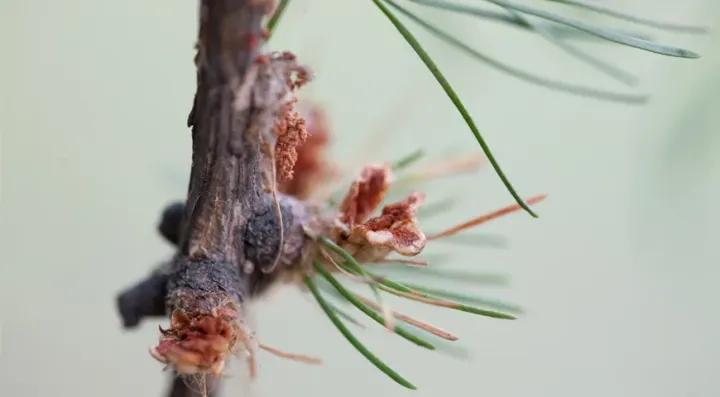
The primary symptom is the appearance of hollow, yellow or grayish needles on the tree, often seen hanging down due to larval feeding.
The presence of small, needle-like tubes (cases) attached to the twigs or foliage is the most definitive sign of an active infestation.
In spring, affected trees often exhibit a sparse, "thin" canopy appearance, as the needles have been consumed or damaged during the early feeding stage.
Frass (larval waste), which looks like fine dark dust, may accumulate on lower branches or the ground underneath heavily infested trees.
Trees that appear to have a brownish or copper hue in mid-spring, despite having healthy green buds, are likely harboring casebearer larvae.
Control measures
Effective control involves the application of systemic or contact insecticides during the early spring, precisely when the larvae emerge from their winter dormancy.
Pruning and destroying heavily infested branches can be an effective mechanical control method for smaller trees or early-stage infestations.
Biological control methods, such as the use of Bacillus thuringiensis sprays, are suitable for managing populations in parks and residential areas.
Promoting tree health through proper irrigation, balanced fertilization, and avoiding drought stress helps the tree withstand potential pest damage.
- Monitor adult moth flights using pheromone or light traps to time insecticide applications.
- Encourage natural predators, such as insectivorous birds and parasitic wasps, which feed on the larvae.
- Ensure strict nursery inspection protocols to prevent the introduction of infested plant material.
Taxonomy
- Latin name
- Cecidomyia pumila
- Order
- Diptera (flies)
- Family
- Cecidomyiidae
- EPPO code
- CECIPU
Discussion
No discussions yet — be the first.