
Gall midges
Cecidomyia
Description
How to identify
Gall midges (Cecidomyiidae) are a large family of dipteran insects comprising thousands of species, many of which are serious agricultural pests. Adult insects typically appear as tiny, fragile midges with long legs and antennae, rarely exceeding 3 mm in length.
The larvae of gall midges have a specific morphology: they are legless, often bright orange, yellow, or white. The larval body is spindle-shaped, and a diagnostic feature called the "sternal spatula" is often visible on the ventral side of the anterior end, which helps them penetrate plant tissues.
Systematically, this family belongs to the order Diptera, family Cecidomyiidae. They include both highly host-specific species that target a single crop and polyphagous species that damage a wide range of plant hosts.
Identification to the species level is often difficult due to the microscopic size of the adults. Agronomists frequently rely on the analysis of galls — abnormal plant tissue growths formed in response to larval feeding or secretions.
Many gall midge species exhibit sexual dimorphism, but in field conditions, the larval stages are most commonly detected as they live protected inside stems, leaves, or flower buds of the host plants.
What it damages
Gall midges damage a vast array of agricultural crops. Economically important species include the Hessian fly, which causes severe damage to cereal crops, and the alfalfa gall midge, which significantly reduces seed production.
The pest attacks a broad spectrum of plants, including small grains, fruit and berry trees (currants, raspberries), vegetable crops, and ornamental flowers in gardens and landscapes.
Larvae feed on plant juices, injecting specific enzymes that disrupt physiological processes. This leads to stunted growth, deformation of plant organs, and reduced photosynthetic activity.
Damaged plant tissues often become entry points for secondary infections, such as bacterial or fungal diseases. Consequently, the plant not only loses biomass but may die completely under high infestation pressure.
The economic impact manifests as reduced grain yields, loss of marketability in fruits and berries, and a sharp decline in seed quality, making the management of these pests critical for agricultural profitability.
When it appears
The life cycle of gall midges is tightly synchronized with the phenological stages of their host plants. Adult emergence usually coincides with the start of the growing season or the flowering period of the specific crop.
They most commonly overwinter as larvae in the soil, within plant debris, or under the bark of trees. As temperatures rise in spring, the larvae pupate, and adults emerge shortly thereafter.
Adults have a short lifespan, focusing entirely on mating and egg-laying. Females deposit eggs in clusters on young shoots, leaf axils, or directly into flower buds, targeting the most vulnerable tissues.
Depending on temperature and humidity, one to several generations can occur within a single season. Warm and humid weather conditions are particularly favorable for mass reproduction of the pest.
The greatest damage typically occurs during periods of rapid plant growth, when metabolic processes are most active, and plant tissues are tender and easily accessible to the larvae.
Signs of infestation
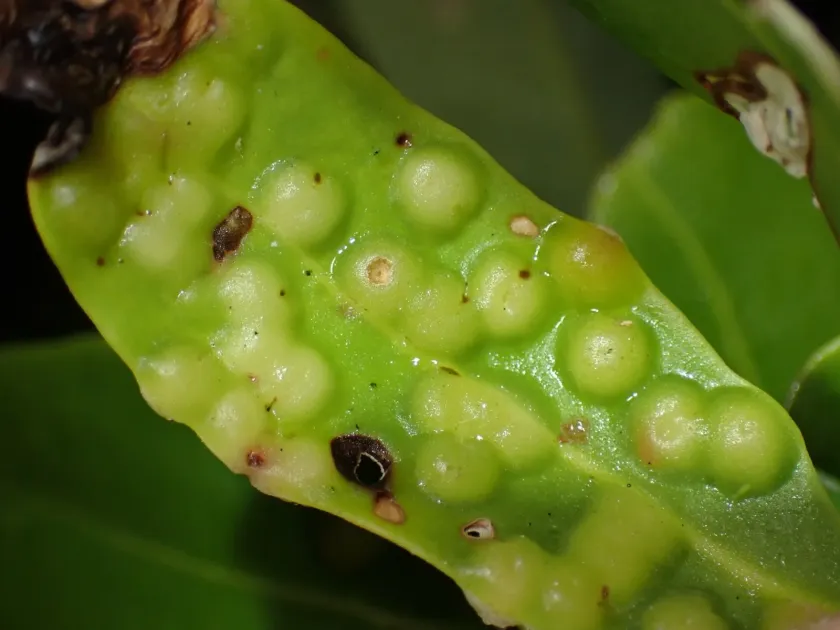
The primary sign of gall midge infestation is the formation of specific galls — swellings, lumps, or abnormal growths on leaves, stems, or buds. These structures provide the larvae with protection from environmental factors.
Symptoms often include twisting of stems, premature yellowing, and leaf drop. In cereal crops, infested stems may dry out prematurely, leading to shriveled or empty ears.
On berry bushes, larval damage to flower buds leads to bud drop or the formation of malformed berries, which significantly reduces the yield of the garden plot.
- Appearance of round or cone-shaped galls on leaves.
- Deformation and curling of terminal leaves.
- Reddening or yellowing of the affected tissue areas.
- Stunted internode growth and general poor plant development.
- Presence of tiny, legless larvae inside plant tissues or axils.
When inspecting crops, it is essential to check the base of the plant and internal stem cavities, where pest colonies often hide and remain invisible during superficial field scouting.
Control measures
Integrated pest management (IPM) for gall midges begins with cultural practices. Proper crop rotation and deep autumn plowing of the soil are recommended to destroy pupae overwintering in the ground.
Timely harvesting and removal of crop residues are crucial, as these materials often harbor the main reservoir of the pest for the next growing season.
Biological control methods include the use of natural enemies, such as parasitoid wasps, which can effectively suppress midge populations in natural or semi-managed environments.
When economic thresholds are reached, chemical insecticides with systemic or contact action may be employed. Applications must be timed accurately to target the adult flight period before larvae penetrate deep into plant tissues.
The use of resistant cultivars and hybrids is considered the most sustainable and cost-effective strategy for long-term population control of gall midges in large-scale agricultural systems.
Taxonomy
- Latin name
- Cecidomyia
- Order
- Diptera (flies)
- Family
- Cecidomyiidae
- EPPO code
- CECISP
Discussion
No discussions yet — be the first.