
Willow-carrot aphid
Cavariella aegopodii
Description
How to identify
The willow-carrot aphid (Cavariella aegopodii) is a small, soft-bodied insect belonging to the Aphididae family, primarily known as a pest of umbelliferous crops.
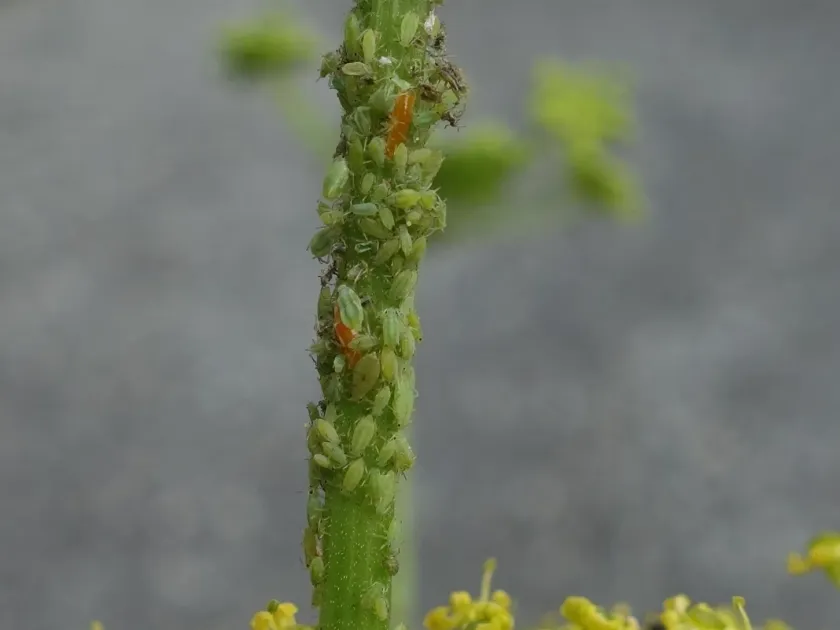
These aphids are typically pale green or yellowish-green, with adult wingless females measuring around 1.5 to 2.5 mm in length, often living in dense colonies.
A distinctive morphological feature is the supracaudal process—a small, upward-curved projection on the abdomen—which helps specialists distinguish this species from others.
The life cycle involves an alternation of hosts: it overwinters as eggs on willow (Salix) trees and migrates to herbaceous plants in the summer.
Spring generations hatch on willows and produce winged offspring, which are responsible for the dispersal to primary carrot and parsley fields.
What it damages
This pest mainly attacks members of the Apiaceae family, causing direct damage by sucking phloem sap from leaves, stems, and flower stalks of the host plants.
The feeding process leads to severe curling, yellowing, or reddening of leaves, which significantly inhibits the photosynthetic capacity of the carrot plants.
Beyond physical damage, the aphid is a primary vector for the carrot red leaf virus, which causes severe stunting and discoloration, often ruining the entire crop.
Heavy infestations on young plants can result in plant death, while late-season attacks lead to poor root quality and low marketability of the produce.
The accumulation of honeydew secreted by aphids provides a substrate for sooty mold growth, which further reduces the vigor and health of the vegetable crops.
When it appears
The life cycle begins in spring on willow trees, where the aphids develop through several generations before wing formation is triggered by overcrowding.
The mass migration to carrot fields typically occurs in early to mid-summer, depending on the climatic conditions and regional temperature patterns.
During the summer months, the population thrives on carrot crops, producing multiple generations of wingless viviparous females that reproduce rapidly.
As day length decreases and temperatures drop in autumn, winged sexuparae are produced to migrate back to the winter host, the willow tree.
Dry, warm conditions are particularly favorable for rapid population expansion, allowing the aphid to colonize large areas within a few weeks.
Signs of infestation
The most common symptom is the severe curling and distortion of the younger carrot foliage, often accompanied by a distinct yellow or reddish hue.
Inspecting the underside of the leaves usually reveals colonies of tiny, pale green insects huddled around the veins and leaf petioles.
- Leaf curling and deformation.
- Sticky honeydew patches on foliage.
- Presence of sooty mold growth.
- Overall stunted growth of the carrot crop.
- Reduced root size and poor development.
When infestation is severe, the canopy may look stunted, and the overall yield of the carrot crop is significantly compromised compared to healthy plants.
Control measures
Cultural control practices include the removal of wild umbelliferous weeds around field margins to eliminate secondary host plants for the aphid population.
Maintaining spatial isolation between carrot fields and willow plantations can effectively reduce the risk of early-season migration and colonization.
Biological control methods involve promoting natural enemies such as ladybeetles, lacewings, and hoverflies, which can naturally suppress aphid numbers.
If economic thresholds are reached, the use of systemic insecticides is recommended to ensure the protection of the plant's internal tissues from sap-sucking pests.
Farmers should implement a regular scouting program to detect aphids early, allowing for timely and precise interventions that minimize pesticide reliance.
Taxonomy
- Latin name
- Cavariella aegopodii
- Order
- Hemiptera (bugs, aphids, leafhoppers)
- Family
- Aphididae
- EPPO code
- CAVAAE
Discussion
No discussions yet — be the first.