
Tortoise beetle
Cassida
Description
How to identify
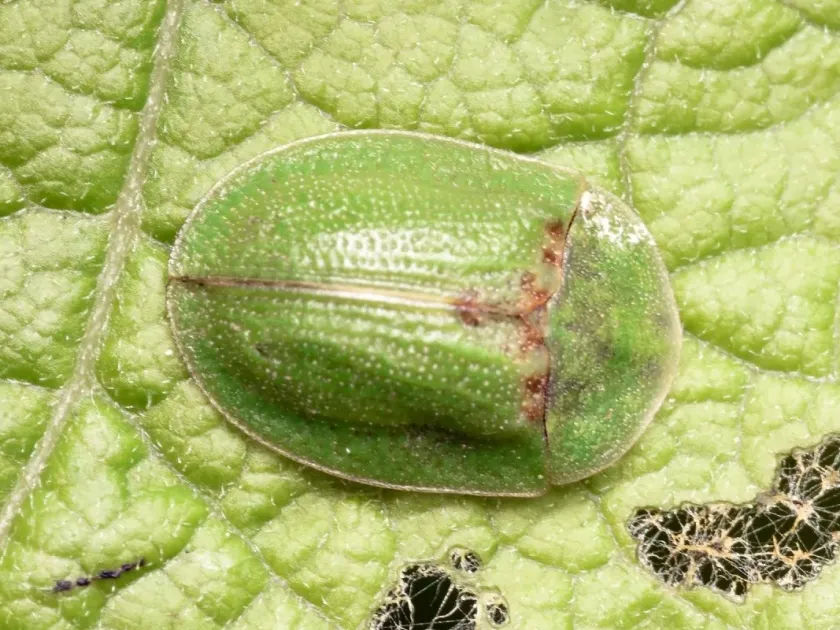
The genus Cassida (tortoise beetles) belongs to the Chrysomelidae family, order Coleoptera. Adult beetles are characterized by a flattened, oval body shape where the pronotum and elytra extend significantly, covering the head and legs, resembling a protective shield.
The coloration of adults is usually green, yellow, or brownish, which provides effective camouflage on leaves. During development, larvae pass through several instars and possess flattened bodies with lateral spines.
A biological feature of the larvae is a special appendage at the end of the abdomen used to hold feces and molted skins. This protective shield helps the larvae survive predation and high solar radiation.
Adult beetles overwinter in the soil, under plant debris, or in leaf litter. In spring, they emerge from diapause, begin feeding on young leaves, and subsequently initiate mating and oviposition.
The lifecycle includes complete metamorphosis: egg, larva, pupa, and adult. Depending on climatic conditions, tortoise beetles may undergo one or several generations per season.
What it damages
Primary host plants for many species in this genus include members of the Amaranthaceae family (especially beets) and Asteraceae. In agriculture, the beet tortoise beetle is the most prominent species.
This pest affects sugar, fodder, and garden beet crops. Furthermore, insects can feed on weeds such as lambsquarters and orach, which serve as initial reservoirs for the pest population.
Beyond beets, various species of tortoise beetles can be found on mint, sage, artichokes, and other herbaceous plants. High population density can lead to significant foliage loss.
Damage is most severe during the seedling emergence stage and the formation of the first true leaves. Weakened plants become more susceptible to fungal and viral pathogens.
In cases of massive infestations, tortoise beetles can significantly reduce the photosynthetic capacity of plants, leading to smaller root development and lower overall sugar yield.
Signs of infestation
A characteristic sign of tortoise beetle infestation is the appearance of circular holes in leaves, which the insects chew while remaining on either the underside or surface of the lamina. Heavy damage turns leaves into a lace-like structure.
During the early vegetative stages, adults are easily spotted; they often drop to the ground and feign death when disturbed. Their distinct shield shape makes them easily recognizable.
Larvae feed by skeletonizing the leaves, leaving larger veins intact. On the underside of leaves, one can often find egg clusters covered by a thin film of the female's excrement.
The presence of larvae carrying "shields" made of excrement is an absolute diagnostic indicator for this specific pest. This visual marker differentiates them from other leaf-eating insects.
Fields may show localized infestation patches that gradually expand. Leaves of affected plants often turn yellow, wilt, and dry out prematurely, reducing the plant's overall vigor.
Control measures
The primary agrotechnical method for control is the eradication of Amaranthaceae weeds around fields. Thorough soil cultivation in the autumn reduces the number of overwintering adults.
Adherence to crop rotation is essential, preventing the planting of beets in the same location for consecutive years. Early planting allows plants to reach a more resilient stage before peak beetle activity.
Once the economic threshold of damage is reached, systemic or contact-stomach insecticides are employed. Products based on pyrethroids and organophosphorus compounds are typically effective.
Biological control methods involve the use of entomophages, such as parasitic wasps that attack the eggs and larvae of tortoise beetles, naturally limiting their population growth.
- Maintaining spatial isolation of crops.
- Regular field monitoring during the seedling phase.
- Use of high-quality, certified planting material.
Taxonomy
- Latin name
- Cassida
- Order
- Coleoptera (beetles)
- Family
- Chrysomelidae
- EPPO code
- CASSSP
Discussion
No discussions yet — be the first.