
Graceful Willowfly
Capnia gracilaria
Description
How to identify
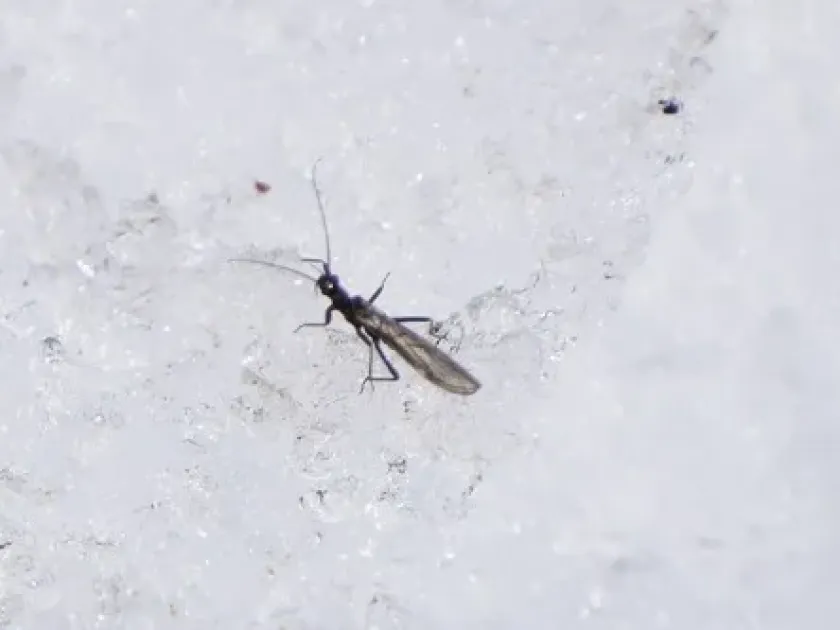
The graceful willowfly (Capnia gracilaria) belongs to the order Plecoptera, family Capniidae. These are small, slender insects with a flattened body structure and two pairs of wings that fold flat over the abdomen when at rest.
Adults typically measure between 5 and 10 millimeters in length. Their coloration ranges from dark brown to black, providing camouflage against the damp substrates they inhabit. A distinctive feature is the presence of long cerci at the tip of the abdomen.
The mouthparts of the adults are weakly developed, as their primary focus during this stage is reproduction rather than feeding. They are often among the first insects to emerge in early spring, sometimes appearing near snowmelt.
The larval stage is strictly aquatic. Larvae possess a chewing mouthpart, long antennae, and three pairs of legs equipped for crawling across riverbeds or over submerged debris and vegetation.
Scientific identification requires examining the male genitalia, as external morphology can be quite similar across closely related species within the Capniidae family. This is essential for accurate field sampling.
What it damages
Capnia gracilaria is not considered a significant agricultural pest. It primarily inhabits natural streams and freshwater environments, rarely interacting with commercial crop species in a damaging way.
Minor impacts may occur in nursery settings if water sources used for irrigation are contaminated with high densities of larvae, potentially causing minor mechanical interference with pumping or filtration systems.
There is no evidence of this species feeding on commercially important crops. Any perceived damage to plants near water sources is usually caused by other, more common polyphagous insect species found in the same riparian habitats.
The presence of these insects is often considered a sign of high water quality rather than a pest problem. They are sensitive to pollutants, meaning their presence indicates a healthy aquatic ecosystem.
Overall, the economic damage caused by the graceful willowfly is negligible. Their role in the ecosystem as decomposers and a food source for fish far outweighs any potential minor nuisance they might pose to agriculture.
When it appears
The adult activity period for Capnia gracilaria is limited to the late winter and early spring. This unique phenology allows them to exploit environments before many other insect species become active.
The life cycle encompasses an egg stage, a prolonged aquatic larval stage lasting up to a year, and a relatively short-lived adult phase. Larvae undergo multiple instars throughout their development.
Environmental conditions, specifically water temperature and oxygen concentration, are critical for larval development. They thrive in cold, fast-flowing water, which makes them highly seasonal in their emergence patterns.
Oviposition typically occurs directly into the water or on stones near the water's edge. The eggs are resilient, allowing them to withstand fluctuating environmental conditions during the incubation period.
As larvae approach maturity, they become more active in benthic zones. The transition to the adult stage is synchronized with temperature increases, leading to mass emergence events in early spring.
Control measures
Given that the graceful willowfly is not a threat to crops, targeted chemical control is unnecessary and discouraged. Indiscriminate use of insecticides can devastate aquatic biodiversity and harm beneficial species.
The most effective management strategy involves maintaining the physical integrity of irrigation channels. Clearing debris and preventing excess sedimentation helps manage population levels in areas where they might be a nuisance.
Farmers should prioritize mechanical solutions, such as fine-mesh filtering of irrigation water, rather than chemical intervention, to prevent insects from entering distribution systems.
- Mechanical cleaning of irrigation channels.
- Screening water intake points.
- Maintaining natural buffers along stream banks.
- Regular water quality monitoring for agricultural use.
Long-term control is best achieved by managing the riparian zone to prevent excessive organic matter accumulation, which otherwise creates an ideal habitat for larval development and population growth.
Taxonomy
- Latin name
- Capnia gracilaria
- Family
- Capniidae
- EPPO code
- CPNIGR
Discussion
No discussions yet — be the first.