
Thistle aphid
Capitophorus elaeagni
Description
How to identify
The thistle aphid (Capitophorus elaeagni) is a species of aphid belonging to the family Aphididae (order Hemiptera). It is a migratory insect that alternates between primary and secondary hosts.
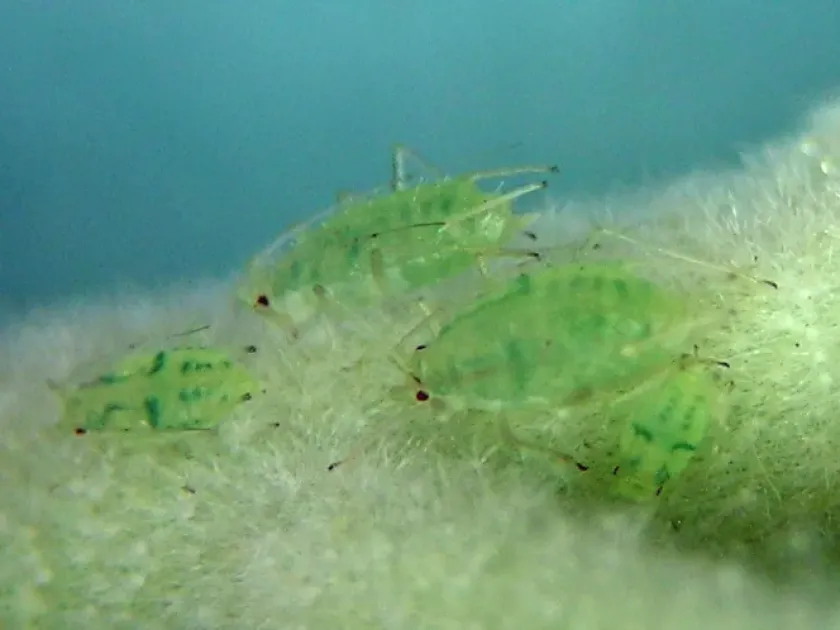
Adults are typically small, measuring about 1.5–2 mm in length. Their bodies are elongated and can range in color from light green to yellowish, often marked with dark patterns.
A key identifying feature of this species is its long, club-shaped antennae that exceed the body length, alongside relatively short siphunculi located at the rear of the abdomen.
The life cycle involves incomplete metamorphosis. Nymphs resemble miniature adults but are smaller in size and wingless during the initial stages of development.
Colonies contain a mix of wingless and winged morphs. The emergence of winged adults is a response to environmental stress, high population density, or the need for seasonal migration.
What it damages
The primary host is the Russian olive (Elaeagnus angustifolia), where the aphid overwinter as eggs. In spring, the hatching nymphs begin their colonization process.
During summer, the aphids migrate to secondary hosts, which include various plants from the Asteraceae family. Artichokes and safflower are among the most economically significant crops affected.
The aphid also utilizes common weeds such as thistles (Cirsium spp.) as alternative hosts, which act as reservoirs that maintain the population throughout the growing season.
On artichoke plantations, the damage is severe as aphids feed on the undersides of leaves and on developing flower heads, withdrawing nutrients and stunted growth.
Besides physical damage, the aphid is a known vector for several plant viruses, which often lead to greater crop loss through systemic infection than the direct feeding of the insects themselves.
When it appears
Overwintering occurs in the egg stage, primarily on the twigs or near the buds of the Russian olive. Hatching happens synchronously with host bud break in early spring.
Spring and early summer are characterized by the production of several generations of wingless viviparous females, enabling rapid exponential population growth.
As summer progresses, winged forms develop to facilitate migration to herbaceous hosts. Peak infestations on artichoke fields are typically observed in June and July.
Autumn triggers the production of sexual morphs (gynoparae). These winged females migrate back to the primary host (Russian olive) to mate and lay overwintering eggs.
The cycle ensures the species' survival through winter by utilizing the woody structure of the primary host, while maximizing reproduction on succulent plants during the warmer months.
Signs of infestation
Visible signs of infestation include the curling and yellowing of young leaves as the plant reacts to the persistent extraction of sap by the aphid colonies.
Large clusters of aphids are easily detected on the underside of leaves, accompanied by the presence of honeydew, a sticky substance excreted during feeding.
The accumulation of honeydew often promotes the growth of sooty mold, a dark fungal coating that covers leaves and interferes with photosynthesis and overall plant health.
Infested artichoke flower heads become deformed, stunted, and fail to reach market quality, leading to significant yield reduction for growers.
General signs of severe infestation include premature leaf senescence, yellowing, and a noticeable decline in the vigor and total biomass of the crop.
Control measures
Effective management includes spatial separation by avoiding planting artichoke fields in the immediate vicinity of Russian olive windbreaks or ornamental plantings.
Cultural control involves the rigorous removal of weeds within the Asteraceae family, such as thistles, from field margins to eliminate secondary host reservoirs.
Biological control can be enhanced by encouraging natural predators, including lady beetles, lacewings, and hoverflies, which can effectively reduce population spikes.
Chemical control is required when monitoring indicates that the economic injury level has been exceeded, using systemic insecticides labeled for use on edible crops.
- Monitor fields regularly using yellow sticky traps.
- Maintain strict weed control programs.
- Apply targeted insecticides when colonies are first detected.
Taxonomy
- Latin name
- Capitophorus elaeagni
- Order
- Hemiptera (bugs, aphids, leafhoppers)
- Family
- Aphididae
- EPPO code
- CAPIEL
Discussion
No discussions yet — be the first.