
Mango psyllid
Calophya mangiferae
Description
How to identify
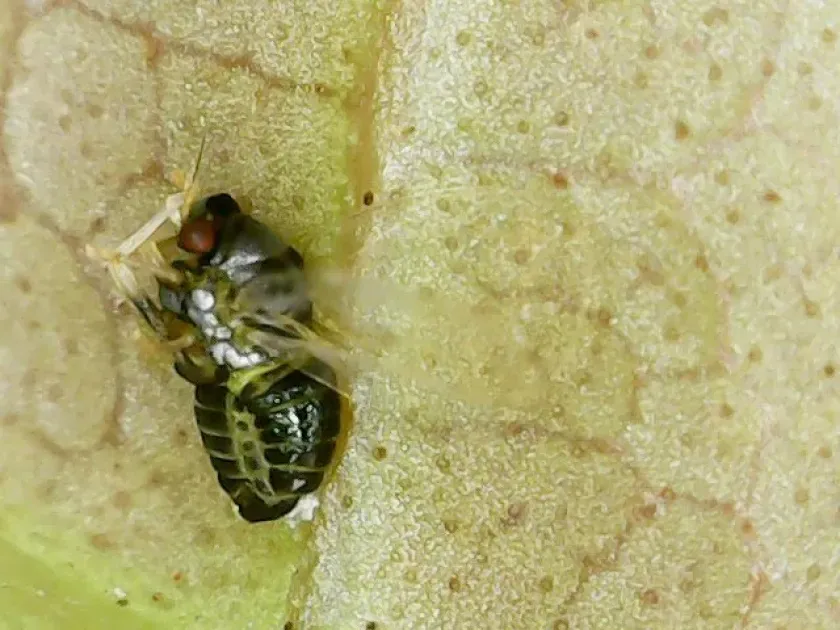
The Mango psyllid (Calophya mangiferae) belongs to the order Hemiptera and the family Psyllidae, commonly known as jumping plant lice.
Adult insects are small, mobile organisms equipped with strong hind legs that allow them to jump quickly when disturbed, which is a characteristic behavioral trait.
Their bodies are typically yellowish to orange-brown, providing effective camouflage against the young, tender leaves of the mango tree where they feed.
Nymphal stages are often sessile and surrounded by protective waxy secretions, which act as a barrier against external environmental stressors and predators.
Accurate identification is based on observing the characteristic damage patterns and the presence of these distinct waxy coverings on the host plant leaves.
What it damages
This pest is highly specialized and primarily attacks mango trees (Mangifera indica), focusing its activity on young flush and developing plant tissues.
By inserting their mouthparts into the plant tissue, psyllids extract essential sap, which directly deprives the plant of nutrients needed for vigorous growth.
Severe infestations lead to the deformation of leaves, causing them to curl, thicken, and eventually lose their physiological function due to cell necrosis.
Damage to the reproductive parts of the tree, specifically flowers and buds, causes shedding and inhibits fruit set, resulting in significant economic losses.
The accumulation of honeydew secreted by the nymphs creates a perfect environment for the growth of sooty mold, which blocks sunlight and stifles photosynthesis.
When it appears
The population dynamics of Calophya mangiferae are strictly synchronized with the vegetative growth cycles of mango trees throughout the growing season.
High temperatures combined with optimal humidity levels significantly accelerate the life cycle, leading to rapid increases in psyllid populations.
The pest is most active during the spring and early summer flushes, which provide the most nutritious and soft tissue necessary for the development of nymphs.
Regular surveillance during these critical periods is essential for detecting early-stage infestations before they spread throughout the orchard.
During the cooler or drier months, the population may decline, but the pest typically persists in low numbers, hidden in the protected areas of the tree canopy.
Signs of infestation
Initial signs of infestation appear as small chlorotic spots or stippling on the leaves, indicating the exact sites where feeding has occurred.
On the underside of the leaves, one can observe colonies of flat, oval nymphs, often encased within white, waxy, or crystalline residues.
The terminal buds may fail to develop properly, becoming stunted and distorted, which gives the canopy an overall unhealthy and jagged appearance.
The presence of sticky honeydew on the leaves is a clear indicator of a pest outbreak, often followed by the appearance of a dark sooty mold layer.
- Leaf curling and deformation.
- Stunted shoot growth.
- Presence of sooty mold.
- Premature flower drop.
- White waxy deposits on leaves.
Control measures
Effective management of Calophya mangiferae requires an integrated approach that emphasizes prevention through proper orchard maintenance and monitoring.
Sanitary pruning to remove heavily infested branches helps to physically reduce the pest population and improves airflow within the tree canopy.
Biological control agents, such as predatory beetles and lacewings, play a crucial role in maintaining psyllid populations below the economic injury level.
Chemical intervention should be strategically applied using systemic insecticides during the early growth flush to target the most vulnerable stages of the pest.
It is vital to rotate different chemical classes to prevent the development of resistance and to minimize the impact on beneficial pollinators and natural enemies.
Taxonomy
- Latin name
- Calophya mangiferae
- Order
- Hemiptera (bugs, aphids, leafhoppers)
- Family
- Calophyidae
- EPPO code
- PAURNI
Discussion
No discussions yet — be the first.