
Cockatoo
Cacatua
Description
How to identify
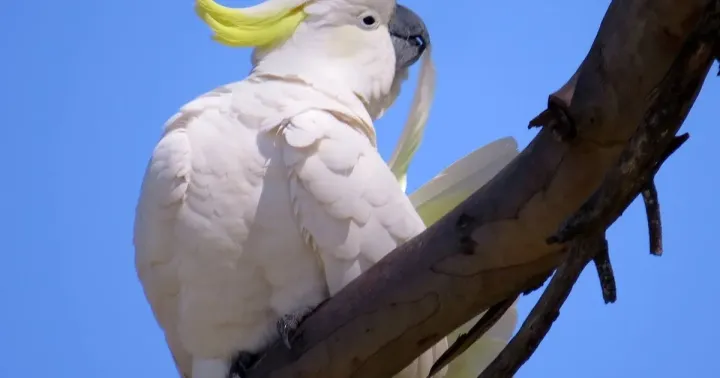
Cockatoos (genus Cacatua) are large, intelligent parrots known in several regions, particularly in Australia, as significant agricultural pests. These birds possess powerful, curved beaks capable of crushing seeds, nuts, and even wooden structures.
They exhibit complex social behaviors, moving in large, noisy flocks that can decimate crops in a very short amount of time. Their high level of intelligence allows them to adapt quickly to simple deterrent measures.
Physically, they are identified by their crests, which can be raised or lowered, and their distinct plumage. They are highly vocal, often announcing their presence with loud, piercing screams that can be heard over long distances.
Biology-wise, these birds have long lifespans and a strong attachment to specific feeding grounds, which makes them persistent pests in affected farming regions.
Belonging to the order Psittaciformes and the family Cacatuidae, their resilience and communal nature make them difficult to manage in large-scale agricultural operations.
What it damages
Cockatoos primarily damage cereal crops such as wheat, corn, and millet, as well as sunflowers. They feed on seeds during the milky stage, often destroying entire fields if left unmonitored.
In orchards, they cause significant losses by consuming fruit buds, young shoots, and ripening fruits of stone fruit trees, leading to stunted tree growth or death of young saplings.
They frequently damage farm infrastructure, including irrigation pipes, plastic greenhouse covers, and wooden structures, primarily driven by their need to keep their beaks sharp and worn down.
The severity of damage increases during drought years when natural food sources diminish, driving large populations of birds toward managed farmlands.
Because they are creatures of habit, they often revisit the same fields repeatedly, turning a single farm into a permanent target for their feeding activities.
When it appears
The period of peak activity occurs during the crop maturation phase, when moisture and sugar content in the grain are at their highest levels.
Throughout the growing season, cockatoos pose a risk, but their presence becomes critical as soon as the crops become palatable for consumption.
During the peak of the dry season, farmers often see an influx of bird activity as they search for alternative nutrition and water sources provided by irrigated fields.
The birds are most active during the early morning and late afternoon, feeding during these cool periods to avoid midday heat.
In winter months, flocks may congregate near grain silos and processing facilities, creating additional challenges for crop storage security.
Signs of infestation
The primary sign of a cockatoo presence is the accumulation of plant debris, such as torn husks and partially eaten stems, found beneath trees or along field edges.
Visible patches of bare soil within grain fields indicate areas where large flocks have finished feeding, often leaving behind broken stalks and total crop loss.
Auditory evidence is the most common indicator; the loud, discordant screeches of a cockatoo flock are unmistakable and usually precede physical sightings.
Damage to fruits is distinct, characterized by large, jagged bite marks that differ significantly from the more precise punctures made by insects or smaller birds.
Droppings, scattered feathers, and signs of chewing on farm machinery or wooden fence posts confirm that the flock has been present on the property.
Control measures
Managing cockatoo populations requires an integrated pest management approach, as they quickly learn to ignore static visual deterrents like scarecrows or fake owls.
Acoustic deterrents, such as distress calls or sonic blasts, can be effective, but they must be rotated and triggered randomly to prevent the birds from habituating to the sound.
Physical barriers remain the gold standard for high-value crops, with bird-proof netting being the most reliable way to prevent access to orchards and greenhouses.
Agronomic strategies include early harvesting to reduce the time crops remain vulnerable in the field, as well as minimizing available water sources in non-essential areas.
- Remove roosting trees near crop fields to discourage flock congregation.
- Use automatic gas cannons that fire at irregular intervals.
- Deploy laser-based bird deterrents during pre-dawn and twilight hours for targeted protection.
Taxonomy
- Latin name
- Cacatua
- Family
- Cacatuidae
- EPPO code
- CCTUSP
Discussion
No discussions yet — be the first.