
Brahmaea wallichii
Brahmaea wallichii
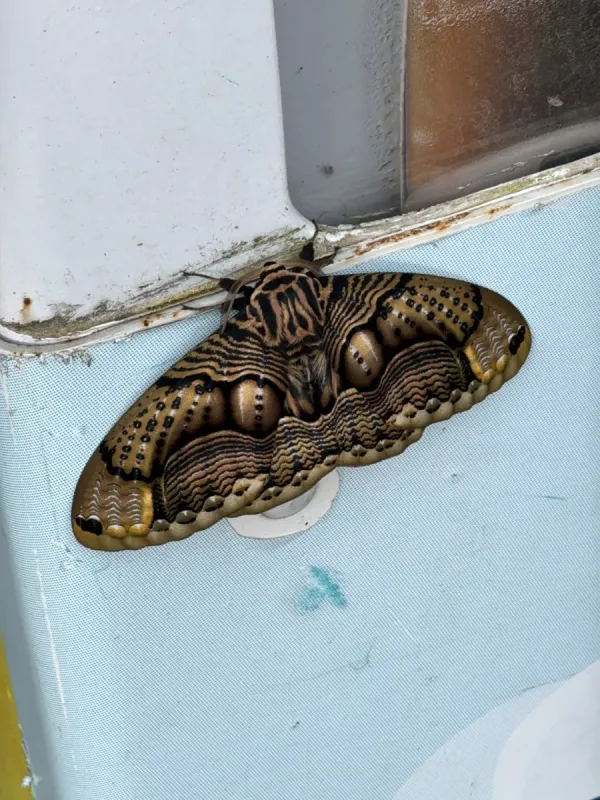
Description
How to identify
Brahmaea wallichii is a large moth belonging to the family Brahmaeidae within the order Lepidoptera. It is well-known for its impressive wingspan, which can reach up to 15 centimeters, decorated with intricate wavy patterns of dark and light lines providing excellent camouflage.
The larvae, or caterpillars, of this species are notable for their size and distinct appearance, often possessing appendages on their segments that serve as a defense mechanism against potential predators.
The pupae are typically encased in dense cocoons found within the soil or deep inside the forest floor litter, making them exceptionally difficult to detect during standard inspections.
As adults, these moths do not possess a functional feeding apparatus, as their life cycle focuses entirely on reproduction. They are primarily nocturnal, making them invisible during daylight hours.
While historically found in forest ecosystems, the species can adapt to adjacent man-made environments such as parks and gardens if their primary host plants are abundant.
What it damages
The host plants most frequently targeted by Brahmaea wallichii larvae include members of the Oleaceae family, such as Ash (Fraxinus), Lilac (Syringa), and Privet (Ligustrum).
The primary damage is caused by the caterpillars, which exhibit high feeding intensity, leading to rapid defoliation of the infested trees and shrubs.
Young larvae often start by consuming patches of the leaf tissue, while mature caterpillars devour the entire leaf blade, leaving only the primary veins and petiole behind.
Heavy defoliation severely disrupts the plant's photosynthetic capacity, resulting in significant stress, reduced vigor, and increased vulnerability to secondary infections or winter damage.
In ornamental landscaping, the destruction of foliage significantly reduces the plant's aesthetic value, which can be devastating for commercial nurseries and public green spaces.
When it appears
The life cycle of Brahmaea wallichii is heavily influenced by regional climatic conditions, with adult moths typically emerging in late spring or early summer.
Oviposition occurs on the leaves or stems of host plants, and the eggs have a relatively short incubation period, allowing the larvae to exploit the spring growth spurt of the plants.
The period of peak larval activity occurs during mid-summer, when the plants are at their most succulent, providing the necessary nutrients for the caterpillars to complete their development.
Pupation takes place toward the end of the season, and the insect overwinters in the pupal stage, buried in the soil or protected by forest debris until the following year.
Weather factors, such as ambient temperature and humidity, play a critical role in determining the population density, with moderate conditions often favoring high survival rates.
Signs of infestation
A primary indicator of an infestation is the presence of granular fecal pellets on the leaf surface or on the ground directly beneath the infested branches.
Visible defoliation patterns, characterized by jagged leaf edges and denuded branches, serve as a clear sign of active caterpillar feeding in the canopy.
Large caterpillars may be spotted by a careful observer, although their cryptic coloration and tendency to remain on the undersides of leaves or deep within branches help them evade detection.
Stunted plant growth and delayed leaf emergence in the spring can be secondary signs of significant stress caused by the previous season's larval activity.
Increased bird activity, particularly flocks of insectivorous birds hovering around the canopy, often signals the presence of a high concentration of larvae within the tree.
Control measures
Manual collection of larvae is a viable, albeit labor-intensive, control method for small ornamental trees or during the initial stages of a minor infestation.
Biological insecticides containing Bacillus thuringiensis are highly effective against young larvae while minimizing environmental impact on beneficial insects in the vicinity.
For more severe outbreaks, systemic or contact chemical insecticides may be necessary to protect the plant's canopy and prevent widespread destruction of leaf tissue.
Cultural practices, such as deep tilling of the soil under the canopy during the autumn, can help disrupt the overwintering pupae and reduce the adult moth population for the next cycle.
- Conduct regular canopy inspections to catch infestations early.
- Remove debris under the trees to eliminate hiding spots for pupae.
- Encourage natural predators like birds and predatory beetles in the area.
- Monitor the timing of larval development to ensure insecticide application is effective.
Taxonomy
- Latin name
- Brahmaea wallichii
- Order
- Lepidoptera (butterflies)
- Family
- Brahmaeidae
- EPPO code
- BRHMWA
Discussion
No discussions yet — be the first.