
Cedar waxwing
Bombycilla cedrorum
Description
How to identify
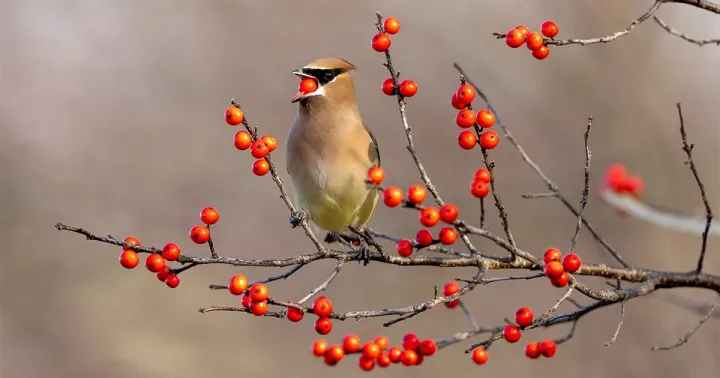
The Cedar waxwing (Bombycilla cedrorum) is a member of the Bombycillidae family known for its sleek, crested appearance. These birds are identifiable by their pale brown to beige plumage and a distinct black mask across the eyes.
One of the most notable features of the species is the bright red, waxy-looking tips on the secondary wing feathers. Adults are typically about 6 to 7 inches in length, exhibiting an elegant and streamlined build.
These birds are highly social and are almost always found in flocks, which increases the impact they have on agricultural crops. They are agile flyers, capable of maneuvering quickly within dense orchard canopies.
Juvenile Cedar waxwings are distinguishable by their streaked chests and more muted colors, gradually developing the smooth plumage of the adult as they mature. Recognition is crucial for early detection in orchard environments.
Their flight calls, which are high-pitched and whistling, are often the first sign of a flock approaching an orchard. Understanding their behavior is essential for timely agricultural intervention.
What it damages
Cedar waxwings pose a significant risk to fruit and berry crops due to their habit of feeding in large, concentrated groups. They are particularly attracted to orchards during the peak ripening phase of the fruit.
Vineyards are highly susceptible to damage, as these birds can quickly consume large quantities of grapes, leaving only stems behind. Other common targets include cherries, blueberries, strawberries, and orchard apples.
The damage extends beyond simple consumption; birds often puncture the skin of fruits, which provides an entry point for insects, fungal infections, and rots. This leads to substantial spoilage and quality loss.
Because they feed aggressively, a flock can ruin the marketability of an entire row of produce in a matter of hours. Farmers often face high economic losses if protective measures are not implemented.
While they are native birds, their ability to switch food sources depending on availability makes them persistent pests in regions with intensive fruit cultivation.
When it appears
The presence of Cedar waxwings in agricultural areas is largely governed by fruit maturation periods and their migration patterns. Peak damage usually occurs from mid-summer through early autumn.
During these months, birds are hyper-focused on consuming high-sugar fruits to gain energy for their seasonal flights. Early-ripening varieties are particularly vulnerable to sudden mass attacks.
In some cases, waxwings remain in agricultural areas well into the winter months if leftover fruit is present. This late-season feeding can inadvertently damage future buds on fruit trees.
Seasonal weather patterns, such as droughts that limit natural forest food sources, drive these flocks into orchards. These years often see the highest level of pest pressure on commercial crops.
Monitoring regional bird populations during the weeks preceding harvest is a recommended agronomic practice for risk assessment and preparation of deterrent strategies.
Signs of infestation
Signs of infestation include missing fruit, jagged edges on remaining berries, and visible peck marks. In vineyards, the complete stripping of grapes from the bunches is a classic indicator.
Noisy, restless behavior within the tree canopy indicates the presence of a flock. Heavy droppings on leaves and branches beneath the feeding area are further evidence of an active infestation.
Large amounts of discarded fruit fragments on the orchard floor suggest that the birds are actively feeding above. This debris often attracts secondary pests like wasps or fruit flies.
Changes in local wildlife activity, such as songbirds abandoning the area or becoming unusually quiet, can serve as an indirect warning that a large flock of waxwings has arrived.
Inspecting the top canopy of trees is vital, as this is where the birds prefer to congregate and start their feeding process before moving deeper into the foliage.
Control measures
Successful management of Cedar waxwings involves a multi-modal approach that uses physical barriers and sensory deterrents to discourage birds from lingering in orchards.
- Installing anti-bird netting over grape vines and high-value berry crops.
- Deploying visual deterrents such as predatory bird decoys or reflective tapes.
- Utilizing sound-based systems that broadcast alarm calls to create an inhospitable environment.
- Using automated scare devices to disrupt feeding patterns through unpredictable triggers.
- Harvesting crops promptly as soon as they reach maturity to minimize exposure time.
Netting is widely considered the most effective long-term solution for small to medium-scale operations. It provides a reliable physical barrier that effectively blocks bird access.
Acoustic and visual deterrents are useful for larger acreage but require frequent rotation or adjustments to prevent the birds from habituating to the equipment.
Integrating these methods into a proactive farm management plan significantly reduces the risk of crop loss and helps maintain the overall health and profitability of the orchard.
Taxonomy
- Latin name
- Bombycilla cedrorum
- Family
- Bombycillidae
- EPPO code
- BMBYCE
Discussion
No discussions yet — be the first.