
Waxwing
Bombycilla
Description
How to identify
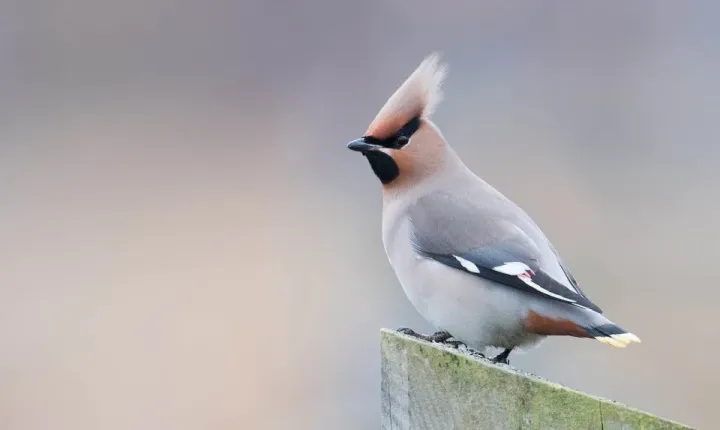
The Bohemian Waxwing (Bombycilla garrulus) is a passerine bird belonging to the Bombycillidae family. An adult specimen reaches about 18-20 centimeters in length and possesses a distinctive crest on its head.
The plumage is predominantly pinkish-brown, with a black eye-stripe and bright yellow and red tips on the wings and tail. These birds are known for their social behavior in flocks and a characteristic trilling whistle while in flight.
During winter and early spring, these birds migrate in search of food, frequently appearing in residential and agricultural areas. Their activity is highly dependent on the availability of berry-bearing plants.
Unlike insects, waxwings are vertebrate pests that cause direct damage to agricultural production by consuming fruits. Their presence is easily identified visually due to their size and the noisy behavior of the flocks.
The biology of the species is closely linked to a nomadic lifestyle, making their arrival in gardens sudden and massive. They quickly adapt to new food sources in human-altered landscapes.
What it damages
The primary damage caused by waxwings involves the destruction of berry and fruit crops in late winter and early spring. Fruits remaining on branches are particularly vulnerable.
Plants most susceptible to attacks include mountain ash (rowan), viburnum, hawthorn, sea buckthorn, rose hips, and decorative shrubs. Birds may also damage the buds of fruit trees.
In gardens growing valuable berry varieties, waxwings can consume nearly the entire yield within a short period. This reduces both the economic and decorative value of the plantings.
Consuming the buds of fruit trees in late winter is especially dangerous, as it reduces potential yield for the current season. This weakens the plants and slows their vegetative growth.
Beyond the direct destruction of fruit, the birds contaminate produce and surfaces with droppings, which degrades the sanitary condition of allotments and nurseries.
When it appears
Waxwings appear on agricultural sites primarily during the winter and early spring. Their activity is directly linked to the scarcity of natural food sources in the wild.
Mass infestations are observed during severe cold spells or when wild berry stocks are depleted. During these times, birds move into gardens and parks in search of accessible nutrition.
Peak activity occurs in February and March, when natural food sources are nearly absent. This is when the main damage to berry crops and tree buds occurs.
With the onset of active sap flow and the appearance of the first thaws, flocks typically migrate back to northern forest zones. The period of their harmful impact is limited to the cold season.
Agronomists should monitor migration calendars to install protective measures before the arrival of the first large flocks to the farm territory.
Signs of infestation
The main sign of pest presence is a noisy flock of birds settling on fruit bushes. Waxwings are not timid around humans and tend to remain at the feeding site for extended periods.
Trees and shrubs show damaged or partially eaten fruits, often with a large amount of debris left on the ground. Visually, this appears as "stripped" or gnawed branches.
Large amounts of bird droppings in the feeding area are a sure sign of a flock's prolonged stay. Additionally, undigested berry seeds are often found beneath the trees.
The specific whistling call of the birds during flight and landing is clearly audible in quiet weather, allowing for the detection of their arrival before feeding begins.
Incidental bud damage in spring appears as clipped or pecked terminal and lateral buds, which can be mistaken for the activity of other garden pests.
Control measures
Effective protection against waxwings is based on the use of deterrents and mechanical barriers. The use of chemical pesticides against birds is strictly prohibited and counterproductive.
- Using reflective tapes, old compact discs, or mirrored hangers.
- Installing ultrasonic repellers that mimic the calls of predatory birds.
- Applying protective netting with fine mesh to cover valuable shrubs.
- Hanging noise-making structures, such as rattles or moving scarecrows.
- Harvesting berry crops in a timely manner before the peak of winter bird migrations.
It is important to combine several protective methods, as birds quickly habituate to one type of deterrent. It is recommended to change the location of scarecrows every few days.
On large industrial plots, the use of bioacoustic systems that broadcast specific alarm signals is highly recommended. This is the most humane and effective method for protecting large areas.
Taxonomy
- Latin name
- Bombycilla
- Family
- Bombycillidae
- EPPO code
- BMBYSP
Discussion
No discussions yet — be the first.