
Sting nematode
Belonolaimus
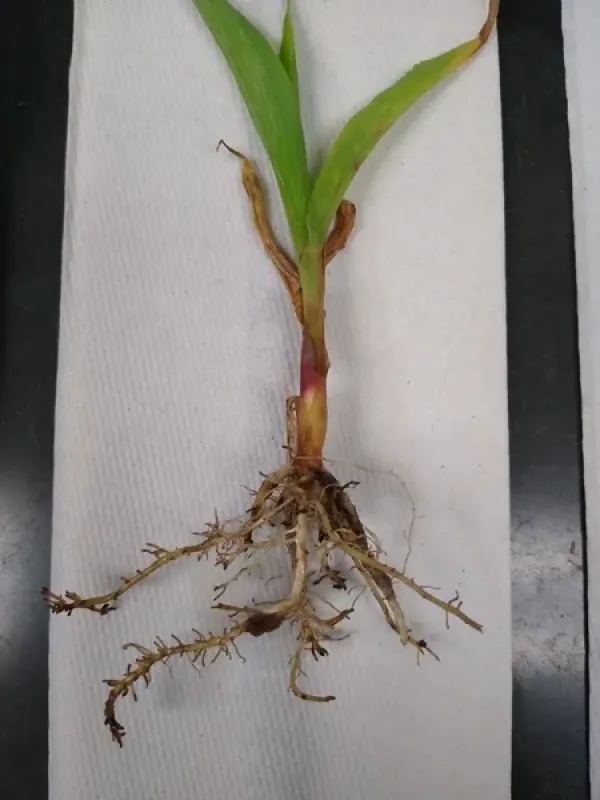
Description
How to identify
The sting nematode of the genus Belonolaimus is a dangerous soil-borne plant-parasitic helminth belonging to the order Tylenchida and family Belonolaimidae. These nematodes are equipped with a long, slender stylet used for feeding.
Adults range from 2 to 3 mm in length, making them among the largest plant-parasitic nematodes. Their bodies are transparent or yellowish, cylindrical, and highly adapted for movement in porous soil structures.
They lead an ectoparasitic lifestyle, remaining outside the roots while feeding. They exhibit a strong preference for sandy soils, which allow for rapid movement and effective access to root systems.
The life cycle encompasses an egg stage, four larval stages, and an adult stage. All developmental phases occur within the soil, where they maintain a close association with host plant roots.
Reproduction is sexual, with females depositing eggs directly into the soil near root zones, ensuring immediate access to food sources for the newly hatched larvae.
What it damages
This pest affects a wide array of agricultural crops, including corn, soybeans, peanuts, various vegetables, and turfgrasses. They are recognized as significant agricultural threats.
The parasite targets young root tips. During feeding, it injects enzymes that disintegrate plant cells and cause the complete cessation of root growth in the infected areas.
Root damage significantly impairs the plant's ability to absorb water and essential nutrients, which becomes particularly critical during periods of drought or rapid growth.
In cases of heavy infestation, the root system appears severely stunted, deformed, and often lacks secondary roots, leading to plant death or drastically reduced yields.
The economic impact involves substantial yield loss and degradation of product quality, forcing farmers to implement rigorous management and protection strategies.
Signs of infestation
In the field, infestation signs often manifest as stunted or yellowed patches where plant growth is noticeably retarded compared to healthy sections of the field.
Excavated root systems often display a characteristic lack of fine lateral roots, while primary roots appear stubby, discolored, and covered with necrotic lesions.
Plants frequently exhibit persistent drought stress symptoms because the compromised root system cannot keep pace with the plant's transpiration requirements.
Infested fields display uneven development, which compromises the overall field structure and makes management and harvesting operations more difficult.
Diagnosis is frequently challenging because symptoms are often mistaken for nutrient deficiencies or other pathogens, necessitating laboratory analysis of soil samples.
Control measures
The most effective strategy is the implementation of crop rotation using non-host crops, which helps to naturally suppress the nematode population levels in the soil.
Chemical nematicides can be utilized as a management tool, though their application must be strictly regulated to minimize environmental impacts and adhere to safety standards.
Agronomic practices include deep tillage to disrupt the pest's habitat and strict weed control to prevent the buildup of nematodes on alternative host weeds.
Managing soil moisture is critical, as sandy fields with low moisture levels provide the optimal environment for the rapid reproduction and activity of this species.
The adoption of resistant plant varieties is a promising long-term solution, although the current availability of such varieties remains limited for many major crops.
Taxonomy
- Latin name
- Belonolaimus
- Order
- Nematodes
- Family
- Dolichodoridae
- EPPO code
- BELOSP
Discussion
No discussions yet — be the first.