
Australian lawn beetle
Autoserica insanabilis
Description
How to identify
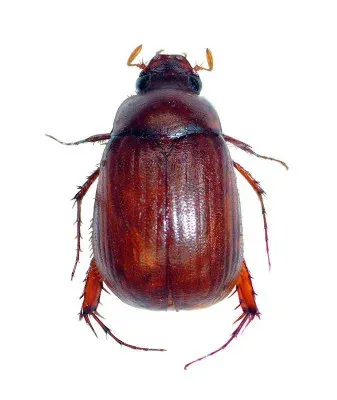
The Australian lawn beetle (Autoserica insanabilis) is a member of the Scarabaeidae family, known for causing significant damage in their larval stage. Adults are typically small, brownish beetles that are most active during the warmer months.
The larvae, commonly referred to as white grubs, have a distinct C-shaped body with a creamy-white color, a dark head capsule, and three pairs of well-developed thoracic legs used for movement through the soil profile.
The insect undergoes a complete metamorphosis, moving through egg, larva, pupa, and adult stages. The length of this lifecycle is heavily dependent on temperature and soil moisture levels, which determine the speed of larval development.
Identifying the exact species often requires professional entomological examination, as the larvae share many physical characteristics with other related species of chafers found in similar environments.
These pests are highly adaptable and thrive in managed landscapes, where dense root systems provide a reliable and abundant food source for developing larvae.
What it damages
Larval stages of the Australian lawn beetle are root-feeders. They chew through the root systems of turfgrass, ornamental plants, and various seedlings, which prevents the uptake of water and essential nutrients from the soil.
In turf management, the infestation often leads to the death of grass patches. The damage is so severe that the affected turf can be easily pulled back like a rug, revealing the rootless soil underneath and the larvae feeding.
Beyond turf, these grubs can cause significant economic loss in nurseries and vegetable farms. Young saplings are particularly vulnerable, as their smaller root systems are easily decimated by the feeding activity of several larvae.
Adult beetles also feed on the foliage of trees and shrubs, although this damage is generally considered less detrimental compared to the extensive destruction caused by the subterranean larvae.
- Destruction of root systems
- Large dead patches in lawns
- Stunted growth of ornamental plants
- Increased susceptibility to drought stress
Signs of infestation
The most visible sign of an infestation is the irregular yellowing and thinning of the grass, which does not improve despite adequate irrigation and fertilization efforts.
Small, irregular holes in the ground or areas where the turf feels spongy underfoot are common indicators that larvae are active beneath the surface.
Increased activity of birds, such as crows or starlings, digging in specific areas of the lawn or field, often signals a high concentration of larvae near the soil surface.
During the adult flight season, finding numerous beetles near exterior lights at night is a strong indicator of an impending egg-laying period for the next generation.
Simple soil sampling by extracting a core sample of roughly 20x20 cm can reveal the presence and density of grubs, helping to make informed treatment decisions.
Control measures
Chemical control involves the application of soil-applied insecticides, which are most effective when targeted at the early larval stages when the grubs are still feeding near the surface.
Biological control methods include the use of entomopathogenic nematodes (Steinernema or Heterorhabditis species), which are applied as a soil drench to provide a natural and targeted biological solution.
Cultural practices such as proper aeration, maintaining healthy soil moisture, and avoiding overly close mowing can help the root system remain resilient against minor pest pressures.
Light traps are used to monitor and reduce the adult population, effectively cutting down the number of eggs laid in the area throughout the season.
Integrated Pest Management (IPM) strategies emphasize monitoring populations first, and applying controls only when thresholds are exceeded to maintain environmental balance.
Taxonomy
- Latin name
- Autoserica insanabilis
- Order
- Coleoptera (beetles)
- Family
- Scarabaeidae
- EPPO code
- AUTSIN
Discussion
No discussions yet — be the first.