
Aulonium trisulcum
Aulonium trisulcum
Description
How to identify
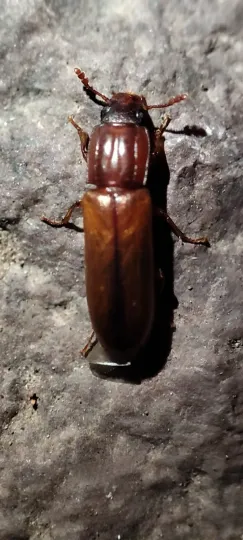
Aulonium trisulcum is a member of the Zopheridae family, order Coleoptera. It is a small beetle with an elongated, flattened body specifically adapted for navigating and living within narrow galleries under tree bark.
The adult coloration ranges from dark brown to almost black. A distinguishing feature of its appearance is the presence of distinct longitudinal grooves (sulci) on the pronotum and elytra.
The larvae possess a whitish or yellowish body, characteristic of many wood-dwelling coleopterans, and feature well-developed heads with robust mandibles for navigating through organic material.
These beetles are highly mobile during their flight season and are adept at locating weakened host trees. They are frequently found coexisting within the galleries previously excavated by primary bark beetles.
Adult insects typically measure between 4 and 6 millimeters in length, making them difficult to detect during standard visual inspections of the tree trunk surface.
What it damages
The primary hosts for this species include various deciduous trees, with a notable preference for elm species. The pest is closely associated with the habitats of elm bark beetles.
Damage typically occurs in weakened or stressed stands where sap flow is impaired or where mechanical damage has breached the protective bark barrier. Healthy trees are rarely attacked, as their defenses effectively prevent colonization.
While the direct damage caused by Aulonium is often secondary, high population densities can accelerate the decline of trees already infested by primary borers by further compromising cambium tissues.
Significant damage is primarily observed in forest stands where Aulonium acts as a secondary colonizer during mass outbreaks of bark beetles, complicating overall forest phytosanitary status.
The disruption of the bark integrity allows for the secondary colonization of fungal pathogens, which thrive in the galleries created by the beetle, further accelerating the structural decay of the wood.
When it appears
Adult flight occurs during the warmer months, typically from late spring through late summer, during which time the beetles are highly active in searching for suitable host material.
Breeding and oviposition take place within existing galleries excavated by other insects under the bark. Larvae feed and develop throughout the summer, significantly increasing in size as they mature.
Overwintering occurs at either the adult or larval stage within the bark or immediately beneath it, where the insects are effectively shielded from extreme ambient winter temperatures.
As spring temperatures rise, the beetles resume activity to locate new feeding sites. The population peak often aligns with the seasonal vegetation cycle of the host trees.
Environmental stressors, particularly drought, increase tree susceptibility, creating optimal conditions for Aulonium to reach high population levels within a single season.
Signs of infestation
The primary indication of infestation is the presence of entry holes in the bark created by primary bark beetles, which Aulonium later utilizes. Direct detection usually requires the removal of bark fragments.
Upon closer examination, fine wood dust (frass) may be observed accumulating in bark fissures. This is a combined result of the feeding activities of bark beetles and associated fauna like Aulonium.
Removing small patches of loose or dead bark reveals winding galleries where adult beetles or larvae are present, confirming an active infestation within the tree trunk.
Gradual crown dieback and chlorosis (yellowing of leaves) on individual branches are indirect indicators that the internal structure of the tree is being compromised by wood-boring pests.
Sloughing or peeling of bark from the lower trunk is a critical sign of advanced infestation, indicating that the pest population has caused severe physiological exhaustion to the tree.
Control measures
The fundamental control measure is the timely sanitary removal and disposal of infested trees. Eliminating symptomatic specimens prevents the spread of the beetle to healthy neighboring trees.
Regular monitoring of forest stands, particularly during prolonged dry spells, is essential for the early detection of pest clusters and the implementation of necessary management interventions.
The use of trap trees can divert a portion of the beetle population away from healthy stands; these trap trees must be systematically removed or debarked before the next generation emerges.
Chemical trunk applications of insecticides are generally reserved for high-value ornamental trees, though their effectiveness is limited against beetles that are already protected by thick bark.
Improving the overall vigor of the trees through irrigation and appropriate nutrient management increases the host's natural resistance, effectively reducing the likelihood of successful pest colonization.
Taxonomy
- Latin name
- Aulonium trisulcum
- Order
- Coleoptera (beetles)
- Family
- Colydiidae
- EPPO code
- AULOTR
Discussion
No discussions yet — be the first.