
Red-horned bark beetle
Aulonium ruficorne
Description
How to identify
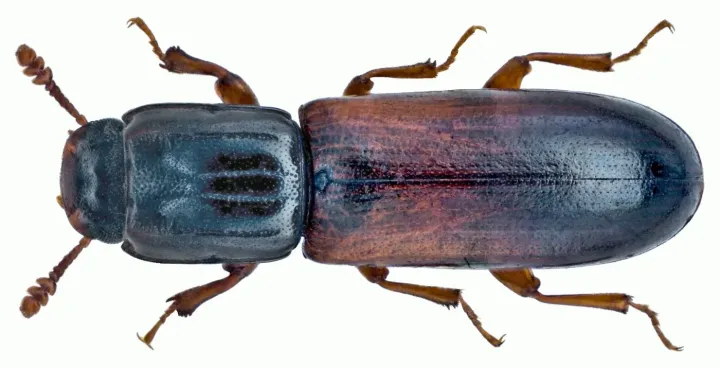
The red-horned bark beetle (Aulonium ruficorne) is a member of the Zopheridae family. This small, elongated beetle typically measures between 3 to 5 millimeters in length, making it difficult to spot with the naked eye.
The beetle's body is dark brown or black, often with a subtle, glossy sheen. Its defining characteristic, which gives it its common name, is the presence of distinctly reddish or orange-brown antennae.
Larvae are white and flattened, specifically adapted to thrive within the tight, compressed spaces between the tree bark and the cambium layer where they reside.
Adult beetles are nocturnal, spending the daylight hours in deep crevices of the bark or inside their larval galleries to avoid dehydration and predators.
Taxonomically, while often labeled as a predator of other bark beetles, Aulonium ruficorne acts as a component of the subcortical ecosystem, interacting with both the trees and other wood-boring insects.
What it damages
This species is primarily associated with coniferous trees, particularly pine and spruce species that are already compromised by drought, disease, or other primary pests.
While the beetles occupy the subcortical zone, high populations can cause mechanical damage to the tree's vascular tissue, which interferes with the flow of nutrients and moisture.
In many forest stands, this beetle is considered a secondary pest or an associate of primary bark beetle outbreaks, as it prefers habitats where the bark has already been loosened.
The cumulative effect of larval feeding and adult gallery construction can accelerate the decline of stressed trees, contributing to patches of forest dieback.
Economic damage is typically localized rather than systemic, affecting the quality of the timber if infestation levels remain high for several consecutive seasons.
When it appears
The active life cycle begins in spring when rising temperatures trigger the emergence of overwintering adults from their sheltered locations within the forest debris.
The breeding season occurs during the summer months, during which females lay eggs in cracks in the bark of suitable host trees, ensuring larvae have access to a food source.
Overwintering takes place in the adult stage, with the beetles finding refuge under the bark at the base of trees or in the leaf litter, protecting them from extreme temperatures.
The species usually completes one generation per year, although exceptionally warm and prolonged summers may allow for more rapid development or partial overlapping generations.
By late summer, the new generation of adults reaches maturity and prepares for dispersal, seeking out new host trees to colonize before the onset of winter.
Signs of infestation
Presence of the beetle is often revealed by the secondary indicators of bark beetle activity, such as fine, sawdust-like frass accumulating at the base of the trunk.
Visible peeling of the outer bark on older trees can expose the complex, flattened galleries that are characteristic of this species' subcortical activity.
Exit holes, which are typically small and circular, indicate that a new generation of beetles has completed its development and emerged from the tree.
The yellowing or wilting of the crown serves as a general indicator of tree distress, necessitating a closer investigation of the trunk's bark condition.
Discovery of the beetles in pheromone traps deployed for primary bark beetle monitoring provides clear evidence of their local population density.
Control measures
The most effective management strategy is the implementation of sanitary logging, which involves the rapid removal of heavily infested trees to interrupt the beetle's life cycle.
Maintaining high forest hygiene, particularly the removal of fresh logging residue, is crucial in preventing the creation of new breeding grounds for these insects.
Encouraging natural biological controls, such as avian predators and parasitic wasps, can play a significant role in keeping populations below economic injury levels.
Integrated forest management, including regular monitoring and drought mitigation, helps keep stands healthy and less susceptible to secondary pest colonization.
- Regular forest health monitoring and inventory.
- Prompt sanitation harvesting of infested timber.
- Proper management of forest debris and logging waste.
- Promotion of natural biodiversity to support entomophagous insects.
Taxonomy
- Latin name
- Aulonium ruficorne
- Order
- Coleoptera (beetles)
- Family
- Colydiidae
- EPPO code
- AULORU
Discussion
No discussions yet — be the first.