
Pumpkin leaf beetle
Aulacophora femoralis
Description
How to identify
The pumpkin leaf beetle, scientifically known as Aulacophora femoralis, belongs to the Chrysomelidae family within the order Coleoptera, commonly recognized as leaf beetles.
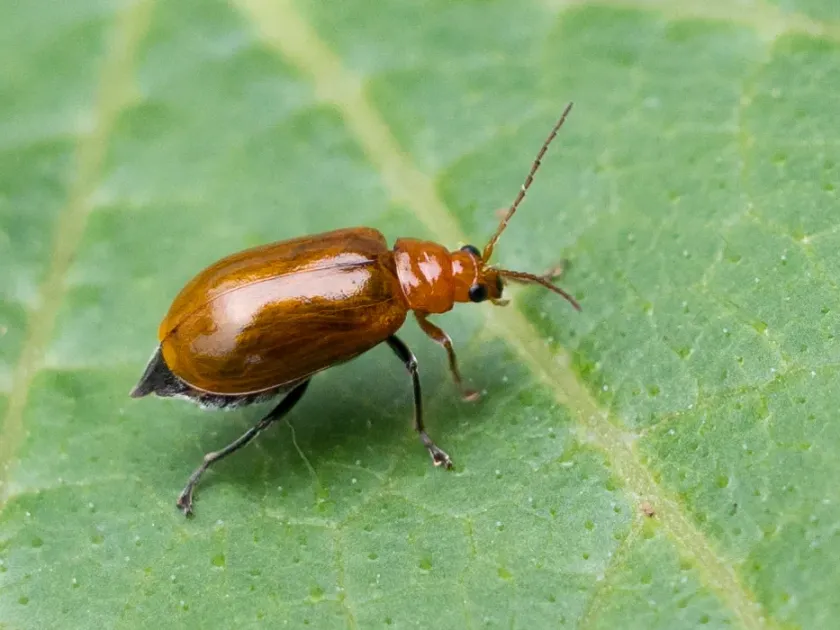
Adult beetles are relatively small, typically measuring 6 to 8 mm in length, and are easily distinguished by their bright orange or reddish-brown elytra.
The larvae are cream-colored or yellowish, reaching about 10-12 mm, with a well-developed head and legs, designed for life and movement within the soil environment.
Eggs are minute, oval, and deposited by females near the base of host plants, usually in moist soil crevices where the hatching larvae can quickly access roots.
Pupation occurs entirely within the soil, where the beetle undergoes its transformation into the adult stage, sheltered from most surface-level environmental stressors.
What it damages
This pest exclusively targets members of the Cucurbitaceae family, including cucumbers, pumpkins, squash, watermelons, and melons, causing damage to both foliage and roots.
Adult beetles feed on the leaves, creating irregular holes and sometimes skeletonizing the foliage, which reduces the plant's ability to photosynthesize effectively.
Larval damage is generally more severe, as they feed on the root system and bore into the lower stem, severely disrupting the plant's nutrient and water transport.
Root system impairment often results in stunted growth, yellowing of leaves, and premature wilting, which can lead to total crop failure in heavily infested areas.
Openings created by larvae in the stem serve as entry points for various soil-borne pathogens, including bacteria and fungi, which induce secondary rot.
When it appears
Adult activity typically commences in late spring or early summer, synchronized with the onset of favorable temperatures for the rapid growth of cucurbit seedlings.
Depending on the climatic zone, the beetle may complete one or several generations throughout the growing season, posing a continuous threat to successive plantings.
Peak infestation usually aligns with the flowering and fruit-setting stages of the crop, making these phases critical for monitoring and implementation of control measures.
As temperatures begin to drop in autumn, adult beetles seek shelter in soil residues or protected areas to enter diapause, surviving the winter until the next season.
Proactive monitoring during the warmest months is essential, as the beetle population can escalate rapidly if initial sightings are ignored by farm managers.
Signs of infestation
The first observable signs include small, irregularly shaped holes in the leaves, often accompanied by the presence of orange-colored beetles on the underside of foliage.
Wilting of entire plants during the peak daylight hours, despite adequate soil moisture, is a strong indicator of larval damage to the primary root structures.
Observation of yellowing or browning leaves across the patch may suggest that the root system has been compromised, hindering overall plant development.
Upon closer inspection of the plant base, small tunnels or larvae themselves may be found beneath the soil surface, confirming an infestation.
- Small feeding punctures in young leaves.
- Sudden, unrecoverable wilting of the plant.
- Stunted plant growth and deformed fruit development.
Control measures
Effective crop rotation is the primary preventive strategy, ensuring that cucurbit crops are not replanted in the same location for at least three to four years.
Post-harvest deep soil tillage is recommended to destroy overwintering pupae and adults by exposing them to extreme weather conditions and predatory birds.
Physical barriers, such as floating row covers, are highly effective in early-season management, preventing adults from landing on crops to lay eggs.
When chemical control is necessary, targeted application of authorized insecticides should be timed during the adult flight stage to prevent further egg laying.
Biological controls, including the application of entomopathogenic nematodes or specific biological insecticides, can significantly reduce larval numbers within the soil.
Taxonomy
- Latin name
- Aulacophora femoralis
- Order
- Coleoptera (beetles)
- Family
- Chrysomelidae
- EPPO code
- AUACFE
Discussion
No discussions yet — be the first.