
Caspian silverside
Atherina boyeri
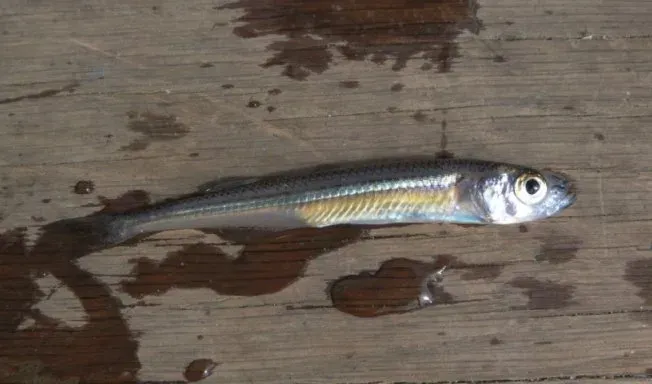
Description
How to identify
The Caspian silverside (Atherina boyeri) is a small, schooling ray-finned fish belonging to the order Atheriniformes and the family Atherinidae. It is a well-known species in brackish and coastal marine environments.
This fish features a streamlined, elongated body with silvery scales and a distinctive dark horizontal stripe along its lateral line. It typically reaches lengths of 10 to 15 centimeters.
The species is physically characterized by having two dorsal fins that are clearly separated. It is well-adapted to environments with varying salinity levels, such as estuaries and coastal lagoons.
It is crucial to clarify that the Caspian silverside is an aquatic animal and is not classified as a pest of terrestrial plants or agricultural crops under any scientific criteria.
Any association of this fish with crop damage is unfounded, as it lacks the physiological traits, such as herbivorous mouthparts or mobility, to interact with or damage agricultural crops.
What it damages
The Caspian silverside does not damage crops, gardens, or forests. It is an insectivorous and planktivorous species, primarily feeding on zooplankton, small crustaceans, and aquatic larvae.
Because its entire lifecycle occurs in the water, it has zero impact on the health, yield, or structural integrity of land-based plants or cultivated fields.
In agricultural science, the species is never listed as a threat, and there are no recorded instances of it interfering with farming operations or damaging plant tissue.
If found in irrigation water, the Caspian silverside is harmless to crops; it may even contribute to aquatic health by consuming organisms that might otherwise overpopulate and affect water quality.
Concerns regarding "pest status" are purely misinformed, as the fish does not possess the biology or behavior of a phytophagous organism.
When it appears
The activity of the Caspian silverside is governed by water temperature. During the spring and summer months, the fish move toward shallow, warmer waters for their reproductive cycle.
Spawning involves depositing eggs on submerged substrates or vegetation, which is a standard biological process for this species and has no negative effect on plant growth or agricultural development.
Throughout the summer, the fish remain active in the water column, focusing on feeding and growth, entirely independent of the phenology of agricultural crops on land.
As water temperatures drop in the autumn and winter, the silversides migrate to deeper, more stable aquatic environments to wait out the cold season.
There is no seasonal correlation between the life cycle of this fish and the planting, harvesting, or protection schedules of agricultural crops.
Control measures
Since the Caspian silverside is not a plant pest, no control measures are required. Agricultural pest management practices are focused on insects, pathogens, and mammals that impact crop yield.
The use of pesticides or toxins to eradicate fish from water sources is highly discouraged and often illegal, as it destroys local aquatic biodiversity and violates environmental safety regulations.
In managed aquaculture settings where silversides might compete with other farmed species for food, professional fisheries management techniques, such as selective harvesting, are used, which are unrelated to crop agronomy.
For any agronomic pest management, farmers should rely on scientifically verified data regarding target pests rather than mislabeling harmless aquatic species.
The best practice is to ensure water purity and ecosystem health, as the Caspian silverside serves as a functional part of the natural aquatic environment.
Taxonomy
- Latin name
- Atherina boyeri
- Family
- Atherinidae
- EPPO code
- ATHNBO
Discussion
No discussions yet — be the first.