
Spruce cone gall midge
Asynapta strobi
Description
How to identify
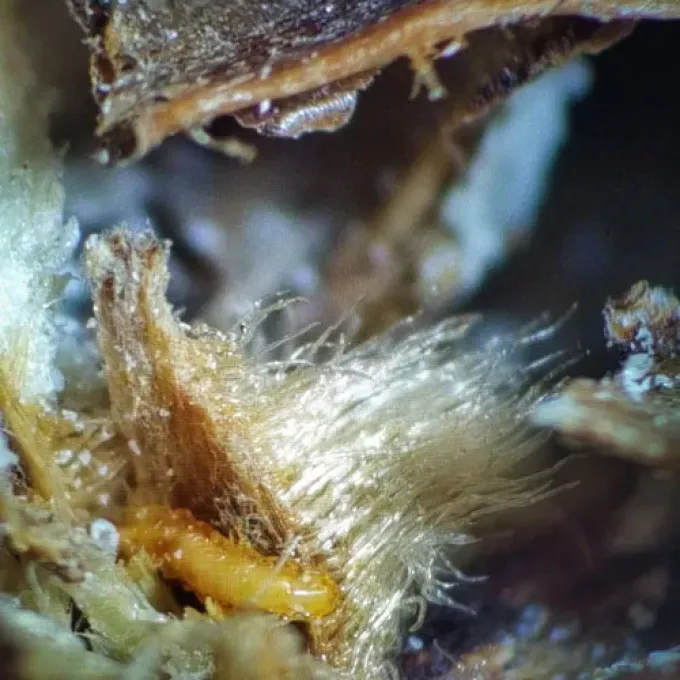
The spruce cone gall midge, scientifically known as Asynapta strobi, is a small dipteran insect belonging to the Cecidomyiidae family. Adults are delicate, measuring only a few millimeters, with long antennae and narrow wings.
The larvae are typically legless and yellow-orange, living internally within the developing spruce cones. Their life cycle is highly specialized, synchronized with the cone development of host trees.
Identification is best achieved by inspecting cones during the active growth phase, as the adults are rarely seen due to their short lifespan and cryptic behavior.
These insects survive the winter as larvae, primarily in the leaf litter beneath host trees, waiting for the spring warming to emerge and complete their cycle.
Accurate species identification usually requires professional entomological analysis of larval morphology or rearing adults from infested cones in laboratory settings.
What it damages
Asynapta strobi larvae feed directly on the seed scales and developing seeds within the spruce cones. This internal feeding prevents proper cone development and seed maturation.
The primary economic impact is the reduction of viable seed yields in seed orchards, which are essential for forest regeneration projects and reforestation efforts.
Severe infestations lead to deformed cones that are often shed prematurely, significantly complicating the collection process and reducing the total harvestable crop.
Feeding activities create entry points for fungal pathogens, which can cause internal decay of the cones, rendering them entirely useless for seed extraction.
In high-density populations, the midge can cause substantial financial losses by destroying a large percentage of the year's potential seed crop.
When it appears
The flight period of adult midges generally occurs in late spring, matching the phenology of spruce flowering. This is the critical window for mating and oviposition.
Females deposit eggs on the young, receptive cones. Once hatched, larvae penetrate the scales to begin feeding, spending the entire summer inside the cone structure.
As the cones mature and harden in late summer, larvae complete their development and exit the cones to move into the soil or forest floor.
The insect typically completes one generation per year, making it a univoltine species that is highly dependent on favorable spring weather conditions.
Timing of monitoring and control efforts must be precise, as the window of vulnerability to insecticides is limited to the short period of adult activity.
Signs of infestation
Visual symptoms include premature yellowing or browning of the cones, which deviate from the normal green color observed in healthy, developing spruce cones.
Deformed, stunted, or curved cones are common indicators of larval feeding, as the damage causes irregular growth patterns in the cone tissues.
Premature abscission or falling of cones is a strong sign of infestation, often indicating that the structural integrity of the cone has been compromised.
External resin flow on the cone surface is often a response to tissue injury caused by the feeding larvae within the cone scales.
Internal examination of suspected cones will reveal larval galleries and frass, confirming the presence of the pest even if the larvae are not immediately visible.
Control measures
Effective management requires an integrated approach that focuses on both preventive cultural practices and targeted chemical interventions when necessary.
- Removal and destruction of fallen cones to reduce the overwintering larval population in the soil.
- Applying systemic insecticides during the peak adult flight period to prevent oviposition.
- Utilizing pheromone-based monitoring to determine the exact timing for control applications.
- Encouraging natural biological controls, such as parasitoid wasps that predate on the midge larvae.
- Maintaining spatial separation between seed orchards and wild spruce stands to minimize pest migration.
In environmentally sensitive areas, biological control methods, including the use of entomopathogenic fungi, are preferred over synthetic chemicals.
Careful coordination with forest phenology data is essential for success, as once the larvae enter the cone, chemical protection becomes ineffective.
Long-term protection strategies should focus on selecting spruce genotypes that show natural resistance or reduced attractiveness to the gall midge.
Taxonomy
- Latin name
- Asynapta strobi
- Order
- Diptera (flies)
- Family
- Cecidomyiidae
- EPPO code
- ASYALA
Discussion
No discussions yet — be the first.