
Beet stem weevil
Asproparthenis foveocollis
Description
How to identify
The beet stem weevil (Asproparthenis foveocollis) belongs to the Coleoptera order and the Curculionidae family. It is a well-known pest that primarily affects beet crops in their early developmental stages.
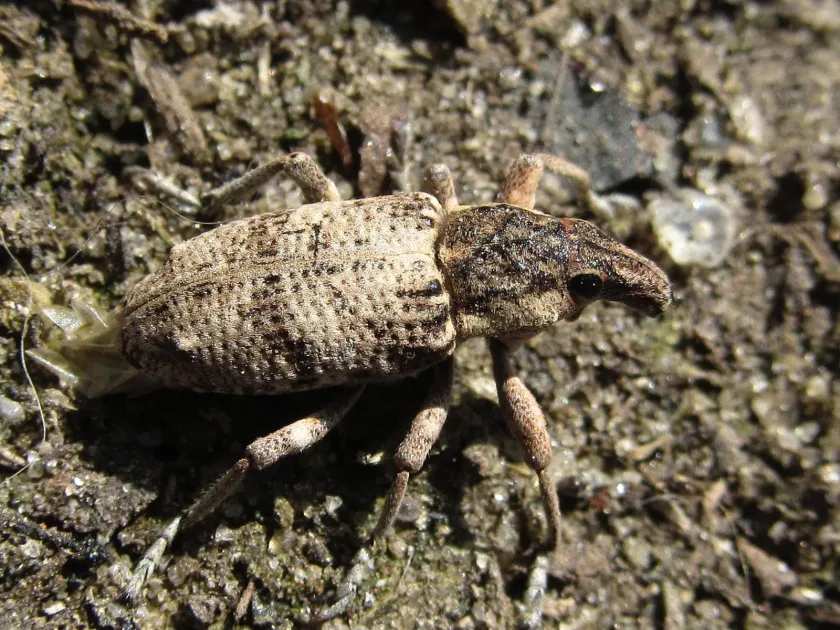
The adult beetle reaches 10–14 mm in length and has a characteristic snout. Its body is covered with grayish-brown scales, providing excellent camouflage against soil and plant debris.
The larvae are legless, fleshy, and white to yellowish in color with a brown head. They have a curved body shape and are specialized for internal feeding within plant tissues.
This species overwinters as an adult in the soil at depths of up to 20 cm. They emerge in the spring when soil temperatures rise, which typically coincides with the sprouting of beets.
The pest is particularly dangerous due to its early activity, often attacking the crop at the cotyledon stage, which is the most vulnerable period for the plant's survival.
What it damages
The beet stem weevil primarily attacks sugar beet, fodder beet, and red beet. Both adults and larvae contribute to the destruction of the crop, although the types of damage differ.
Adult beetles feed on the stems and cotyledons, often causing significant thinning of the stand. In cases of high infestation, they can completely destroy the young plants.
Larvae feed inside the petioles and stems, disrupting the vascular system. This causes stunted growth, deformation of leaves, and a significant reduction in the plant's overall biomass.
The weakened state of the plant makes it susceptible to secondary infections, such as root rot and various bacterial diseases, which can spread rapidly through the field.
The level of damage is heavily dependent on environmental conditions; slow-growing crops during cold, wet springs are at the highest risk of irreversible losses.
Signs of infestation
The first signs of infestation are small holes and ragged edges on the cotyledons and young leaves. If you see these, it is crucial to check for adult beetles in the field.
A yellowing or wilting central leaf often indicates that a larva is feeding inside the stem or petiole, cutting off the supply of nutrients to the upper part of the plant.
Patches of dead or disappearing plants, commonly known as "bald spots" in the field, are a classic sign of localized infestation, often starting from the edges of the field.
Adult beetles can be spotted by examining the base of the plants, especially in the morning or on cloudy days when they are active on the soil surface.
Infected plants often appear significantly smaller and weaker compared to healthy ones, showing visible signs of damage at the base of the root collar.
Control measures
Crop rotation is the most effective cultural method to manage this pest. Avoiding consecutive years of beet cultivation in the same field disrupts the lifecycle of the weevil.
Deep autumn plowing (tillage) is essential as it brings overwintering adults to the soil surface, exposing them to unfavorable weather conditions and natural predators.
Seed treatment with systemic insecticides is a highly recommended practice to protect young seedlings from the initial wave of weevil attacks during the first weeks of growth.
If population thresholds are exceeded, targeted insecticide spraying should be applied, focusing on the field margins where the adult beetles typically migrate from.
- Regular field scouting starting from the very first signs of plant emergence.
- Eliminating weed hosts, particularly those in the Chenopodiaceae family.
- Using mechanical barriers or bait furrows to trap migrating adult beetles.
Taxonomy
- Latin name
- Asproparthenis foveocollis
- Order
- Coleoptera (beetles)
- Family
- Curculionidae
- EPPO code
- BOTHFO
Discussion
No discussions yet — be the first.