Description
How to identify
The rose tortrix (Archips rosana) is a moth belonging to the family Tortricidae. It is a widespread pest that affects a variety of woody plants across temperate regions.
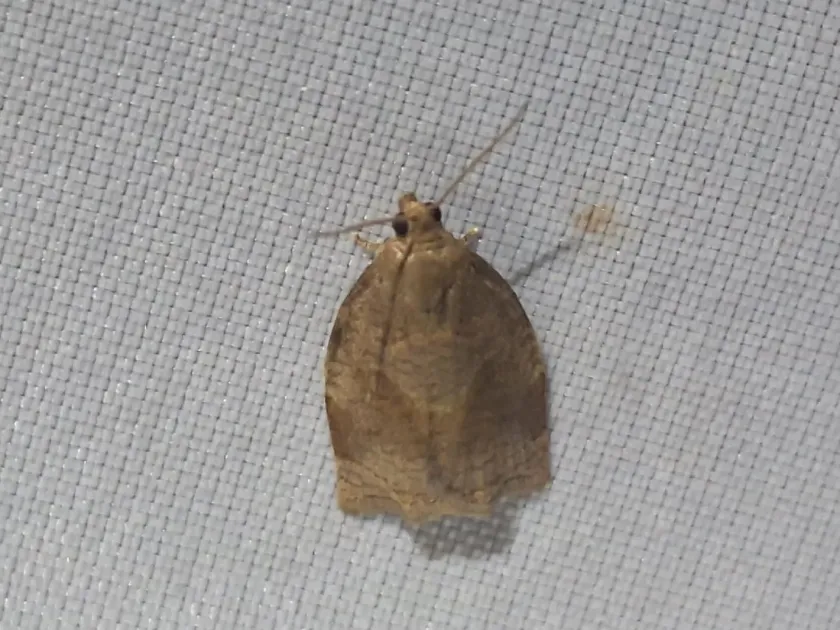
The adult moth has a wingspan of 17-25 mm. Its forewings display a variable pattern of dark, irregular transverse bands on a brownish or tan ground color.
The larvae, or caterpillars, reach lengths of up to 20 mm. They are typically olive-green to yellowish-green with a shiny black or dark brown head capsule.
Eggs are laid in small, flat, shield-like masses on the bark of host trees. These masses are cleverly camouflaged to match the texture and color of the bark.
The species overwinters in the egg stage. Larvae hatch in early spring, precisely when buds begin to swell, allowing immediate access to succulent plant tissue.
What it damages
Rose tortrix is a polyphagous pest, meaning it feeds on a broad range of hosts, including apple, pear, plum, cherry, rose, and various ornamental shrubs.
Young larvae feed on opening buds and unfolding leaves, while later instars move on to consume flower buds and developing fruit tissues.
The larvae spin silken threads to roll or fold leaves into protective tubes or clusters, commonly known as leaf rollers, which shield them from predators.
Feeding damage on fruit consists of shallow to deep, irregular cavities, which significantly reduce the market value and storability of the harvested produce.
Heavy infestations can lead to substantial foliage loss, which weakens the tree's vigor and reduces the potential for fruit-bud formation in the following year.

When it appears
This species is univoltine, meaning it completes only one generation per year. Development is closely synchronized with the phenology of host plants.
Larval activity commences in spring as temperatures rise above 10°C. Feeding continues for roughly 30 to 40 days before the larvae pupate within rolled leaves.
Pupation occurs inside the silk-spun leaf shelters and typically lasts for about two weeks, depending on ambient temperature conditions.
Adult moths emerge in early to mid-summer, usually spanning June and July, with the flight period often being quite prolonged across a population.
After mating, females lay eggs on branches and trunks. These eggs enter a state of diapause and remain dormant on the tree bark throughout the winter.
Signs of infestation
The most diagnostic sign of an infestation is the presence of tightly rolled or folded leaves bound together by thin, resilient strands of white silk.
Early spring damage manifests as ragged holes in developing leaves and hollowed-out buds that fail to open properly during the growth cycle.
Small, surface-level scars or deep craters on young fruit, often found adjacent to a webbed leaf, are classic indications of late-stage larval feeding.
During the winter, look for greyish-brown, elliptical egg masses on the bark. They are difficult to spot but appear as slight, firm protrusions on smooth bark.
Deformed flowers or fruit clusters that seem to wither prematurely are further evidence that larvae are hidden within the foliage or near the fruit peduncles.
Control measures
Effective management includes cleaning bark of old, loose debris where egg masses may be sheltered, and removing excessive weeds under the tree canopy.
Biological control using microbial insecticides based on Bacillus thuringiensis is highly effective when applied during the early larval stage.
Chemical control should target the window of larval emergence. Systemic or contact insecticides applied at the 'green tip' stage provide the best results.
- Use pheromone-baited traps to monitor moth flight and time interventions precisely.
- Hand-pick and destroy infested leaf clusters in small gardens or orchards.
- Encourage beneficial insects, such as parasitic wasps, which can reduce pest numbers.
Always practice integrated pest management (IPM) to minimize chemical exposure and preserve the natural balance of beneficial predators in your garden.
Connections · Rose tortrix
Products · 1
Taxonomy
- Latin name
- Archips rosana
- Order
- Lepidoptera (butterflies)
- Family
- Tortricidae
- EPPO code
- CACORO
Discussion
No discussions yet — be the first.