
Aphthona
Aphthona
Description
How to identify
The genus Aphthona belongs to the family Chrysomelidae, or leaf beetles, within the order Coleoptera. These small insects are widely known as flea beetles due to their specialized hind legs, which enable them to jump considerable distances when disturbed.
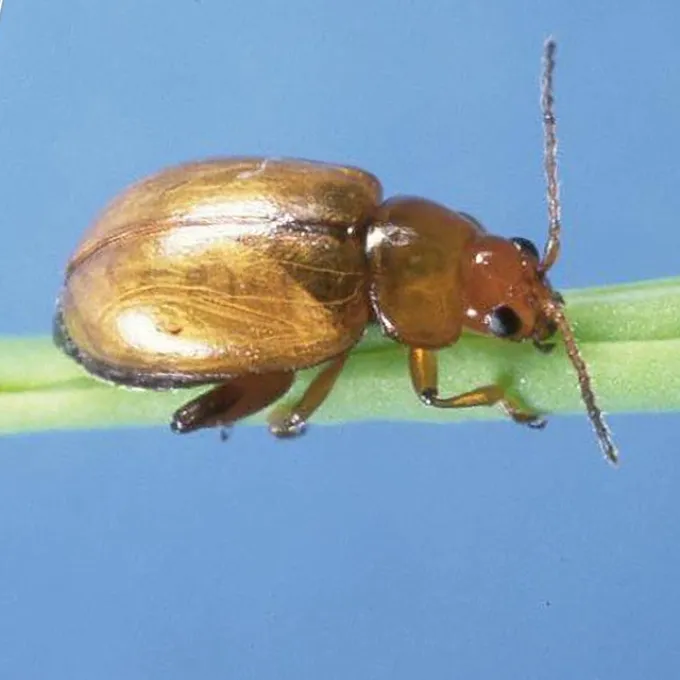
Adult beetles are typically small, ranging from 1.5 to 3 mm in length. Their appearance varies between species, often displaying metallic colors such as bronze, blue, or deep black, which helps them blend into their surroundings.
The larvae are worm-like, pale in color, and feature a darker head capsule. They live a cryptic lifestyle, primarily dwelling within the soil or inside plant tissues, where they feed on roots, causing significant underground stress to the host plants.
The life cycle involves complete metamorphosis: egg, larva, pupa, and adult. Most species complete one generation per year, typically overwintering as adults in the soil or protected under crop residues.
These insects exhibit host specificity, often targeting plants from families such as Euphorbiaceae or Linaceae. Understanding this host preference is crucial for effective identification and monitoring in agricultural settings.
What it damages
One of the most notable species, Aphthona euphorbiae, is a well-documented pest of flax. Adults feed on foliage, while larvae consume the root systems, leading to severe damage, especially in early plant stages.
Feeding by adult beetles results in distinct, small, circular holes in the leaves. When populations reach high densities, this "shot-hole" damage can completely defoliate young seedlings, causing stand failure.
Larval feeding on the roots disrupts the plant's ability to absorb water and nutrients. This often leads to stunted growth, wilting, and chlorosis, which can be easily confused with drought stress or nutrient deficiencies.
Heavy infestations, particularly in young crops, can reduce the overall plant population significantly, leading to reduced fiber yield and quality in crops like flax, which is highly sensitive to early growth disruptions.
In addition to direct damage, feeding sites can serve as entry points for secondary pathogens, further weakening the plant and increasing the risk of diseases spreading through the field.
When it appears
Adults emerge from their overwintering sites in the spring when temperatures consistently rise. This emergence period is often synchronized with the germination of spring-sown crops, making seedlings particularly vulnerable.
Active feeding by adults occurs throughout the late spring and early summer. During this time, they reproduce and begin laying eggs in the soil near the host plants, initiating the next stage of the cycle.
The larval stage develops in the soil throughout the summer months. Because they are hidden below the surface, their presence is often overlooked until the host plants show visible signs of damage above ground.
Pupation occurs in the soil towards the end of summer. Once the adults emerge from the pupal stage, they engage in a final feeding period before seeking suitable sites to overwinter, completing the annual cycle.
Autumn scouting is essential to identify the buildup of the new beetle generation, which helps agronomists predict potential pressure for the following growing season and prepare management interventions.
Signs of infestation
The most recognizable sign of an Aphthona infestation is the characteristic perforation of leaves, often described as a "shot-hole" pattern where numerous small holes appear in the foliage.
When walking through a field during the day, the sudden jumping of small dark insects is a clear indicator of a flea beetle presence. This behavior is a defensive reaction that makes them easy to detect.
In the field, patches of stunted, wilting, or yellowing plants can indicate root feeding by larvae. If these plants are easily pulled from the ground, it is a sign that the root system has been compromised.
Stand gaps or missing patches in newly emerged flax crops are common indicators of severe early-season pressure, where high adult populations decimated the seedlings before they could establish.
- Shot-hole perforations on leaves.
- Active jumping of beetles when plants are disturbed.
- Stunted, chlorotic, or wilting seedlings.
- Patchy emergence and thinning of crop stands.
Control measures
Effective management begins with agronomic practices. Early planting can help the crop reach a growth stage where it is more tolerant to beetle feeding before the peak adult emergence occurs.
Crop rotation is a vital component of integrated management. By avoiding host plants for several seasons, the beetle population in the soil naturally declines due to the lack of suitable food sources.
Weed control is essential, as many weed species, particularly those in the spurge family, can act as alternative hosts that maintain or increase local beetle populations near crop fields.
If economic thresholds are met, the application of insecticides is required. Systemic treatments or contact-action pyrethroids applied during the emergence phase provide the best protection for seedlings.
Seed treatments using systemic insecticides are a highly effective preventative measure, ensuring that the plant is protected from both adult and larval feeding during its most vulnerable early development weeks.
Taxonomy
- Latin name
- Aphthona
- Order
- Coleoptera (beetles)
- Family
- Chrysomelidae
- EPPO code
- APHTSP
Discussion
No discussions yet — be the first.