

Pest · Coleoptera (beetles)
Strawberry bud weevil
Anthonomus signatus
Description
How to identify
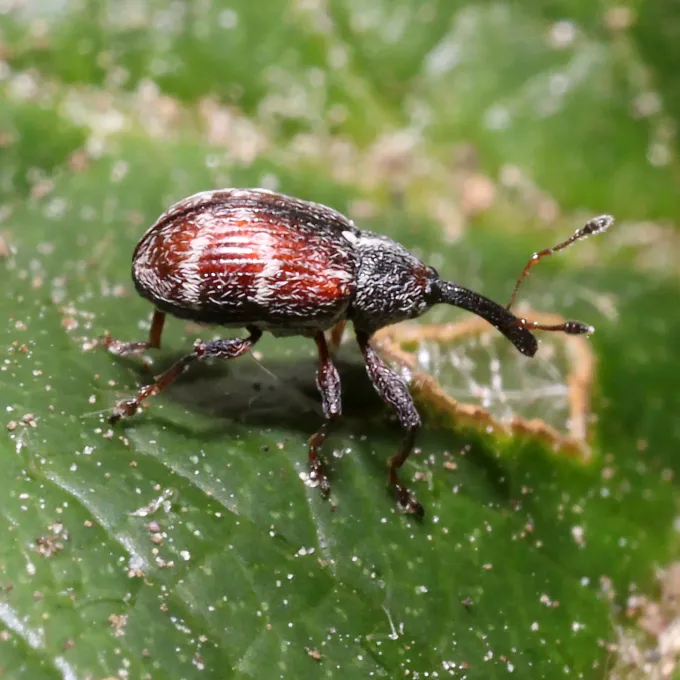
The strawberry bud weevil (Anthonomus signatus), often called the strawberry clipper, is a small beetle belonging to the Curculionidae family.
These insects are approximately 2 to 3 mm long and can be identified by their dark brownish-black color and characteristic long, curved snout.
They overwinter as adults, hiding deep within leaf litter, soil, or sheltered areas in or near berry plantings until spring temperatures rise.
As soon as the weather warms, the adults emerge and begin feeding on young leaves, which serves as a precursor to their mating and egg-laying cycle.
The female weevil is known for its precise behavior: it pierces a flower bud, deposits a single egg inside, and then girdles the stem, causing the bud to droop.
What it damages
The strawberry bud weevil primarily targets strawberries, raspberries, and blackberries, often causing significant economic losses to berry producers.
The damage is most severe during the budding stage, as the developing larva feeds on the interior of the bud, effectively killing the potential fruit.
Because the female girdles the stem, the injured buds often wilt, turn brown, and eventually drop off, leaving the plant devoid of that fruit.
In cases of heavy infestation, a large percentage of the flower buds can be destroyed, severely reducing the total yield of the berry patch.
Adults also contribute to plant stress by feeding on the leaves, creating small, pin-like holes that can reduce the plant's overall vigor.
When it appears
Adults emerge from their overwintering sites in early spring, precisely when the host plants begin their initial vegetative growth phase.
The peak activity for egg-laying occurs during the period when buds start to swell and separate, which is the most critical window for protection.
New adults emerge from the damaged buds in early summer, typically around the time of the peak berry harvest, and begin feeding before entering diapause.
During the mid-to-late summer, the beetles enter a period of summer diapause, where they become much less active and seek cooler, shaded environments.
By late autumn, the beetles gradually transition into their winter dormancy state, burrowing into protected locations to survive the cold months.
Signs of infestation
The most prominent sign of infestation is the presence of withered, drooping flower buds that seem to be hanging by a thin thread or have already fallen.
If you examine the wilted buds closely, you will notice a small, clean puncture hole on the side of the bud, where the female inserted her snout.
The stems of the affected buds are partially severed or girdled, which is the defining physical characteristic of the weevil's destructive work.
Check the foliage for small, round, pin-prick-sized holes, which indicate that adult beetles have been feeding on the leaves of the plant.
- Wilted or hanging flower buds.
- Partially severed stems at the base of the bud.
- Small puncture holes on the buds.
- Pin-sized feeding holes in the leaf blades.
Control measures
The most effective management strategy is to apply appropriate insecticides during the bud development phase, specifically before the blooms open.
Sanitation practices, such as clearing away debris and dead leaves around the patch, are essential to remove overwintering sites for the beetles.
In smaller garden settings, manually picking and destroying the clipped or damaged buds can help lower the local population of the weevil.
Choosing resistant cultivars or planting berry patches away from wild hosts, such as wild raspberries, can help prevent initial colonization.
Regular scouting of the plants during the early spring is crucial for identifying the pest before significant damage to the floral crop occurs.
Content graph
Connections · Strawberry bud weevil
Most often together:
Marketplace
Products · 5


Biology
Taxonomy
- Latin name
- Anthonomus signatus
- Order
- Coleoptera (beetles)
- Family
- Curculionidae
- EPPO code
- ANTHSI
Community
Discussion
No discussions yet — be the first.