
Anoxia villosa
Anoxia villosa
Description
How to identify
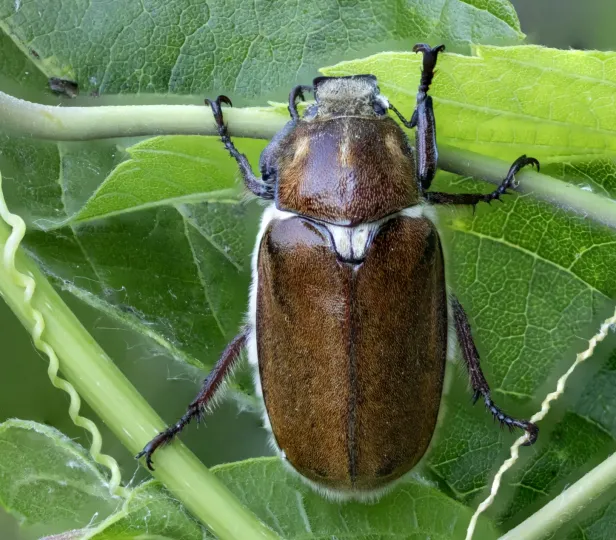
Anoxia villosa is a member of the Scarabaeidae family, commonly known as a scarab or chafers beetle. The adult beetle reaches a length of 18–25 mm.
The body is covered with dense, yellowish hair, which provides a distinct fuzzy appearance, distinguishing it from other related beetle species.
The pronotum is heavily punctured, and the males exhibit a notable sexual dimorphism, possessing significantly longer antennal clubs compared to females.
The larvae are typical "white grubs," featuring a C-shaped soft body, a well-developed head, and three pairs of thoracic legs adapted for soil movement.
Identification at the larval stage requires inspection of the raster pattern, where the anal slit position helps confirm the species during entomological surveys.
What it damages
Adults cause damage to foliage, feeding on the leaves of fruit trees, vines, and shrubs, which can result in significant reduction of photosynthesis capacity.
The larvae are subterranean pests that cause severe damage by feeding on the root systems of various agricultural crops and seedlings.
Major host plants include cereals, potatoes, sugar beets, strawberries, and young trees in nurseries, making it a threat to diverse agricultural sectors.
Larval feeding destroys the root hairs and main roots, leading to physiological drought, yellowing of foliage, and eventually plant death.
Heavy infestations, especially in loose, sandy soils, can lead to the complete destruction of crops across entire patches of farmland.
When it appears
Adult beetles are typically active during the early summer months, primarily in June and July, depending on local temperature and climate.
They exhibit nocturnal behavior, spending the daylight hours buried in the soil or hiding beneath dense ground vegetation to avoid predators.
The life cycle of Anoxia villosa spans several years, usually taking 2–3 years to complete, depending on the environmental conditions and food availability.
Larvae overwinter deep in the soil, often below the frost line, to ensure survival during the colder months of the year.
Spring activity begins as the soil warms up, triggering the larvae to move toward the upper soil layers to resume feeding on new plant roots.
Signs of infestation
The primary sign of larval presence is the sudden wilting of crops that have adequate water supply, suggesting that root function has been compromised.
Inspecting the soil around affected plants reveals damaged, chewed root systems with missing or severed fine root structures.
Larvae can often be found near the base of dead plants, typically curled into a C-shape within the soil profile.
Adult feeding activity is indicated by skeletonized or ragged leaf edges on shrubs and trees during the summer flight season.
The use of light traps at night effectively reveals the presence of adult beetles, confirming the start of the breeding and egg-laying period.
Control measures
Deep autumn plowing is a highly effective cultural control method, as it exposes the larvae to avian predators and desiccating surface conditions.
Implementing proper crop rotation strategies helps disrupt the multi-year life cycle of the pest, making the environment less favorable for population growth.
Chemical control involving soil-applied insecticides is recommended for high-pressure areas to protect vulnerable crop root zones.
Biological control, such as the application of entomopathogenic fungi or nematodes, provides a sustainable alternative for reducing grub populations.
- Regular soil monitoring for larval density before planting.
- Utilization of light traps to manage adult beetle populations.
- Maintaining field hygiene to remove debris that harbors adults.
Taxonomy
- Latin name
- Anoxia villosa
- Order
- Coleoptera (beetles)
- Family
- Scarabaeidae
- EPPO code
- ANOXVI
Discussion
No discussions yet — be the first.