
Anomoea laticlavia
Anomoea laticlavia
Description
How to identify
Anomoea laticlavia, commonly known as the clay-colored leaf beetle, belongs to the family Chrysomelidae. This beetle is a recognized pest in various agricultural and horticultural systems.
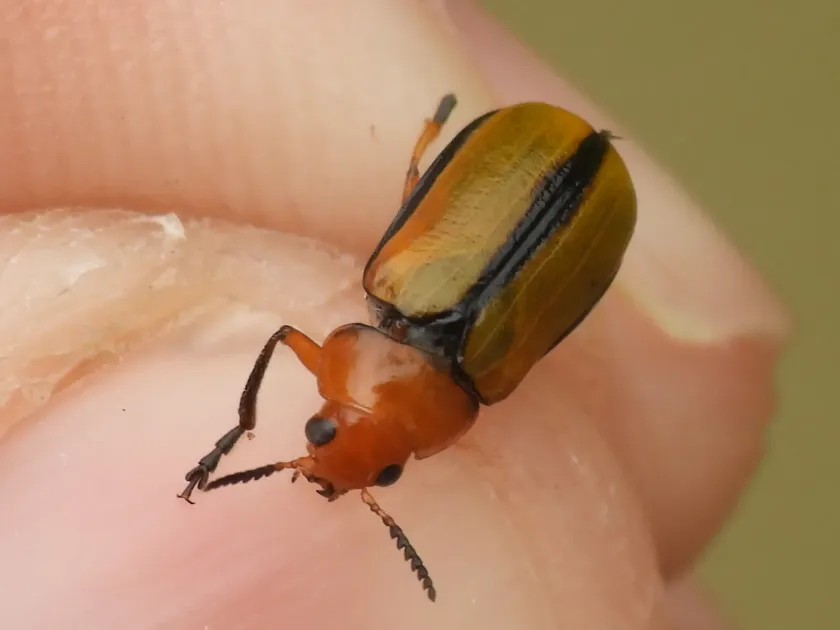
Adult beetles are typically 7–10 mm long with a distinct appearance: their body is yellowish-brown, but the head, pronotum, and a wide longitudinal stripe on the elytra are black.
The larvae lead a cryptic lifestyle, often found in the soil or protected within rolled leaves of their host plants. They possess a curved, pale body and strong mouthparts for consuming plant tissues.
The species undergoes complete metamorphosis: egg, larva, pupa, and adult. Adults are capable fliers, which allows them to migrate rapidly across fields during the active growing season.
Hibernation typically occurs at the larval stage, where they remain in the upper soil layers or under debris, protecting them from extreme winter conditions.
What it damages
This beetle primarily affects legumes, including soybeans, beans, and certain types of clover. It can be a significant nuisance in both home gardens and commercial agricultural fields.
Besides leguminous crops, the beetles may feed on various trees and shrubs, such as oaks and black locusts, which serves as a secondary food source when primary crops are unavailable.
Adult beetles cause damage by skeletonizing leaves, chewing irregular holes through the leaf blades, which significantly reduces the plant's photosynthetic capacity.
Larval feeding on roots and lower stem parts can weaken the plant, making it more susceptible to environmental stress and secondary infections from soil-borne pathogens.
High levels of infestation often result in significant yield losses, as plants struggle to allocate enough energy to flower and pod production due to severe foliage damage.
When it appears
The adult activity of Anomoea laticlavia begins in late spring, coinciding with rising temperatures that favor their feeding, mating, and subsequent egg-laying processes.
Peak population density usually occurs in June and July. During this time, the beetles are most visible and active, especially during the warmer hours of the day.
Hot, dry weather patterns can trigger population spikes, as these conditions are often favorable for the development of the larvae and increase the metabolism of the adults.
By late summer, the activity of the adults declines as they prepare for the next generation's egg-laying, while the new larvae begin to settle in the soil for the winter.
Early-season monitoring is crucial, especially during the seedling stage of legume crops, to prevent early defoliation and ensure healthy plant development.
Signs of infestation
The primary symptom of an infestation is the appearance of numerous holes in the foliage, often referred to as a shotgun-hole pattern, which eventually leads to ragged, tattered leaves.
Adults can often be spotted on the upper parts of the plants. When disturbed, they frequently drop to the ground and play dead, a classic defense mechanism for this species.
Plants affected by larvae may show signs of stunting, wilting, or yellowing, particularly when the root system has been compromised during the early stages of growth.
In cases of heavy infestation, plants may shed their buds prematurely, significantly reducing the potential yield for the current growing season.
Checking the ground beneath the plants often reveals the presence of insect frass, which is another indicator of an active population feeding in the canopy above.
Control measures
Effective crop rotation is the first line of defense; avoiding planting legumes in the same area for consecutive years helps break the pest's life cycle.
Deep autumn tillage is highly recommended as it exposes the overwintering larvae in the soil to freezing temperatures and natural predators, significantly reducing their numbers.
Maintaining clean field borders by removing weeds that serve as alternative hosts helps limit the population size before they migrate into the main crop.
If economic thresholds are exceeded, targeted applications of approved insecticides can be used to manage the adult beetle population and minimize further foliage damage.
- Encouraging natural predators such as birds and beneficial insects.
- Using yellow sticky traps for monitoring beetle presence and timing.
- Applying balanced fertilization to help plants recover from foliage loss.
Taxonomy
- Latin name
- Anomoea laticlavia
- Order
- Coleoptera (beetles)
- Family
- Chrysomelidae
- EPPO code
- ANMELA
Discussion
No discussions yet — be the first.