
Anomoea
Anomoea
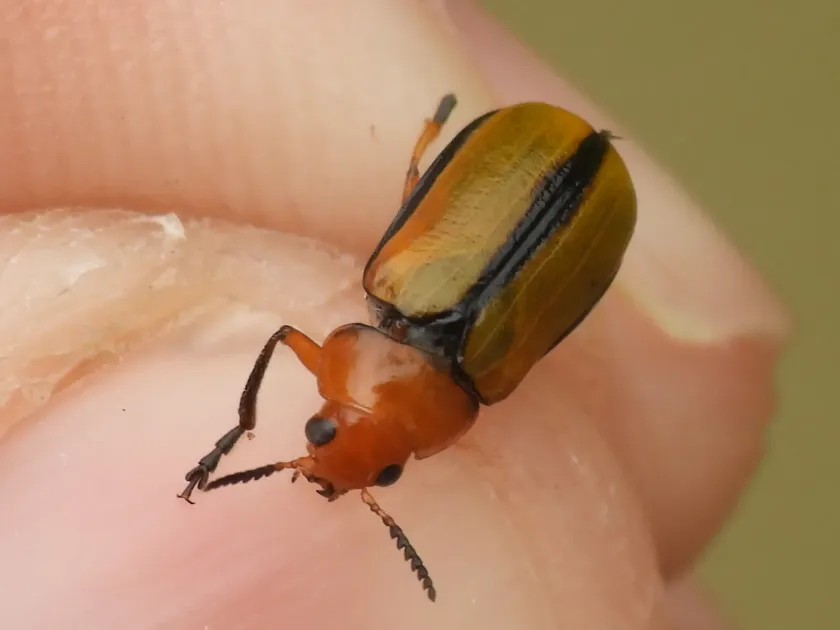
Description
How to identify
Anomoea is a genus of beetles belonging to the Chrysomelidae family, commonly known as leaf beetles, within the order Coleoptera. These insects are distinguished by their compact, robust, and moderately convex bodies, which are well-adapted for life on foliage.
Adult beetles in this genus often exhibit earth-tone colors, including shades of brown or dull yellow, which serve as camouflage against their host plants. Their mouthparts are strong and designed specifically for chewing plant material.
A notable biological feature of Anomoea larvae is their habit of constructing portable cases or "shelters." These cases are made from a mixture of their own waste and environmental debris, providing protection against natural predators and desiccation.
Identification in the field requires close inspection of both the top and underside of leaves. Due to their tendency to drop to the ground when disturbed, detecting these beetles during a routine crop walk requires a quick and stealthy approach.
While members of the genus Anomoea share common traits, specific identification at the species level usually requires the use of taxonomic keys and microscopic examination of the genitalia and body structure by an entomologist.
What it damages
Anomoea species are known to be polyphagous, feeding on a wide variety of plants including those in the legume and nightshade families. This broad host range makes them a persistent concern in both horticultural and field crop environments.
Adult beetles inflict damage by consuming significant portions of the leaf surface. This feeding behavior results in ragged holes or skeletonized leaves, which limits the plant's photosynthetic capacity and weakens its overall vigor.
Young, succulent growth is particularly susceptible to infestation. Heavy feeding pressure at the early seedling stage can lead to stunted development, leaf abscission, and, in severe cases, the complete loss of individual plants.
Although larvae are often found in protective cases, their feeding habits contribute to additional damage, particularly to lower leaves and detritus near the soil surface, which can lead to further plant stress.
Economic damage is typically measured by the reduction in biomass and yield quality. When pest populations exceed certain thresholds, the cost of yield loss necessitates immediate intervention to preserve the crop's market value.
When it appears
The life cycle of Anomoea is heavily influenced by seasonal temperature cycles. Activity typically commences in late spring as temperatures rise, signaling the emergence of overwintering adults from the soil.
Summer serves as the peak period for reproduction and larval development. During these warm months, multiple overlapping generations may occur, especially in regions with longer growing seasons and favorable moisture conditions.
The rate of development through egg, larval, and pupal stages is highly dependent on ambient heat accumulation. Warmer years often correlate with more frequent and intense infestations, requiring higher vigilance from agricultural producers.
As autumn approaches and temperatures drop, adults and larvae seek protected microhabitats to enter diapause. The timing of this entry is a critical survival mechanism for the population, allowing them to endure harsh winter conditions.
Understanding the seasonal patterns of this beetle allows for the strategic timing of preventative measures. Monitoring programs should be focused on the transition periods between the late spring emergence and the peak summer heat.
Signs of infestation
The primary diagnostic sign of an Anomoea infestation is the presence of irregular, notched feeding patterns on the foliage. These marks often appear as scattered holes that give the leaves a tattered or "windowed" appearance.
The discovery of small, soil-encrusted cases attached to the stems or undersides of leaves is a definitive indicator of Anomoea presence. These structures can be easily overlooked as small clumps of dirt if the observer is not specifically looking for them.
Visible chlorosis or general wilting of the plant canopy in localized patches is a secondary sign of heavy stress. As feeding removes the surface area needed for photosynthesis, the plant's metabolic processes are severely compromised.
During the early morning hours, adult beetles can often be observed on the upper surfaces of leaves. Their reaction to vibration is immediate, and they will often fall to the soil as a defensive maneuver.
- Irregular perforations in leaves (window-paning).
- Notched margins on foliage.
- Small, protective larval cases found on plant stems.
- Overall stunting and loss of vigor in crops.
- Premature yellowing of foliage in damaged areas.
Control measures
Integrated Pest Management (IPM) is the most effective approach for controlling Anomoea. Cultural practices, such as deep tillage post-harvest, can significantly reduce the overwintering success of larvae and pupae within the soil.
Crop rotation is essential for breaking the pest's cycle. By removing the preferred host plants from a field for a season or two, growers can force the population to disperse or experience high mortality due to food scarcity.
Chemical control should be reserved for periods when populations reach the economic threshold. Application of selective insecticides that minimize impact on beneficial predatory insects is highly recommended for long-term sustainability.
Biological control agents, including parasitic wasps or predatory beetles, can help regulate Anomoea numbers. Maintaining biodiversity in field margins helps to bolster these natural enemy populations.
Regular monitoring using yellow sticky cards or visual inspection protocols is vital. Early detection allows for spot treatments, which are more environmentally friendly and cost-effective than applying broad-spectrum pesticides across an entire field.
Taxonomy
- Latin name
- Anomoea
- Order
- Coleoptera (beetles)
- Family
- Chrysomelidae
- EPPO code
- ANMESP
Discussion
No discussions yet — be the first.