
Anomala schoenfeldti
Anomala schoenfeldti
Description
How to identify
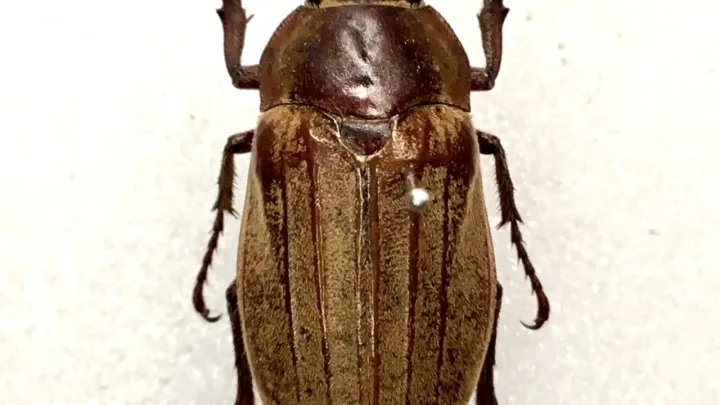
Anomala schoenfeldti belongs to the Scarabaeidae family, order Coleoptera. Adult beetles are of medium size, characterized by an oval, moderately convex body shape typical of the Anomala genus.
The coloration of adults ranges from yellowish-brown to dark brown, often featuring a metallic sheen on the elytra. The head and pronotum are densely punctate, while longitudinal grooves are visible on the wing covers.
The larvae are typical C-shaped soil-dwelling grubs, white or yellowish-white with a brown head capsule and developed thoracic legs. They live in the soil and possess powerful mandibles adapted for feeding on plant tissues.
This species exhibits sexual dimorphism, primarily in the structure of the genitalia, which requires microscopic examination for accurate taxonomic identification. The life cycle involves complete metamorphosis: egg, larva (three instars), pupa, and adult.
Adult beetles are primarily nocturnal, showing peak activity during evening hours. During the day, they hide in the soil or under debris, making them difficult to detect during standard field inspections.
What it damages
The larvae of Anomala schoenfeldti are significant soil pests that feed on the roots of various herbaceous plants, young trees, and shrubs. They cause primary damage to the underground parts of agricultural and wild vegetation.
Adults cause damage to the aerial parts of plants by actively feeding on leaves, buds, and flowers. In cases of high infestation, the pest can cause significant defoliation, negatively impacting plant photosynthesis and overall vigor.
Cereals, forage grasses, and certain vegetable crops are most susceptible to infestation. In orchards, the pest damages the root systems of saplings and the young shoots of fruit-bearing trees.
Larval feeding involves severing roots, which leads to wilting, yellowing, and the eventual death of weakened plants. Young crops are especially sensitive during the period of intensive root system development.
In fields with high larval population density, localized patches of stunted or sparse crops are common. This reduces overall field productivity and necessitates prompt protective interventions.
When it appears
Adult emergence of Anomala schoenfeldti typically occurs in late spring or early summer, correlated with soil temperature increases. The flight period usually continues until mid-summer.
During their active phase, adults feed on vegetative plant parts and mate. After fertilization, females lay eggs in loose, moist soil rich in organic matter.
Larvae develop in the soil over one or more seasons, feeding on organic matter and living roots. Larvae of different instars overwinter deep in the soil, below the frost line, ensuring high survival rates.
In spring, with the beginning of the growing season, larvae move to the upper soil horizons (plow layer) and begin intensive feeding on roots. This coincides with seed germination and initial crop development stages.
Pupation occurs in specialized earthen cells within the soil in late spring or early summer. The total life cycle can take between one to two years depending on regional climatic conditions.
Signs of infestation
A primary indicator of larval presence in the soil is sudden plant wilting despite sufficient soil moisture. Excavation of the root zone in affected areas usually reveals the presence of C-shaped grubs.
On the leaf surface, signs of adult activity include characteristic "window-paning" or complete skeletonization of leaf blades. Severe damage may result in shredded foliage and shoot deformation.
At night, adults can be spotted on plant foliage using a flashlight, as they are active feeders and do not retreat under artificial light. Light traps can also be used to monitor adult populations during their flight period.
An indirect sign of pest activity is the presence of soil predators or birds digging into the soil to feed on grubs. In fields, this manifests as characteristic disruptions to the turf or soil surface.
Overall reduced growth rates and non-uniform crop development often indicate hidden root damage by soil-dwelling pests. When such patches are identified, soil sampling is necessary to determine larval density.
Control measures
Agronomic measures include deep autumn plowing or soil cultivation, which exposes larvae to the surface, making them vulnerable to birds or lethal winter temperatures.
Crop rotation is an effective strategy for reducing population numbers: alternating crops that are unappealing to larvae helps prevent population buildup. It is crucial to avoid planting highly susceptible crops after permanent grasslands.
The use of biological control agents based on entomopathogenic fungi (e.g., Beauveria bassiana or Metarhizium anisopliae) or nematodes allows for effective larval management without chemical environmental pollution.
Chemical control includes the application of soil-acting insecticides during planting or the use of seed treatments. Foliar spraying with contact-stomach insecticides during the adult flight period can also be effective.
- Adhering to optimal planting dates to avoid peak pest activity windows.
- Regular monitoring of adult populations using light traps.
- Weed control to eliminate alternative food sources for adults.
- Maintaining high soil fertility to encourage rapid root system recovery following minor damage.
Taxonomy
- Latin name
- Anomala schoenfeldti
- Order
- Coleoptera (beetles)
- Family
- Scarabaeidae
- EPPO code
- ANMLSC
Discussion
No discussions yet — be the first.