
Anomala marginata
Anomala marginata
Description
How to identify
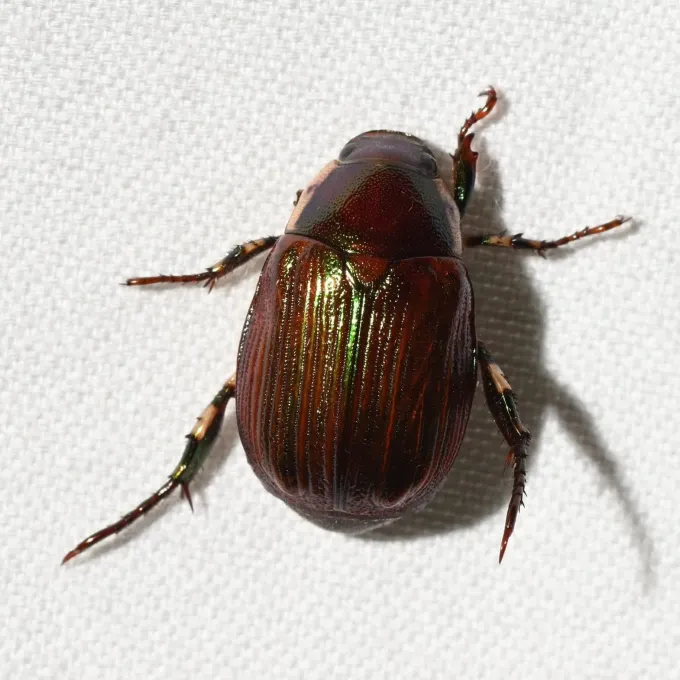
Anomala marginata is a species of beetle belonging to the family Scarabaeidae. These beetles are commonly known as a type of scarab or leaf chafer.
Adults are recognized by their oval-shaped body and a distinctive metallic sheen, often featuring a contrasting margin along the edges of the elytra.
The larvae, often referred to as white grubs, possess a C-shaped body with a soft, creamy-white abdomen and a hardened, brownish head capsule.
Adult beetles are proficient flyers and are particularly active during the warm summer evenings when they search for host plants and mates.
Morphologically, these insects are adapted to burrowing into the soil during their larval stage and moving across foliage during their adult life phase.
What it damages
Adult Anomala marginata beetles are foliage feeders, causing damage to a wide range of deciduous trees, shrubs, and ornamental plants.
They consume leaf tissue, often leaving behind shredded leaves or creating irregular holes, which in severe infestations can lead to total defoliation.
The subterranean larvae feed extensively on the roots of various plants, including grasses and young saplings, which disrupts water and nutrient uptake.
This root damage causes the host plant to wilt and, in the case of younger trees or nursery stock, can lead to complete plant death.
Economic impact is significant in agricultural settings where root destruction limits the vigor and productivity of fruit trees and horticultural crops.
When it appears
The emergence of adult beetles typically occurs in early summer, triggered by the warming of the soil and favorable ambient temperatures.
Feeding activity of the adults is most intense during the mid-summer months when they are actively reproducing and seeking host vegetation.
Eggs are deposited into the soil where the developing larvae spend the majority of their life cycle feeding on organic matter and roots.
The larval development may span one or more years, depending on local environmental conditions and the availability of food sources.
During winter months, larvae descend into deeper soil horizons to avoid freezing, entering a period of diapause until spring temperatures return.
Signs of infestation
Symptoms of adult infestation include noticeable feeding patterns on leaves, where tissue between veins is removed or leaves are entirely skeletonized.
Signs of larval presence include patches of yellowing or dying vegetation that lack the firm root structure normally holding the plant in place.
High numbers of adult beetles attracted to outdoor lights at night provide an early warning of potential infestation in the surrounding landscape.
Birds, such as crows or starlings, frequently foraging in a specific area may indicate the presence of large larval populations just below the soil surface.
For fruit trees, a sudden drop in fruit quality or premature leaf yellowing can indicate root system impairment due to larval feeding.
Control measures
Cultural control involves tilling the soil in late summer or autumn to expose larvae to natural predators like birds and environmental stressors.
Light traps can be utilized during the peak flight season of adults to monitor and physically remove a portion of the breeding population.
Biological controls, such as beneficial nematodes (e.g., Heterorhabditis or Steinernema), are effective for targeting larvae in the soil.
If chemical intervention is necessary, systemic or contact insecticides may be applied to foliage during adult activity or to the soil for larval control.
Maintaining strong plant health through proper irrigation and fertilization helps plants recover more effectively from light to moderate pest pressure.
Taxonomy
- Latin name
- Anomala marginata
- Order
- Coleoptera (beetles)
- Family
- Scarabaeidae
- EPPO code
- ANMLMA
Discussion
No discussions yet — be the first.