
Anomala beetle
Anomala
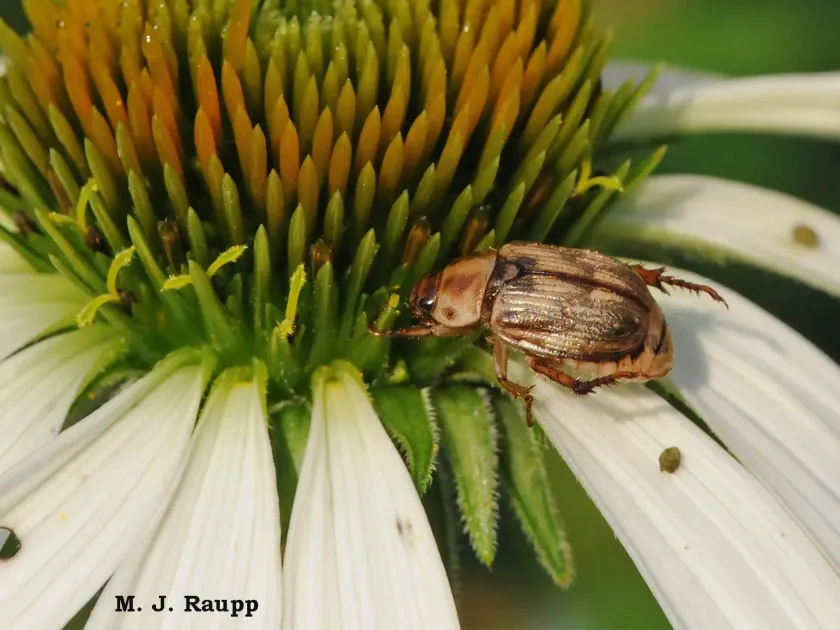
Description
How to identify
The genus Anomala belongs to the order Coleoptera and the family Scarabaeidae. These beetles are typically oval-shaped and range from 10 to 15 mm in length.
Adult beetles exhibit varied coloration, often ranging from yellowish-brown to metallic green. The elytra (wing covers) display distinct punctate rows, which are essential for field identification.
The larvae, often referred to as white grubs, possess the characteristic C-shaped body typical of the Scarabaeidae family, with a well-developed head and legs.
Identification often relies on examining the raster pattern (the arrangement of spines and hairs on the underside of the last abdominal segment) under magnification.
Pupation occurs within earthen cells in the soil, where the insect remains protected until the final metamorphosis into the adult stage.
What it damages
Anomala beetles are polyphagous, meaning they feed on a wide variety of plant species including fruit trees, grapevines, and various ornamental shrubs.
Adults consume leaves, often leading to significant defoliation, which reduces the plant's photosynthetic capacity and weakens overall vitality.
The larvae are subterranean dwellers that feed primarily on the root systems of agricultural crops, grasses, and young nursery stock.
Root damage causes plant stunting, yellowing, and sudden wilting, as the plant can no longer efficiently transport water and nutrients from the soil.
Severe infestations in nurseries or fields can lead to complete plant death, resulting in significant economic losses for farmers and gardeners.
When it appears
The flight period for adult Anomala beetles typically spans from late spring through the summer months, depending on the climatic region.
After mating, females burrow into the soil to lay eggs. The entire life cycle, depending on temperature and moisture, can take one or two years to complete.
The larval stage is the longest part of the life cycle, with larvae feeding actively in the soil during the warmer periods of the growing season.
During winter, the larvae move deeper into the soil profile to avoid freezing temperatures, entering a state of dormancy until spring.
As soil temperatures rise in the spring, the larvae move closer to the surface to resume feeding on fresh roots, which coincides with the start of the planting season.
Signs of infestation
The presence of adult beetles is indicated by ragged, irregular holes in leaves or entire sections of foliage being skeletonized.
Symptoms of larval infestation in the soil often appear as patches of stunted or wilting plants that fail to recover even after irrigation.
Damaged plants are usually easily pulled from the soil, revealing root systems that have been severely pruned or completely consumed by the grubs.
Excavating the soil around the base of affected plants usually reveals the C-shaped larvae curled among the remaining root fragments.
An increase in bird activity, such as crows or starlings digging in lawns or fields, can also be a telltale sign of a high population of larvae in the soil.
Control measures
Effective management of Anomala beetles requires an integrated approach that targets both the foliar adult stage and the subterranean larval stage.
- Cultivating the soil deeply in autumn to expose larvae and pupae to predators and adverse weather.
- Applying soil-incorporated insecticides during planting to prevent root feeding and protect young seedlings.
- Targeted foliar spraying of trees and shrubs with approved insecticides during the peak flight of adult beetles.
- Implementing crop rotation strategies to disrupt the beetle's breeding cycle in specific fields.
- Utilizing biological control agents, such as beneficial nematodes or entomopathogenic fungi, to suppress larval populations in the soil.
Taxonomy
- Latin name
- Anomala
- Order
- Coleoptera (beetles)
- Family
- Scarabaeidae
- EPPO code
- ANMLSP
Discussion
No discussions yet — be the first.