
Wheat beetle
Anisoplia tritici
Description
How to identify
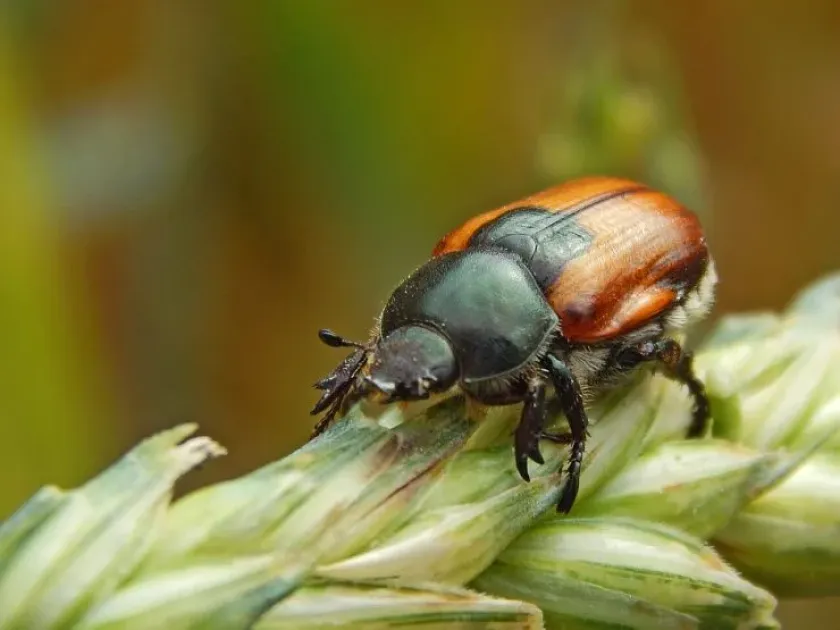
The Wheat beetle (Anisoplia tritici) is a member of the Coleoptera order and the Scarabaeidae family. The adult beetle is between 12 and 16 mm long, with a color ranging from metallic greenish-black to brown.
Its elytra are typically yellowish-brown with a distinct rectangular black spot near the scutellum. The head and pronotum are covered with dense hairs, which serves as a key identification feature for agronomists in the field.
The larvae are typical soil-dwelling grubs, C-shaped, whitish with a brown head and three pairs of legs. They develop in the soil over a two-year period, feeding primarily on plant roots.
The insect undergoes complete metamorphosis. The life cycle includes egg, larva (three instars), pupa, and adult stages, with the adult beetle being the most destructive stage for standing cereal crops.
Adults are highly thermophilic and active during sunny hours. They are particularly active during the day, congregating on the heads of cereals to feed on the developing grain.
What it damages
This pest mainly attacks small grain cereals, including winter and spring wheat, rye, and barley. During years of high population outbreaks, they can cause significant yield losses.
Adults feed on grains at the milk and dough stages of maturity. They consume the contents of the kernel, leaving only the hulls behind, which leads to shriveled grains and reduced quality.
In cases of high infestation, the beetle can destroy a large portion of the crop by knocking grain out of the ear. Infested fields often exhibit a characteristic "whitish ear" appearance due to grain loss.
The soil-dwelling larvae damage the root systems of winter cereals and grasses. This weakens the plants, making them less winter-hardy and reducing their overall tillering capacity.
The economic impact of the Wheat beetle is directly correlated with the population density per square meter and the weather conditions during the grain-filling period.
When it appears
The emergence of the beetles usually begins in June and lasts through early July. This timing coincides with the heading and flowering stages of winter wheat, the most vulnerable periods for the crop.
Beetles are most active during sunny, dry weather. At night or during cool, overcast conditions, they hide within the grain heads or burrow into the soil surface to minimize activity.
The adult feeding period lasts approximately 30–40 days. During this time, females lay eggs in the soil at a depth of 10–15 cm, preferring loose and moderately moist soil structures.
Larvae in their second year of development feed most actively in the spring after the soil warms up. By the end of summer, they pupate, ensuring the pest remains present in the field environment.
Monitoring for the presence of beetles should be performed daily in the morning hours using an entomological net or by visually inspecting grain ears along the field diagonal.
Signs of infestation
The primary sign of infestation is the presence of beetles directly on the grain heads. They can be seen holding onto the ears while feeding on the ripening kernels.
A diagnostic symptom is the presence of "eaten" grain ears, where only empty scales remain. The ears look deformed and underdeveloped due to the loss of kernel content.
- Adult beetles visible on grain heads during sunny weather.
- Empty grain hulls within the ear.
- Grain scattered on the ground beneath the plants.
- Reduced plant density due to root damage caused by larvae.
- Exit holes on the soil surface after mass emergence.
When the pest population is high, the field may appear ragged. An infestation level exceeding 3–5 beetles per square meter typically warrants the initiation of control measures.
Regular field scouting allows producers to detect early stages of migration into the crop and intervene before significant damage occurs.
Control measures
The foundation of management is a proper crop rotation that avoids continuous planting of cereals, which disrupts the development cycle of soil-dwelling larvae.
Deep autumn plowing is a highly effective mechanical measure. It exposes larvae and pupae to the surface, where they become prey for birds or succumb to desiccation and temperature changes.
Chemical control is justified when the economic threshold is exceeded. Insecticides from the pyrethroid or organophosphate groups are applied via spraying during the mass flight of the adults.
Timely harvesting is critical to minimizing losses. Whenever possible, farmers should use a two-phase harvesting method to prevent the grain from being knocked out of the ears by the beetles during standing.
Effective weed control along field margins and non-arable lands reduces the pest's reservoir and limits its breeding sites, thereby lowering the overall population density.
Taxonomy
- Latin name
- Anisoplia tritici
- Order
- Coleoptera (beetles)
- Family
- Scarabaeidae
- EPPO code
- ANISTR
Discussion
No discussions yet — be the first.