
Dog hookworm
Ancylostoma caninum
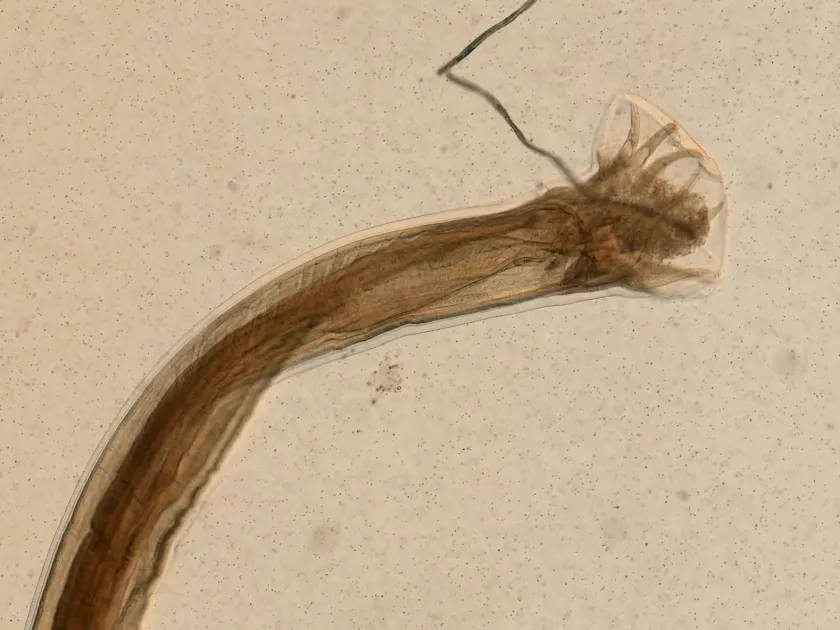
Description
How to identify
The dog hookworm (Ancylostoma caninum) is a nematode species belonging to the order Rhabditida and the family Ancylostomatidae. It is a biological parasite of mammals, not a plant pest.
The adult worms possess a buccal capsule with specialized teeth designed for gripping the intestinal lining of animals, not for penetrating plant cell walls.
The lifecycle involves eggs being passed in feces, which hatch into larvae in the environment. These larvae reside in moist soil while awaiting a suitable host.
Because they lack a stylet, they cannot feed on plants, meaning they are not considered a plant pathogen or a pest in the context of agronomy.
Field identification involves examining soil samples for the presence of larvae, which is relevant for public health monitoring rather than crop production management.
What it damages
There is no direct damage caused to agricultural crops by Ancylostoma caninum. It does not feed on roots, stems, leaves, or vascular tissue of plants.
The organism does not induce any stress symptoms in crops, nor does it affect crop yield, quality, or growth development during any stage of the season.
The presence of larvae in fields does not change the classification of crops as safe for human consumption, as the parasite does not inhabit plant tissues.
Agricultural losses associated with this worm are non-existent; it is strictly an animal health issue that occasionally intersects with human safety in an outdoor environment.
Misconceptions regarding plant damage may arise due to general confusion with plant-parasitic nematodes, which represent entirely different ecological groups.
Control measures
Control strategies in an agricultural setting focus on maintaining site hygiene to minimize human exposure and ensure general farm safety standards.
Mechanical cultivation and plowing effectively reduce larval populations by exposing them to desiccation and direct sunlight, which are detrimental to their survival in the topsoil.
Restricting access of animals to crop production areas prevents the contamination of soil, which is the primary method of controlling the population in a farm environment.
- Implement strict exclusion of stray animals from fields.
- Manage farm animal waste systematically.
- Ensure field workers use appropriate protective footwear and gloves.
No chemical treatments or pesticides are registered or recommended for controlling this parasite in a crop field, as such actions would be environmentally and economically unjustifiable.
Taxonomy
- Latin name
- Ancylostoma caninum
- Order
- Nematodes
- Family
- Ancylostomatidae
- EPPO code
- ANCTCA
Discussion
No discussions yet — be the first.