
Ancognatha
Ancognatha
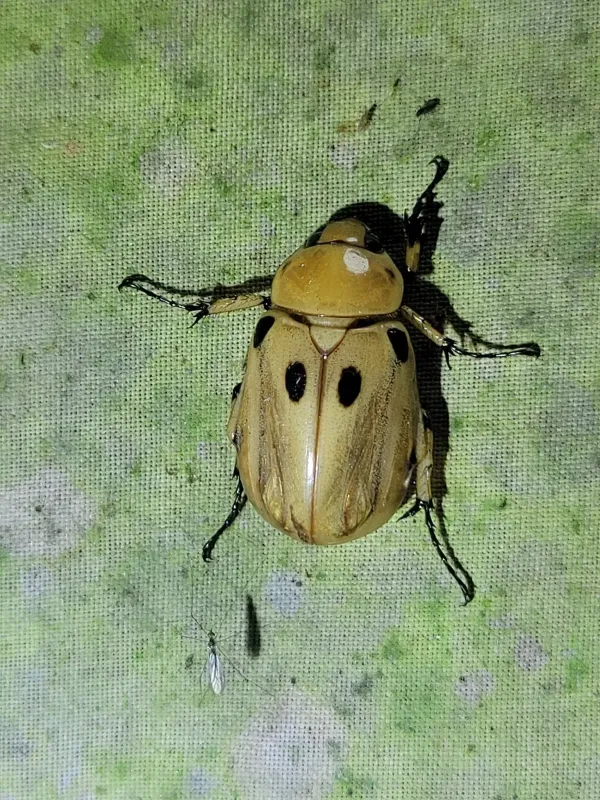
Description
How to identify
Ancognatha is a genus of scarab beetles (family Scarabaeidae) known for their agricultural impact. Adult beetles typically exhibit a robust, oval-shaped body with a dark brown or reddish-brown coloration, resembling smaller versions of rhino beetles.
The larvae, often referred to as white grubs, are C-shaped with a distinct, sclerotized dark head and three pairs of well-developed thoracic legs. Their body is white to cream-colored, with a soft texture that contrasts with the hardened head capsule.
The life cycle consists of egg, three larval instars, pupa, and adult. Depending on the species and environmental conditions, the life cycle can span one to several years, making them persistent pests in various agricultural regions.
Adults are generally nocturnal and are highly attracted to artificial light sources. The larvae remain entirely subterranean, inhabiting the root zone of plants throughout their development.
They are primarily distributed in the Neotropical regions, where they have adapted to feed on a wide range of monocot and dicot crops, presenting a consistent threat to local farmers.
What it damages
The damage is primarily caused by the larvae, which feed on the roots of plants. By severing the root system, they deprive the plant of water and nutrient uptake, leading to rapid wilting and eventual plant death.
In potato cultivation, Ancognatha larvae are particularly destructive, as they burrow deep into the tubers. These excavations render the tubers unmarketable and susceptible to secondary rotting organisms.
Other major hosts include corn and sugar beet, where the larvae destroy primary roots, causing the plants to lose their anchorage and collapse when exposed to wind or physical disturbance.
Damaged areas often show localized patches of stunted or dead plants. These patches tend to expand over time as the larvae migrate through the soil to find new food sources.
Secondary infections by soil-borne pathogens often complicate the initial damage caused by the larvae, leading to widespread decay in the root zone and increased crop loss.
When it appears
Adult beetle emergence is typically synchronized with the onset of the rainy season, which provides the necessary soil moisture for mating and oviposition activities.
Larval activity is most pronounced during the warm growing season when soil temperatures are optimal for metabolic processes and development.
During the colder months, larvae descend to deeper soil layers to avoid freezing temperatures, remaining in a state of reduced activity until conditions improve in the spring.
Late-instar larvae are particularly voracious during the mid-to-late summer months, coinciding with the critical stages of crop development and tuber formation.
Female beetles deposit eggs in the soil near the root systems of preferred host plants, ensuring that the neonate larvae have immediate access to a food source upon hatching.
Signs of infestation
Sudden wilting of plants in the absence of drought stress is a primary indicator of larval infestation in the root zone. Such wilting is a direct response to the loss of root functionality.
Digging around the base of affected plants often reveals C-shaped larvae in the soil. Tubers showing deep, clean-cut, round holes are a tell-tale sign of Ancognatha feeding activity.
Patches of withered or dead crops within a field are indicative of high larval populations. Regular scouting of the soil profile is necessary to quantify the level of infestation.
Observation of nocturnal beetle flight around lights can serve as an early warning sign that a new generation of pests is active and ready to lay eggs in the fields.
Plants that are easily pulled out of the soil are a strong sign of root destruction, which is usually attributed to the feeding habits of these scarab grubs.
Control measures
Management of Ancognatha relies on an integrated approach. Cultural practices, such as deep tillage, can physically kill larvae or expose them to natural predators and birds.
Biological control using entomopathogenic fungi like Metarhizium anisopliae or Beauveria bassiana has proven effective in reducing larval populations in various soil conditions.
Chemical control involves the application of soil-incorporated insecticides at the time of planting to protect the root zone during the most vulnerable early stages of plant growth.
Monitoring the population of adult beetles using light traps allows for precise timing of interventions to prevent future infestations of subsequent larval generations.
- Deep mechanical tillage to disrupt soil habitats.
- Application of entomopathogenic fungal biopesticides.
- Use of soil-incorporated insecticides at planting.
- Monitoring adult flights with light traps.
- Crop rotation to break the pest's life cycle.
Taxonomy
- Latin name
- Ancognatha
- Order
- Coleoptera (beetles)
- Family
- Scarabaeidae
- EPPO code
- ANCOSP
Discussion
No discussions yet — be the first.