
Raspberry aphid
Amphorophora agathonica
Description
How to identify
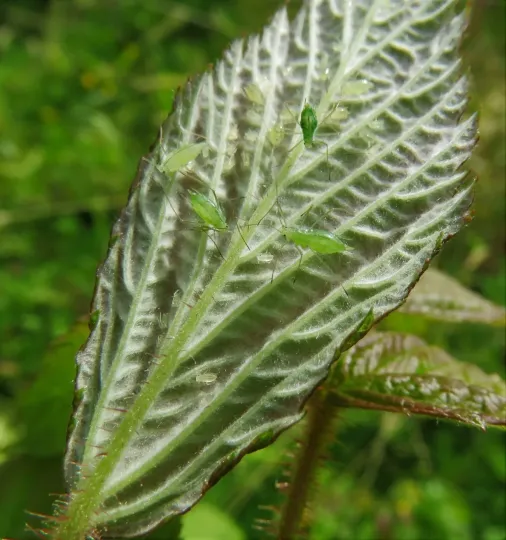
The raspberry aphid (Amphorophora agathonica) is a small sap-sucking insect belonging to the family Aphididae. Adults measure approximately 2–3 mm and typically possess a light green or yellow-green body color.
The species exhibits polymorphism, with both wingless and winged forms present. Wingless individuals are generally pear-shaped, while winged adults have a more defined thoracic structure and are capable of flying to new host plants.
They are highly host-specific, primarily infesting members of the genus Rubus, including raspberries and blackberries. Their small size makes them difficult to detect until the population grows significantly.
Aphids reproduce through parthenogenesis during the growing season, allowing them to rapidly colonize young shoots. They utilize specialized piercing-sucking mouthparts to feed on plant phloem.
These insects often live in small groups on the underside of leaves or at the tips of succulent new growth, making early scouting essential for effective monitoring.
What it damages
The direct damage caused by raspberry aphids includes the withdrawal of essential plant nutrients, which stunts the growth of new shoots and weakens the entire plant.
Beyond direct feeding, Amphorophora agathonica is a critical vector for various raspberry mosaic virus complexes. Even a small number of aphids can successfully transmit these diseases.
Once a plant is infected with a virus transmitted by these aphids, the yield potential decreases significantly, and the fruit quality is negatively impacted over time.
Heavy infestations lead to the curling and yellowing of foliage, causing the plant to lose its photosynthetic efficiency, which is vital for berry development.
The long-term impact of chronic infestation is the degeneration of the plantation, necessitating the removal of infected stock to prevent further spread.
When it appears
The life cycle begins with overwintering eggs laid on the stems of raspberry canes near the buds. As temperatures rise in spring, the eggs hatch into nymphs.
Spring and early summer provide ideal conditions for population explosion as plants produce the tender, succulent growth that aphids prefer for feeding.
During the mid-summer months, winged aphids disperse to neighboring plants, ensuring the colonization of fresh areas within the garden or commercial field.
The population growth rate is highly dependent on environmental temperature and the presence of natural predators, which can suppress aphid numbers in late summer.
In autumn, sexual forms develop, mate, and deposit the cold-hardy eggs that will persist on the canes through the winter to start the cycle again the following spring.
Signs of infestation
Early warning signs include the twisting and curling of apical leaves. Infected plants may appear stunted compared to healthy neighboring canes.
Sticky, shiny residue known as honeydew is often found on the leaves below the aphid colonies. This substance often serves as a substrate for sooty mold growth.
The presence of black, velvety sooty mold on the foliage is a secondary indicator that a large aphid colony has been active on the plant for some time.
In cases of severe infestation, flower buds may fail to develop correctly, and the plant may lose its vigor, resulting in chlorotic or mottled leaf patterns.
- Curling and deformation of shoot tips.
- Sticky honeydew residue on foliage.
- Sooty mold growth on leaves and stems.
- Increased ant activity on the canes.
- Stunted shoot growth or reduced vigor.
Control measures
Good agricultural practices are the first line of defense. This includes removing and destroying infected canes and managing weeds that may harbor aphid populations.
Avoid excessive nitrogen fertilization, which produces the soft, succulent growth that is highly attractive to aphids and increases their reproductive rate.
Promote biological control by providing habitats for natural predators such as lady beetles, lacewings, and parasitic wasps, which can significantly reduce aphid numbers.
When chemical intervention is required, use selective insecticides that minimize harm to beneficial pollinators, applying them only when economic thresholds are met.
Always time applications carefully, avoiding periods of bloom to protect bees and ensuring compliance with the pre-harvest interval for safe fruit consumption.
Taxonomy
- Latin name
- Amphorophora agathonica
- Order
- Hemiptera (bugs, aphids, leafhoppers)
- Family
- Aphididae
- EPPO code
- AMPHAG
Discussion
No discussions yet — be the first.