
Amphimallon aequinoctialis
Amphimallon aequinoctialis
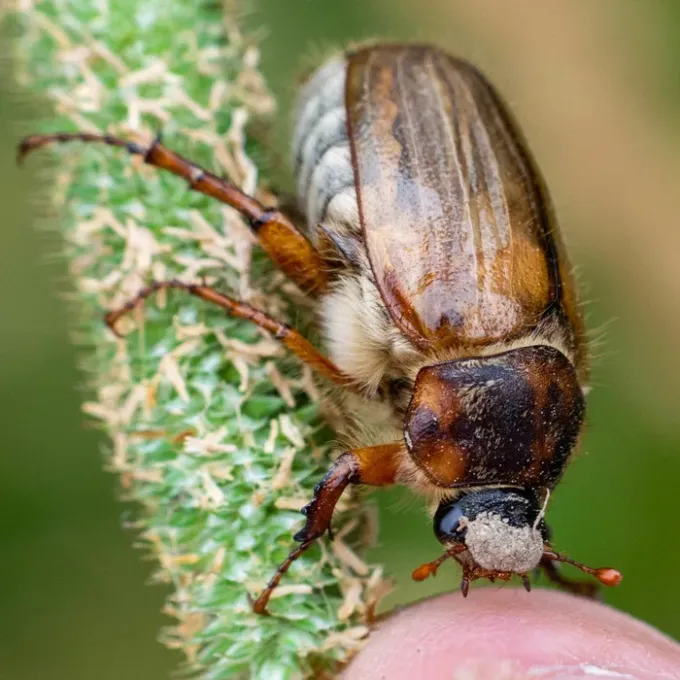
Description
How to identify
Amphimallon aequinoctialis is a beetle belonging to the Scarabaeidae family, part of the Melolonthinae subfamily. The adult insect features an oval-shaped body, typically 12–15 mm in length, with a yellowish-brown or brown coloration.
The larvae, known as grubs, possess a characteristic C-shaped white body, fleshy segments, and well-developed thoracic legs. The head of the larva is usually brown with robust mandibles, perfectly adapted for chewing plant tissues.
Adult beetles can be distinguished by specific antennal structure and the presence of setae on the underside of the body. Unlike the common cockchafer, these beetles exhibit less pronounced sexual dimorphism and show specific emergence site preferences.
The biology of the species is deeply linked to the soil profile. Larval development occurs within the upper soil horizons, where they pass through several instars, gradually increasing in size and accumulating energy reserves for pupation.
The life cycle of this beetle is multi-annual, similar to most scarabs. Most of the insect's life is spent underground, which makes detecting the pest significantly difficult until visible damage to the plants occurs.
What it damages
It is the subterranean larvae that cause the primary damage. They are polyphagous pests, feeding on the underground portions of a wide variety of cultivated and wild plants.
Significant losses occur in cereal crops like wheat and barley, as well as row crops including corn and sunflower. The larvae easily sever the fine roots of young seedlings, leading to rapid wilting.
In nurseries and orchards, Amphimallon aequinoctialis poses a serious threat to the root systems of fruit tree saplings and berry bushes. Mature larvae are capable of completely severing the taproot, causing the plant to die.
Beyond agricultural crops, the pest often concentrates in areas with high organic matter content and in permanent pastures. The intensity of the damage is directly proportional to the larval population density per unit area.
Damage to the root system reduces the plant's ability to absorb water and essential nutrients, ultimately causing general stunting, leaf chlorosis, and a substantial reduction in crop yield.
When it appears
The emergence of adult beetles typically occurs in spring, which is reflected in the species name as it often coincides with the equinox period. This seasonal timing is crucial for their life cycle.
Adults are active during the evening. The beetles congregate on the foliage of trees and shrubs to feed and mate, after which the females return to the soil to deposit their eggs.
Larvae remain active throughout the warm season. In early spring, as the soil warms up, they move from deeper layers to the root-inhabiting zone to begin intensive feeding.
The peak of larval damage usually occurs in the second half of summer and early autumn, when the larvae are growing rapidly before entering dormancy or pupating, depending on their age.
Overwintering of larvae of all stages takes place in deep soil layers, below the frost line, ensuring high survival rates even under harsh climatic conditions.
Signs of infestation
The first visual sign of a pest infestation is focal wilting within the field. Plants suddenly lose turgor, leaves yellow, and the plants can be easily pulled from the soil due to a compromised root system.
Upon inspecting the root system of affected plants, one can observe characteristic "feeding damage." Root tips may be missing, and roots are often gnawed off near the base of the stem or the root collar.
During soil excavations in the immediate vicinity of damaged plants, white C-shaped larvae of various ages can be found at a depth of 5–15 cm. Their clustering confirms a high level of infestation.
In fields severely infested by this species, "bare patches" appear where crops are sparse or dead. These zones tend to expand in subsequent years if proper control measures are not implemented.
Increased bird activity, such as rooks or starlings flocking to specific areas during soil tillage, can serve as an indirect indicator, as they actively forage for the larvae brought to the surface by plows.
Control measures
Agronomic practices remain the cornerstone of protection. Deep autumn plowing during the period of pupation and preparation for winter significantly reduces larval populations by exposing them to frost or natural predators.
Strict crop rotation is critical. Alternating crops is recommended, as continuous cultivation of a single crop on the same site fosters pest accumulation. Growing specific green manure crops can also act as a deterrent.
When the larval density exceeds the economic threshold, soil-applied insecticides containing organophosphorus or neonicotinoid active ingredients are utilized for effective control.
Biological control methods include the use of entomopathogenic nematodes or fungal-based preparations (e.g., Beauveria bassiana), which infect larvae in the soil, naturally reducing their population density.
Monitoring fields via systematic soil sampling before sowing allows farmers to assess risks and make timely decisions regarding the use of chemical seed treatments or soil-applied insecticides.
Taxonomy
- Latin name
- Amphimallon aequinoctialis
- Order
- Coleoptera (beetles)
- Family
- Scarabaeidae
- EPPO code
- AMHIAQ
Discussion
No discussions yet — be the first.